Table of Contents
Key Takeaways
- The UK market for luxury houses spans an enormous geographic and price range — from prime central London postcodes where £1,500 per square foot is a baseline, to Scottish country estates and Cotswolds manor houses that offer extraordinary space and heritage at a fraction of the equivalent London cost.
- Prime central London saw meaningful price corrections in 2024 and 2025, with average list prices cut by around 11% across sought-after postcodes — creating genuine negotiating opportunities for cash-rich buyers entering in 2026.
- The Investec Prime Property Index records over 23,000 homes listed at £1 million or more across the Home Counties in 2025, a 14% increase on the previous year, reflecting growing supply that has improved buyer choice significantly.
- Edinburgh is the strongest regional prime market in the UK going into 2026, with Savills data showing prime prices up 2.1% year-on-year in Q4 2025 — outperforming most of southern England on a growth basis.
- Surrey’s gated estates — St George’s Hill and Wentworth in particular — remain the definitive choice for ultra-high-net-worth buyers seeking maximum privacy and security within commuting distance of London.
- The Cotswolds, North Yorkshire, and the Hampshire countryside represent the most resilient country house markets outside the capital, combining protected landscape, architectural heritage, and consistent demand from domestic and international buyers.
What Makes a Luxury Property Market?
The term luxury houses covers a significant amount of ground in the UK, and the market at the top end operates by different rules to the mainstream. Pricing power is driven less by square footage than by scarcity, provenance, privacy, and the depth of demand from the specific buyer profile that covets each location. A Georgian manor house in the Cotswolds, a Mayfair townhouse, a gated Surrey estate, and an Edinburgh New Town townhouse each represent different versions of the luxury proposition — and each attracts a distinct type of buyer with different priorities.
Understanding which type of luxury you are pursuing — city convenience, rural grandeur, coastal prestige, or international investment security — is the essential first question before narrowing down where to look. The ten areas below cover the full spectrum of what the UK luxury market offers in 2026, drawing on current prime market data from Savills, Knight Frank, and Investec alongside Land Registry transaction evidence.
1. Mayfair and Belgravia, London
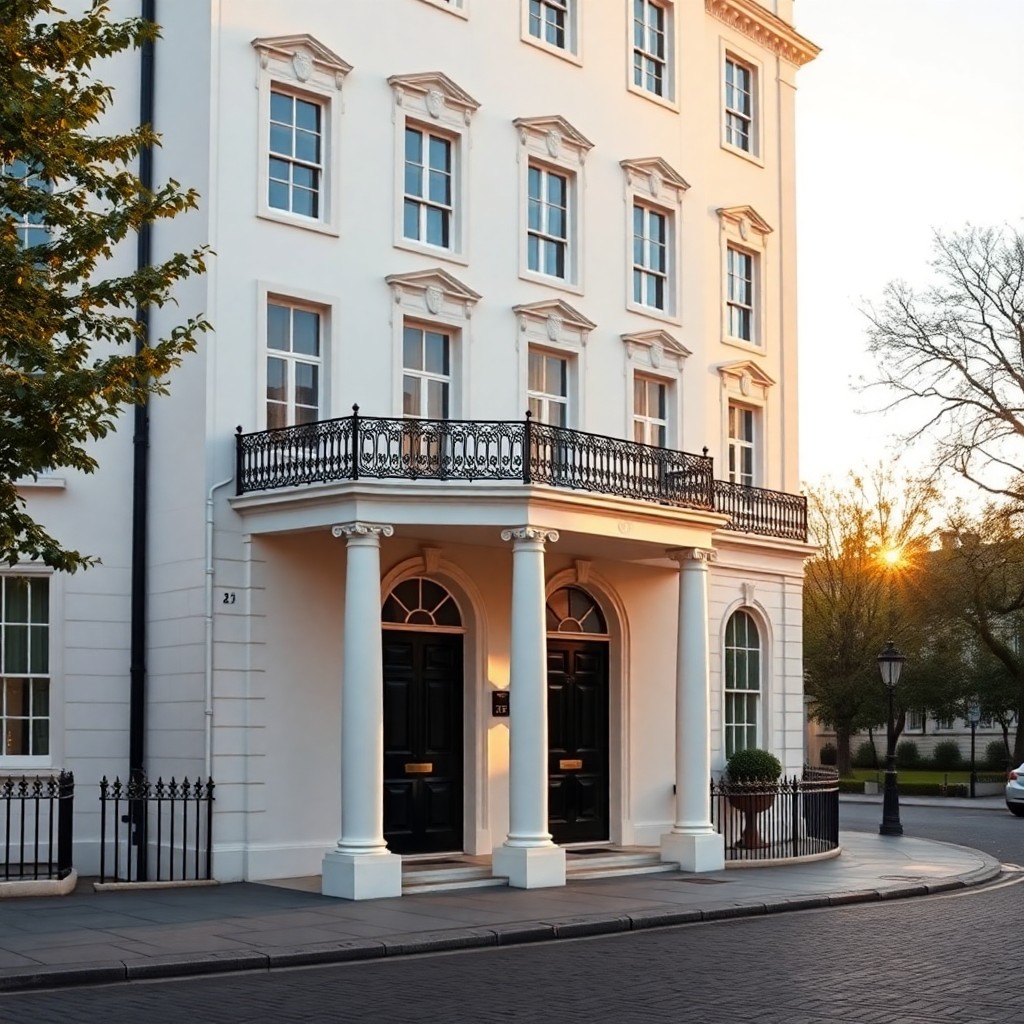
Mayfair and Belgravia represent the absolute apex of the London luxury market — and by extension, one of the most recognised luxury property addresses in the world. Mayfair’s Georgian townhouses, Belgravia’s stucco-fronted terraces, and the network of private garden squares shared between them have defined the premium end of the capital’s residential market for centuries, and show no sign of relinquishing that position.
Both markets saw selective repricing in 2024 and 2025 following the exit of a significant number of non-domiciled residents who sold principal UK residences. According to Beauchamp Estates’ annual survey of London transactions above £15 million, this reshaping of demand underpinned a year of resilient and selective activity, with Belgravia and Knightsbridge notable winners following vendor-led repricing. For buyers with the capital and the appetite, 2026 represents a more favourable entry point into these postcodes than has existed for several years.
Properties here range from substantial lateral apartments in period conversions to freestanding townhouses on the best garden square streets. The buyer profile is genuinely international — private wealth from the Middle East, Asia, the Americas, and Europe competes alongside domestic high-net-worth purchasers — and it is this international dimension that gives Mayfair and Belgravia their unique resilience relative to other UK prime markets.
What to Expect
Entry-level luxury in Mayfair and Belgravia begins at approximately £2–3 million for a well-positioned apartment. Freestanding houses on the best streets — Eaton Square, Chester Square, South Audley Street, Curzon Street — trade from £10 million upward, with exceptional examples reaching well into nine figures.
2. Knightsbridge and Chelsea, London
Knightsbridge and Chelsea complete the prime central London triumvirate alongside Mayfair and Belgravia. Knightsbridge is defined by its position adjacent to Hyde Park and Harrods, and by the concentration of high-specification lateral apartments and penthouse developments that attract wealthy international buyers seeking London residences with hotel-standard amenities — gyms, concierge, security, and generous proportions.
Demand in 2025 was firmly concentrated on fully renovated, furnished, and move-in ready homes, with developments providing lifestyle services and amenities such as gyms, pools, fitness studios, and 24-hour concierge commanding particular interest. This shift toward turnkey luxury — where buyers at this level increasingly expect to walk in without undertaking a renovation programme — has reshaped how prime London developers and vendors present stock.
Chelsea has a slightly more residential, less transactional character than Knightsbridge. The King’s Road corridor, the streets south toward the river, and the conservation area around Cheyne Walk attract buyers who want the texture of a living neighbourhood alongside the prestige of the postcode. The Investec Prime Property Index notes that SW3 (Chelsea) was one of only two prime London areas to see a decrease in the number of listings in 2025, reflecting constrained supply that supports long-term value.
3. Surrey’s Gated Estates: St George’s Hill and Wentworth
For ultra-high-net-worth buyers seeking maximum privacy and security within practical reach of London, Surrey’s private gated estates have no equivalent in the UK outside the capital. St George’s Hill in Weybridge and the Wentworth Estate in Virginia Water are the two most significant, each offering large-scale detached mansions on substantial plots behind 24-hour security.
St George’s Hill and Wentworth have been singled out as key areas for 2026, described as offering privacy, security and scale within easy reach of London, with demand consistently strong among ultra-high-net-worth buyers seeking family homes or UK bases. Properties are predominantly large detached mansions with leisure facilities, making them long-term lifestyle assets with resilient values.
Both estates sit within approximately 30–45 minutes of central London by road or rail, and within 20 minutes of Heathrow — a combination of international connectivity and security that explains their consistent appeal to internationally mobile buyers who want a safe, private family base. The Wentworth Estate is also home to the Wentworth Golf Club, one of the most prestigious golf venues in Europe, which adds a specific lifestyle dimension.
Properties on these estates typically range from £3 million at the entry level to well above £20 million for the most significant homes with the largest plots, indoor pools, staff quarters, and the full complement of amenity.
4. The Cotswolds
The Cotswolds is the definitive English countryside luxury market — the area that defined the international imagination of quintessential English rural life, and which continues to attract buyers from across the globe as a result. The villages of the north and central Cotswolds — Chipping Campden, Bourton-on-the-Water, Burford, Bibury, the Slaughters, and Cirencester — are among the most recognisable vernacular landscapes in England, built from warm honey-coloured oolitic limestone that ages to a quality no modern material can replicate.
The Cotswolds is described by market analysts as a premier luxury countryside market known for heritage villages, protected landscapes and international appeal, with properties typically including historic manor houses, high-end farmhouses and luxury barn conversions. Supply is waning — which is great for those looking to sell, as it supports long-term price stability, but means there are fewer of those quintessential stone buildings available for buyers moving into the area.
The Cotswolds Area of Outstanding Natural Beauty designation constrains new development significantly, and the combination of this supply restriction with sustained domestic and international demand has made the Cotswolds one of the most resilient luxury markets outside London. Properties range from renovated stone farmhouses and period manor houses to contemporary-interior barn conversions that combine historic fabric with modern specification. Budget from £1.5 million for a significant four-bedroom property in a sought-after village, through to £10 million-plus for a genuine manor house with estate land.
5. Edinburgh’s New Town and Prime Suburbs
Edinburgh occupies a unique position in the UK luxury market — a world-heritage city with one of the most architecturally distinguished residential landscapes in Britain, and a prime market that has demonstrably outperformed most of southern England through 2025 and into 2026.
Savills data shows Edinburgh City was the strongest regional prime market in the UK during Q4 2025, with prime prices increasing year-on-year by 2.1%. Supply and availability remain constrained, impacting activity above £500,000, though family home markets have bucked the trend, led by locations including Colinton and Ravelston.
The New Town — James Craig’s 18th-century masterplan, executed in Georgian sandstone across a grid of formal streets and garden squares north of the Old Town — represents the most distinguished residential address in Scottish property. Charlotte Square, Moray Place, and the Heriot Row and Ann Street corridors attract buyers who understand that this kind of Georgian civic architecture, intact at scale, simply does not exist elsewhere in the UK outside Bath and certain London squares. International buyers increasingly recognise Edinburgh’s combination of cultural prestige, relative value compared to London, and quality of life.
Edinburgh has the highest proportion of luxury sales listings in Scotland at 0.8%, with notable examples including a listed four-storey townhouse in the exclusive New Town neighbourhood. Budget from £800,000 for a substantial New Town flat to £3–5 million for the finest freestanding townhouses.
6. Hampshire’s Country House Market
Hampshire is the definitive Home Counties country house county for buyers who prioritise privacy, estate living, and access to both London and the south coast without the premium of the immediately surrounding Surrey market. The area around Winchester, Stockbridge, Romsey, and the Test and Itchen river valleys attracts serious buyers — typically those who want a primary family residence rather than an investment vehicle — and supports a market for some of the most significant country houses in southern England.
The combination of exceptional state schooling — Winchester College, Bedales, and a strong network of preparatory schools — good road and rail connections to London, and the landscape of the Test Valley and South Downs National Park creates a buyer profile of high-net-worth families making considered, long-term lifestyle decisions. Properties range from Georgian and Victorian rectories and manor houses to significant sporting estates with river fishing, shooting, and farm land.
The South Downs National Park designation constrains new development across much of the county and supports long-term values in the protected landscape. Hampshire also benefits from relative value compared to equivalently positioned Surrey properties — buyers frequently find that a given budget achieves meaningfully more space and land in Hampshire than across the county border.
7. The Chilterns and Hertfordshire
The Chilterns and Hertfordshire represent the luxury market most closely integrated with London’s financial and professional world — the area where City and corporate professionals at the very top of their earnings curve have historically chosen to base substantial family homes within an hour of the capital by road or rail.
Hertfordshire was among the Home Counties to record an increase in average prime property prices in 2025, rising to £1.48 million — and the county had 3,318 listings at £1 million or more during the year, the second highest count among the Home Counties after Surrey.
The premium villages of the Chilterns AONB — Great Missenden, Stoke Poges, Penn, Jordans, and the areas around Beaconsfield and Gerrards Cross — attract buyers who want the countryside aesthetic and the quality of life benefits of a National Landscape designation with the practical security of a 25–40 minute Chiltern Railways service into Marylebone. Hertfordshire’s premium addresses around Harpenden, St Albans, and Radlett carry similarly strong school catchments and transport connectivity.
Properties range from large Victorian and Edwardian detached houses in the better villages to substantial modern mansions on significant plots, and the occasional period country house. Budget from £1.5 million for a substantial detached family home with good garden, through to £5–8 million for the best positioned examples.

8. North Yorkshire: The Howardian Hills and Harrogate
North Yorkshire offers a version of the country house market that combines genuine landscape grandeur — the North York Moors, the Yorkshire Dales, and the Howardian Hills — with the commercial and cultural pull of Harrogate, arguably the most affluent market town in northern England.
Harrogate itself consistently ranks among the most desirable places to live in Britain, with its spa heritage, exceptional independent retail and restaurant scene, strong schools including the prestigious Harrogate Ladies’ College, and direct rail access to Leeds and York. The surrounding villages of Knaresborough, Boroughbridge, and the Vale of York area attract buyers seeking the full country house proposition — a significant house with land and outbuildings within 20 minutes of Harrogate’s amenity.
The North Yorkshire market also benefits from a price-per-square-foot advantage relative to the south of England that is striking for the quality of property available. Country houses that would require seven-figure budgets in Hampshire or the Cotswolds can be acquired in North Yorkshire for £1.5–3 million, with the very best estate properties still well below their southern equivalents.
9. Bath and the Somerset/Wiltshire Border
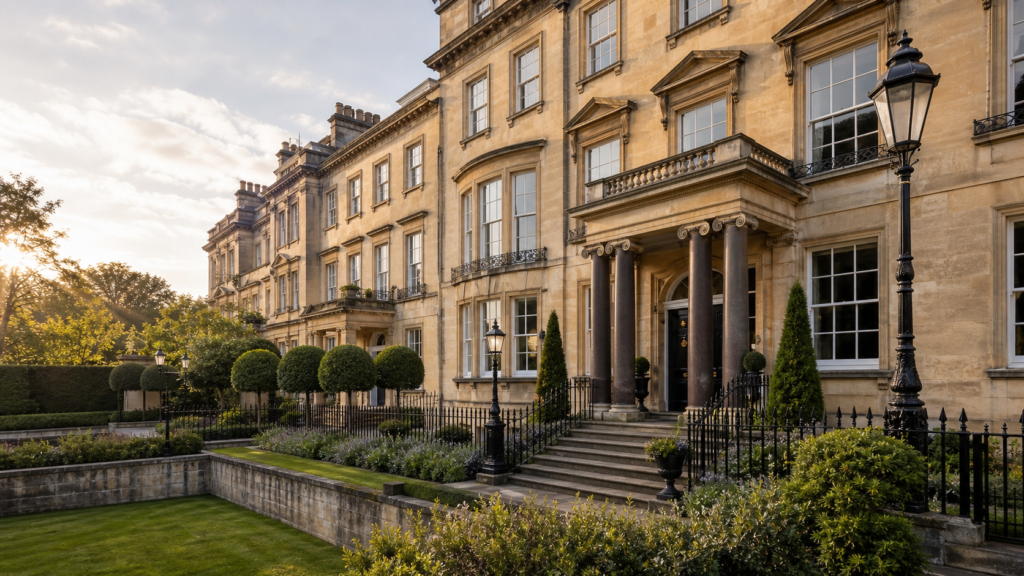
Bath holds a distinctive position in the UK luxury market as the only English city outside London with a UNESCO World Heritage designation, and the only place in England where Georgian terraced architecture exists at the extraordinary civic scale of the Royal Crescent, the Circus, and the Lansdown terraces. For buyers who want the cultural and architectural richness of a historic city alongside country house proximity, Bath has no real rival.
The city’s position on the edge of the Cotswolds to the east and the Somerset levels and Mendip Hills to the south gives buyers access to an exceptional rural hinterland within minutes of the city centre. The M4 corridor provides London connectivity, and Bath Spa station is approximately 90 minutes from Paddington — comfortably within reach for buyers prepared to commute two or three days a week.
Properties range from lateral apartments in the finest Grade I listed terraces — the Royal Crescent and the Circus represent the most prestigious residential addresses in the city — to substantial detached country houses on the high ground above Bath with views across the valley. The Somerset and Wiltshire border market around Bruton, Frome, and Shepton Mallet has developed significantly as a luxury rural address, attracting a creative and media-world buyer profile attracted by its accessible rurality and increasingly sophisticated hospitality scene.
10. The Scottish Highlands and Prime Country Estates
Scotland’s prime country estate market is perhaps the most genuinely unique segment of the UK luxury market — an asset class that exists nowhere else in the British Isles in quite the same form. Highland estates combining sporting rights (deer stalking, salmon fishing, grouse shooting), extensive hill ground, a principal lodge or castle, and staff cottages represent a form of landed ownership that combines lifestyle asset, conservation stewardship, and in some cases meaningful commercial agricultural activity.
Scotland’s prime housing market consistently demonstrates a resilience that sets it apart from other parts of the UK, entering 2026 from a position of relative strength due to a combination of robust sales activity, steady price growth, and broad-based buyer demand.
The Scottish countryside — Perthshire, Speyside, the Borders, and Argyll — contains some of the most extraordinary private landscape in Europe, and the estates that manage it are competed for by wealthy domestic buyers, Americans and Europeans with Scottish heritage, and international buyers who recognise the permanence and prestige of a significant Scottish landholding. Prices range from £1.5 million for a modest sporting property with hill ground to £30 million and above for a premier Highland estate with full complement of rights and substantial lodge accommodation.
What to Consider Before Buying Luxury Property in the UK
Stamp Duty Land Tax
Stamp duty at the top end of the market is a material cost. For properties above £1.5 million, the additional dwelling surcharge (currently 5% for buyers purchasing an additional property) applies on top of the standard residential rates, which reach 12% above £1.5 million. On a £5 million primary residence purchase, SDLT runs to approximately £513,750; for an additional property at the same price, the surcharge adds a further £250,000. Use the HMRC stamp duty calculator to model the precise liability for any transaction.
Survey and Legal Due Diligence
At the luxury end, the survey and legal due diligence requirements are more demanding than in the mainstream market. Heritage properties, listed buildings, estates with complex title, properties with agricultural or sporting rights, and anything with development potential all require specialist legal and survey expertise. Instruct solicitors and surveyors with specific track records in the relevant property type rather than generalists.
Financing and Mortgage Considerations
Private banks — Coutts, Investec, Arbuthnot Latham, and others — are the primary lenders in the luxury market above £2 million, offering relationship-based lending that mainstream high street banks do not. Loan-to-value ratios, stress-testing, and wealth management requirements differ meaningfully from conventional mortgage products. Engaging a private banking relationship before you are under offer on a property, rather than after, positions you significantly better in a competitive situation.
Frequently Asked Questions
Which UK area offers the best value for luxury houses in 2026?
On a price-per-square-foot basis, the UK’s most exceptional value for luxury property exists in Scotland — particularly for country estates, where acreage, sporting rights, and the principal lodge are priced at levels that simply have no equivalent in southern England. Edinburgh’s New Town offers Georgian architecture at a significant discount to comparable London stock. North Yorkshire delivers country house space and quality at prices that remain compelling compared to the Home Counties.
Within the London market, the corrections in prime central London during 2024 and 2025 have created the best buying conditions since the period immediately after the Brexit vote. Sellers across prime London postcodes were willing to cut list prices, with average reductions ranging from 7% to 15%, creating favourable conditions for buyers with committed capital.
Are luxury houses in the UK a good investment in 2026?
The investment case for UK luxury property in 2026 is selective rather than universal. The prime central London market is recovering from a multi-year correction and offers improved entry conditions relative to recent years; Savills predicts 3.5% growth in prime London by year-end following the market corrections of 2024 and 2025. Surrey’s gated estates and the Cotswolds offer resilient values underpinned by constrained supply and deep buyer demand. Edinburgh offers the combination of genuine capital growth and relative value that is rare in UK prime markets.
For detailed guidance on how the broader UK property investment market is performing and where opportunity sits across price points, the guide on how UK property investors are thriving in a changing market provides useful wider context.
What price does a luxury house in the UK start at?
The definition varies by location, but the broadly accepted threshold for the UK prime residential market begins at £1 million — the point at which properties enter specialist prime market analysis by Savills, Knight Frank, and Investec. In prime central London, the practical entry point for what the market considers a luxury property is closer to £2–3 million. Outside London, significant country houses, Highland estates, and premium city townhouses can qualify at £750,000–£1.5 million depending on the local market context.
Is it better to buy luxury property in London or outside it?
This is ultimately a lifestyle and financial question rather than a purely investment one. London offers unmatched global connectivity, cultural density, and international liquidity — the ability to sell to a genuinely global buyer pool. Outside London, the same budget buys dramatically more space and land, and the quality-of-life proposition of the country house market is fundamentally different.
The Investec data shows that the cost of space in all Home Counties was at least half the cost in London, meaning buyers willing to leave the capital could significantly increase the amount of space for the same budget. For buyers whose priority is a family home rather than an investment vehicle, that arithmetic is increasingly compelling.
What are the legal considerations specific to luxury and historic property purchases?
Listed buildings — common in all the areas covered here — require listed building consent for any works affecting their character, applying to internal alterations as well as external changes. Properties within Conservation Areas are subject to additional planning constraints. Estates with agricultural or sporting rights involve complex title and often require specialist rural conveyancing alongside standard residential purchase. The Planning Portal provides access to planning history and listed building status for any property in England, and this should be reviewed as part of pre-purchase due diligence before instructing a survey.
Conclusion
The UK market for luxury houses in 2026 is genuinely broad and arguably better value across several key markets than it has been for a decade. Prime central London’s correction has created negotiating conditions that sophisticated buyers are actively using; the Home Counties and country house markets have more stock available than in recent years; and Scotland continues to offer a combination of quality and value that is unmatched anywhere in the UK for buyers with the flexibility to look north of the border.
The ten areas covered in this guide represent the most compelling and enduring addresses in the UK luxury market — each with its own character, buyer profile, and investment case. Common to all of them is the principle that the best luxury property is bought with proper preparation, specialist advice, and a clear understanding of what the asset actually is and why it commands its price. At the top end of the market, the difference between a well-advised purchase and a poorly-structured one is measured not in thousands but in millions.