Start by brightening your hallway: swap in warm 3000K LED bulbs, add a slim flush-mount, and install a dimmer. Paint walls a clean light neutral (off-white or greige) in satin or eggshell for easy wipe-downs, and keep trim crisp with fresh caulk and paint. Add a bold, low-pile runner with a good pad, then hang a mirror opposite a window to bounce light. Finish with uniform hardware, a hook rail, and slim storage—more simple upgrades are ahead.
Key Takeaways
- Brighten the hallway with warm 2700–3000K LEDs, updated flush-mount fixtures, and dimmers to eliminate dark corners.
- Maximize daylight by cleaning glass, swapping heavy curtains for sheers, and hanging a mirror opposite a window.
- Refresh walls with light, welcoming paint; test swatches in hallway lighting, and choose satin or eggshell for scuff-resistant durability.
- Modernize details by upgrading trim, swapping dated doors for Shaker styles, and using consistent hardware finishes like matte black or brushed nickel.
- Add function and style with a patterned runner, slim wall hooks or shelves, and lidded baskets to control clutter without narrowing the walkway.
Start Updating a Dated Hallway With Light
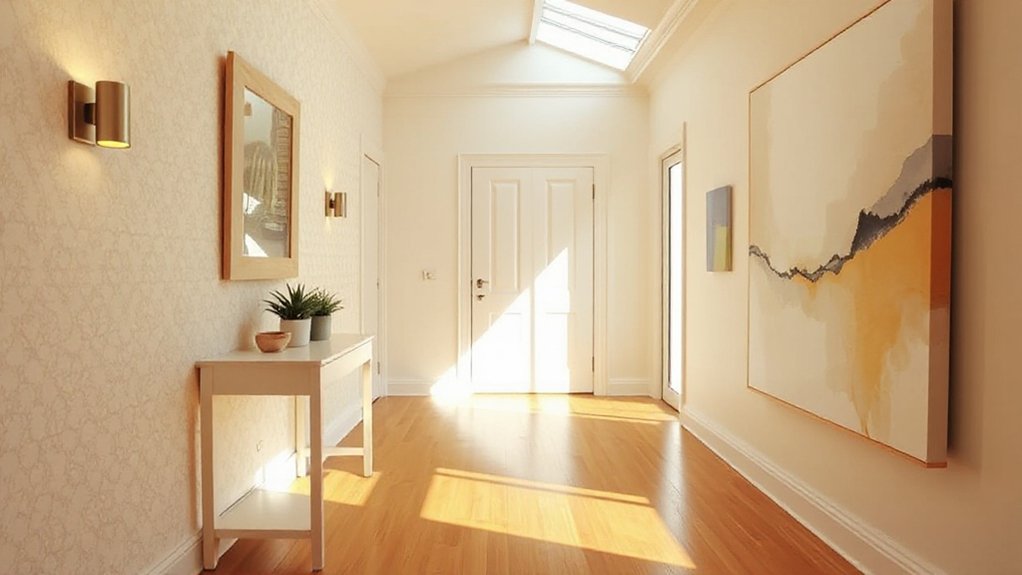
If your hallway feels dated, you can change the entire mood fast by fixing the lighting first. Start by maximizing natural lighting: clean the glass on sidelights, swap heavy curtains for simple sheers, and add a mirror opposite a window to bounce daylight deeper down the hall.
Next, update light fixtures that scream “builder-grade.” Replace a tired flush mount with a slim LED semi-flush or small chandelier that fits your ceiling height and walkway clearance. Use warm-white LEDs (2700–3000K) for a welcoming tone, and aim for even coverage by adding a second fixture if the run is long.
Put everything on a dimmer so you can brighten mornings and soften evenings.
Pick Paint Colors That Modernize the Hallway
Once you’ve brightened the space with better lighting, the right paint color does the heavy lifting to make a hallway feel current without spending much.
Use color psychology to choose tones that suit how you want it to feel: warm off-whites and greiges read inviting, soft sages feel calm, and cool light grays look crisp without turning chilly.
If the hall is narrow, keep walls light and add contrast with a slightly deeper ceiling or end wall to create depth without clutter.
Buy sample pots and test swatches at eye level under day and night light to avoid surprises.
For paint finishing, pick eggshell or satin for washability; use matte only if scuffs won’t bug you.
Stick to one cohesive palette.
Upgrade a Dated Hallway With Trim and Doors
Once your paint’s up, you can make the hallway feel new by updating the trim and doors. Swap dated, skinny casings for a cleaner trim profile (or build it up with inexpensive backband) and caulk, sand, and repaint for crisp lines.
If your doors are hollow, damaged, or mismatched, replace them with simple slabs or Shakers. Finish the upgrade with budget-friendly lever handles and matching hinges.
Refresh Trim Profiles
While paint and lighting can modernize a hallway fast, outdated trim profiles still give it away, so start by evaluating your baseboards, door casings, and header details. If you see overly ornate curves, chunky widths, or mismatched pieces, plan a simple, consistent update.
Keep costs down by retaining what’s straight and solid, then “square up” the look with clean, flat stock and sharp-edged profiles. You can cap existing baseboards with a new 1x strip, add a thin backband to widen casings, or install a restrained header with crisp returns.
Use MDF for paint-grade work, and save hardwood for high-wear spots. Add subtle molding accents sparingly—like a narrow bead or inset reveal—so the hallway feels current, not busy.
Fill nail holes, caulk seams, then prime before paint.
Replace Doors And Hardware
Even if you repaint every wall, dated hollow-core doors and shiny brass knobs will keep your hallway stuck in the past, so prioritize swapping them for cleaner styles and sturdier hardware.
Start with the most visible doors first to stretch your budget. For door replacement, choose simple shaker or two-panel slabs in a consistent style, and match the finish to your trim color for a seamless look.
If frames are solid, you can often swap just the door and reuse hinges, but measure slab thickness and hinge backset before you buy.
Upgrade door hardware to matte black, brushed nickel, or oil-rubbed bronze, and keep levers consistent for accessibility.
Add new strike plates and longer screws to tighten loose jambs and reduce rattles.
Add a Statement Runner to Update the Hallway
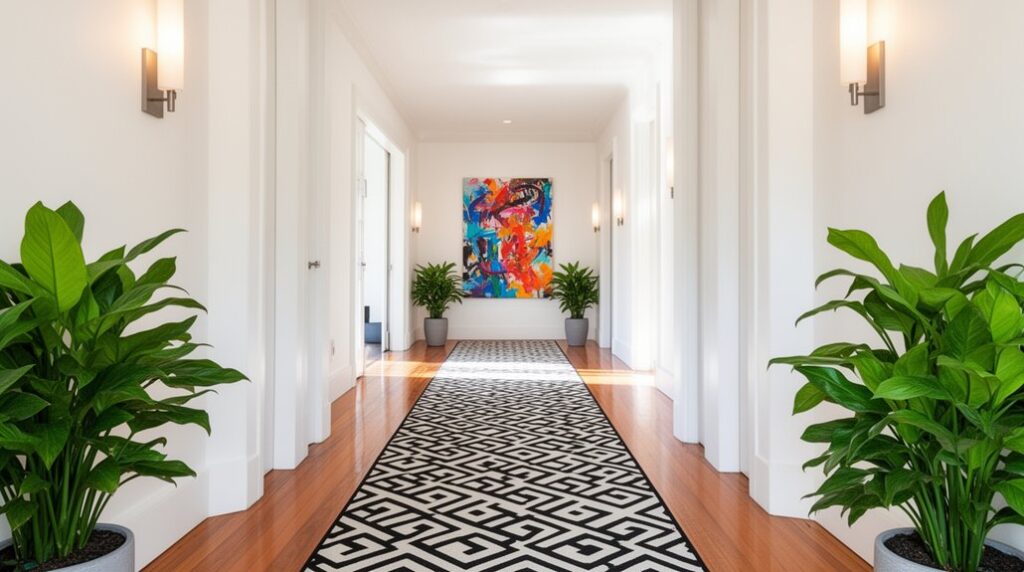
Because a hallway is mostly floor and walls, a bold runner can change the entire space without a full renovation. Choose a statement runner with high-contrast pattern or color that ties into nearby rooms, so it reads as a deliberate hallway statement, not an afterthought.
Measure your length and width, then leave 4–6 inches of floor showing on each side to keep it tailored. For busy homes, pick low-pile wool blends or washable flatweaves; they hide wear and vacuum easily.
Use a quality rug pad to prevent slipping, reduce noise, and protect floors—often cheaper than replacing scratched boards. If your budget’s tight, shop remnants, online clearance, or buy two matching runners and seam them.
Finish by squaring ends and taping edges.
Use Mirrors to Brighten a Dated Hallway
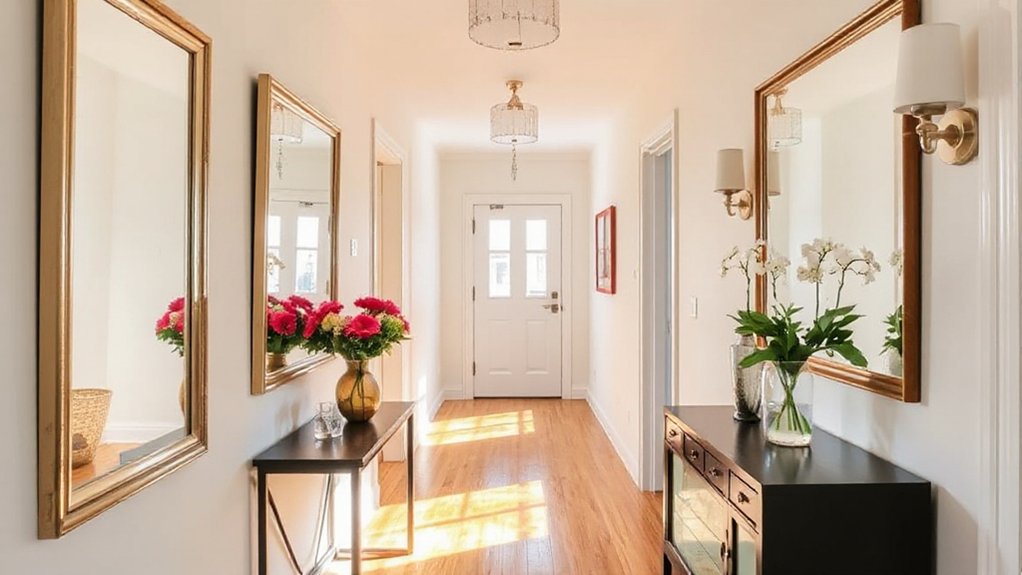
Once your runner anchors the floor, use mirrors to lift a dated hallway by bouncing light and making the space feel wider.
Start with mirror placement: hang one opposite a window or adjacent to a lamp so it catches brightness instead of reflecting a blank wall.
In a dark corridor, position a mirror at the end to pull you forward visually, or add a narrow vertical mirror to elongate tight walls.
Shop secondhand for solid frames and repaint them to match your trim; you’ll get impact without a big spend.
Choose larger reflective surfaces over clusters, since one big mirror reads cleaner and doubles the light.
Mount it at eye level, use anchors for plaster or drywall, and keep edges clear of door swings and traffic.
Update a Dated Hallway With Wall Decor
You can update a dated hallway fast with wall decor that adds personality without a big spend. Start by creating a simple gallery wall using matching frames (thrifted or DIY-painted) and a paper template to keep spacing even.
Then layer in a mirror to bounce light and add a pair of plug-in sconces for warm, budget-friendly lighting.
Create A Gallery Wall
How can a hallway feel finished without major renovations? Build a gallery wall that distracts from dated trim and bland paint. Start by measuring the wall and marking a centered rectangle with painter’s tape.
Lay your arrangement on the floor first, mixing family photos, vintage prints, and simple line art. For artistic framing on a budget, spray-paint mismatched thrift-store frames in one color, or repeat two finishes for cohesion. Keep mat sizes consistent to calm a narrow space.
Hang heavier pieces at eye level, then fill outward with smaller frames. Use paper templates taped up to preview spacing, and keep gaps 2–3 inches. Choose lightweight hardware and avoid overloading old plaster. Your hallway will feel curated fast.
Add Mirrors And Sconces
If the hallway feels dark and chopped up, add a mirror and a pair of sconces to bounce light and create a clear focal point without touching the trim or paint.
Start with Mirror placement: center it at eye level (about 57–60 inches to the middle) and keep it 6–8 inches above a console or shelf so it doesn’t look floaty. Choose a simple frame that matches your door hardware to keep costs down and the look cohesive.
For Sconce lighting, pick plug-in sconces to skip electrician fees, then run cords inside paintable cord covers. Mount sconces 60–66 inches high and 28–36 inches apart, flanking the mirror evenly.
Use warm 2700K LED bulbs for flattering light and low energy use.
Make Hallway Storage Look Built-In
Although a hallway’s footprint feels too narrow for “real” cabinetry, a few simple trim and paint tricks can make basic storage read as built-in without the custom price tag.
Start with a slim bookcase or wall-mounted Built-in shelving unit and push it tight to studs. Add a face frame from 1x2s, then run baseboard and crown across the front so it ties into the room. Fill gaps with backer rod and caulk, then paint everything one color for a seamless look.
Swap mismatched knobs for matching pulls, and add soft-close hinges if you’ve got doors.
For Concealed compartments, use baskets behind a hinged panel, or add a toe-kick drawer for gloves and dog leashes. You’ll gain storage without crowding the walkway.
Style a Dated Hallway With Small Details
Even when you can’t change the layout, small upgrades can make a dated hallway feel intentional and current. Start with hardware: swap mismatched knobs for one finish, and add a simple hook rail for bags and hats.
Upgrade lighting with an affordable flush mount or plug-in sconce, then use warm LED bulbs for a softer tone.
Add vintage accents sparingly—one brass tray for keys, a framed thrifted print, or a small mirror with a patina frame.
Layer in texture without major work by using peel-and-stick textured wallpapers on the ceiling, a single end wall, or the back of open shelving.
Finish with a runner that hides wear, plus a slim vase or bowl on your console to keep clutter contained.
Fix Common Dated Hallway Problems Fast
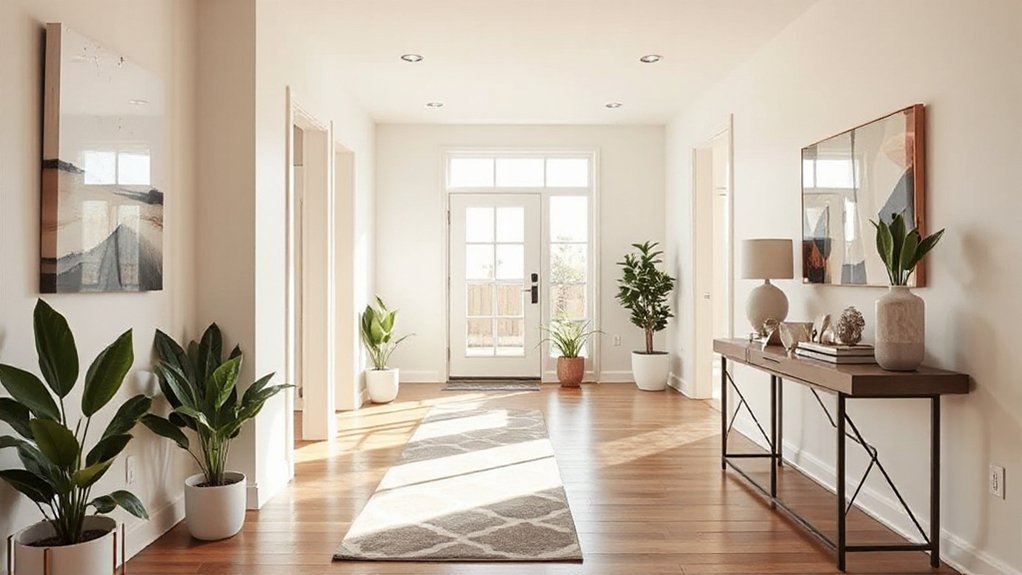
Small style upgrades go a long way, but a hallway still feels dated when the same few problems keep showing up—dark corners, scuffed walls, cluttered drop zones, and cramped walkways.
Brighten fast by swapping yellow bulbs for 3000K LEDs, then upgrade Lighting fixtures: add a slim flush-mount or plug-in sconce where wiring’s pricey.
Hide scuffs with a satin, washable paint and keep a small touch-up kit in a closet.
Tame the entry pileup with Storage solutions that don’t eat floor space: a narrow shelf with hooks, a wall-mounted mail sorter, and a lidded basket for shoes.
If the path feels tight, remove bulky consoles, choose a 3-inch runner, and hang a mirror to bounce light and expand the view.
Frequently Asked Questions
How Much Does a Full Hallway Remodel Typically Cost?
You’ll typically spend $2,000–$15,000 for a full hallway remodel, depending on size and scope. Budget planning should cover demo, drywall repair, paint, trim, flooring, lighting, and permits.
If you move walls or rewire, costs can jump to $20,000+.
For contractor selection, get 3 itemized bids, verify insurance, and confirm who handles materials and cleanup.
Add a 10–15% contingency so you don’t get surprised.
Do I Need Permits to Change Hallway Lighting or Electrical?
You might need electrical permits for hallway lighting upgrades, depending on what you change. If you’re swapping an existing fixture with the same wiring and box, you often don’t need a permit.
If you add new circuits, move wiring, install recessed lights, or change switches/locations, you usually do. Call your local building department before you buy materials.
Permits cost money, but they prevent rework and help insurance claims later.
What’s the Best Flooring Option for a High-Traffic Hallway?
Choose luxury vinyl plank (LVP) for a high-traffic hallway: it’s tough as nails, water-resistant, and budget-friendly. You’ll install it over many subfloors, and you can swap damaged planks without redoing everything.
Pick a medium-toned, matte finish to hide grit, then coordinate color schemes with adjacent rooms. Add rugs and runners as decorative accents, but use non-slip pads to prevent shifting and wear.
How Can I Reduce Noise and Echo in a Long Hallway?
To reduce noise and echo in a long hallway, add soft, sound-absorbing surfaces and block gaps.
Lay a dense runner with a thick pad, hang lined curtains or fabric art, and place a few upholstered benches if space allows.
For stronger soundproofing solutions, seal door bottoms with sweeps and weatherstripping.
You can also do acoustic panel installation: mount panels at ear height, spaced evenly, using removable strips to save.
How Long Does It Usually Take to Update a Hallway?
You can usually update a hallway in 1–3 days for cosmetic work, or 1–2 weeks if you add flooring, lighting, or built-ins.
You’ll move fast if you stick to simple Color schemes and plan purchases upfront.
Painting and swapping fixtures often take a weekend.
Decorative accents (runners, art, mirrors) add another few hours.
You’ll save time and money by reusing hardware and buying in batches.
Conclusion
With a few smart swaps, you turn that dated hallway from a tunnel into a welcome mat. New light acts like sunrise, paint becomes a clean slate, and crisp trim draws a fresh frame around everyday life. A runner guides the path, mirrors bounce brightness, and art tells your story without saying a word. Built-in-looking storage hides the clutter. Finish with new hardware and hooks—you’ve made the in-between feel intentional.