
Table of Contents
Key Takeaways
- Reclaimed brick brings texture, warmth, and authentic character to an interior in a way that no manufactured alternative — including modern brick slips — genuinely replicates.
- The source and age of the brick matters: Victorian and Georgian handmade bricks carry a surface variation and colour depth that machine-made bricks simply do not have.
- Reclaimed brick works across a wide range of interior applications — feature walls, fireplace surrounds, flooring, splashbacks, and exposed structural walls — each with its own preparation and finishing considerations.
- The pros are compelling: sustainability credentials, unique aesthetics, and a material that improves with age. The cons are real: inconsistency of supply, variable condition, and the skill required to work with it well.
- Cleaning, sealing, and pointing are the three stages that determine whether a reclaimed brick interior looks stunning or disappointing — all three require patience and the right products.
- Like working with reclaimed timber, the key to success with reclaimed brick is understanding the material before you commit to it — its history, its condition, and what it will ask of you during the installation process.
The Wall That Changed the Room
It started as a practical decision. The kitchen extension had a structural wall at one end that needed to be finished, and the budget was not stretching to the bespoke tiling that had been the original plan. Someone suggested leaving the blockwork exposed and cladding it in reclaimed brick slips — thin sections cut from the face of salvaged bricks — and what began as a budget compromise became the most admired surface in the house.
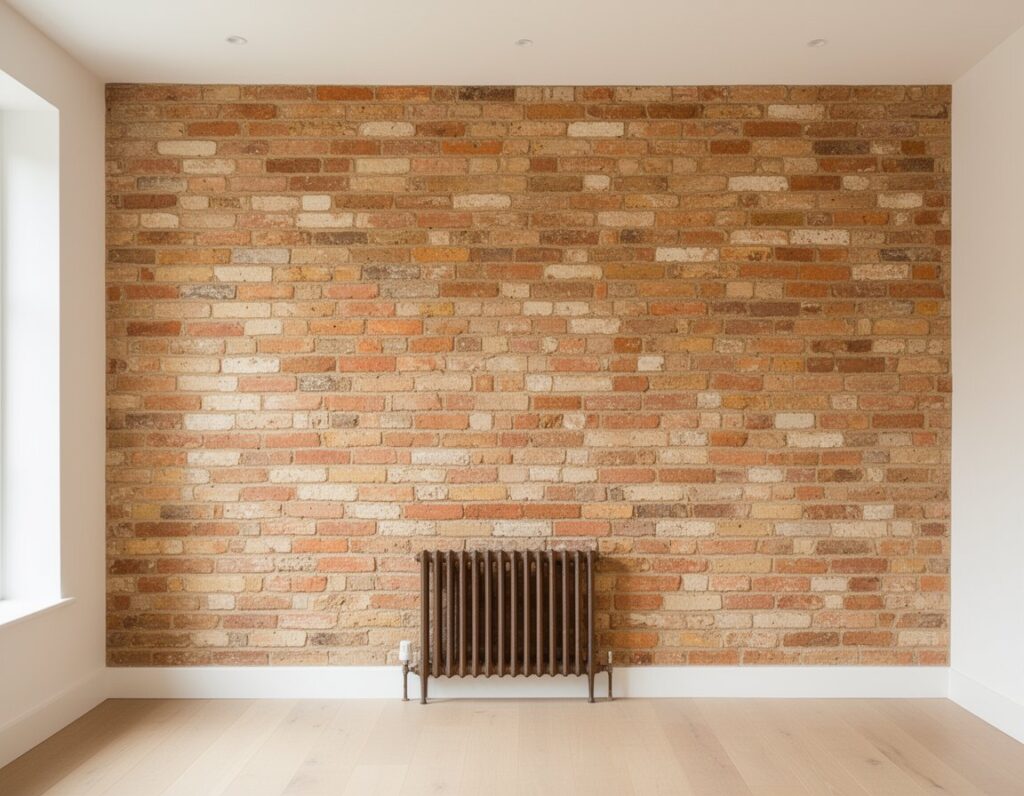
That is the nature of reclaimed brick in an interior. It does not announce itself as a design statement. It settles into a room and makes everything around it look more considered, more grounded, more real. The colour variation across the face of handmade Victorian brick — the flashes of orange, cream, and deep red that no two bricks replicate in quite the same way — gives a wall a visual depth that painted plaster or uniform tiling cannot approach.
This guide covers everything you need to know to use reclaimed brick effectively in an interior — from sourcing and selecting the right material to installation, cleaning, sealing, and the honest assessment of what the material asks in return for what it gives.
What Is Reclaimed Brick?
Reclaimed brick is brick salvaged from demolished or renovated buildings — Victorian terraces, Georgian farmhouses, industrial warehouses, old mill buildings, and civic structures that used brick as their primary building material. Rather than being crushed for aggregate or sent to landfill, the bricks are recovered, cleaned, and made available for reuse.
The distinction between reclaimed brick and new brick matters more than it might appear. Modern machine-made bricks are manufactured to consistent dimensional tolerances, with uniform colour and smooth, regular faces. Reclaimed Victorian and Georgian bricks were handmade or early machine-pressed — slightly irregular in dimension, with soft arrises (edges), surface texture that carries the marks of the moulding and firing process, and a colour variation across the face that comes from the specific clay composition and kiln conditions of a particular batch. No two are identical, and no modern brick — however carefully it is manufactured or artificially aged — successfully replicates the accumulated character of a brick that has been in a wall for a hundred and fifty years.
Full Bricks vs Brick Slips
Reclaimed brick is used in interiors in two main forms:
Full bricks are used where genuine structural or visual depth is required — a full-thickness interior wall or partition, an exposed structural wall revealed during renovation, or a fireplace surround built from the original full depth of the brick.
Brick slips are thin sections cut or split from the face of a full brick, typically 20–25mm in depth, and applied to an existing wall surface with adhesive. They give the appearance of a full brick wall without the structural and weight implications. For most interior feature wall applications, brick slips are the practical choice — they can be applied to a standard plasterboard or plastered wall, they are significantly lighter than full bricks, and they make the material available in contexts where full brickwork would be impractical.
Both options are available from specialist reclamation and brick slip suppliers. Full bricks can be cut down into slips on site using a tile saw, which gives more control over the face character of each individual slip — though it is a time-consuming process.
The Case for Reclaimed Brick: The Pros
Authentic Character That Cannot Be Manufactured
The surface of a handmade Victorian brick carries information that modern manufacturing cannot replicate: the thumbprint of the moulder pressed into the frog, the slight curve where the clay sagged in the drying rack, the colour variation from the hotter and cooler zones of the kiln, the occasional impurity in the clay that created a flash of unexpected colour in the fired surface. These are not defects. They are the record of a human process, and they are exactly what gives a wall of reclaimed brick its visual depth.
Genuine Sustainability Credentials
Every reclaimed brick reused in an interior is a brick that did not go to landfill and a new brick that did not need to be manufactured. Brick production is an energy-intensive process — firing clay to the temperatures required for a durable brick generates significant carbon emissions. Reusing existing bricks avoids that production energy entirely, and the embodied carbon already present in the brick continues to be useful rather than wasted. For a renovation or interior project where environmental impact matters, reclaimed brick is one of the most defensible material choices available.
It Improves With Age
Reclaimed brick that is correctly cleaned, pointed, and sealed will continue to develop character in use rather than deteriorating. The surface absorbs the patina of the room it sits in — the warmth of a kitchen, the light of a south-facing sitting room — in a way that deepens its character over time. A feature wall of Victorian brick that has been in a room for twenty years looks more beautiful than it did on the day it was finished, which is a claim that very few manufactured wall finishes can make.
Thermal Mass
Full reclaimed brick walls and thick brick slip applications on solid walls retain heat and release it slowly — a quality known as thermal mass. In a well-designed space, this moderates temperature swings and contributes to a more comfortable, stable indoor environment. In a kitchen or a south-facing room where solar gain is a factor, the thermal mass of exposed brick can meaningfully reduce the demand on heating and cooling systems.
Connection to the History of a Place
There is something specific about using material that came from the local built environment. Victorian terrace bricks from a demolition a few streets away, or stock bricks from a demolished farmhouse in the same county, bring a connection to the local landscape and building tradition that imported or generic materials do not carry. For homeowners who care about the story of their house and its relationship to its setting, this matters.
The Honest Assessment: The Cons
Inconsistency of Supply
Reclaimed brick is not a standardised product. Brick dimensions vary between manufacturers, periods, and regions — a Victorian London stock brick is a different size from a North of England handmade red, which is different again from an eighteenth-century Flemish bond farmhouse brick. If your project requires a large quantity of matching bricks, finding enough from the same source to complete the work is a genuine challenge. Running out of matching bricks mid-project is a common and frustrating problem that can only be resolved by buying more than you think you need from the outset.
Variable Condition and Hidden Problems
Not all reclaimed bricks are in suitable condition for interior use. Bricks that have been exposed to sustained moisture, freeze-thaw cycles, or chemical contamination can have internal deterioration that is not visible from the face. Spalling — where the face of the brick breaks away — is a risk with bricks that have absorbed significant moisture and then dried unevenly. Salt efflorescence — the white crystalline deposits that appear on brick surfaces as dissolved salts migrate to the face and dry — is more common in reclaimed bricks than in new ones, and can be persistent and unsightly.
Buying reclaimed bricks from a reputable yard that has assessed and graded its stock is significantly safer than buying from an untested source. Ask specifically about condition grading, the origin of the bricks, and any known issues with salt or contamination before committing to a large quantity.
The Skill Requirement
Working with reclaimed brick well — whether cutting slips, bedding and pointing a feature wall, or building a fireplace surround — requires more skill than many interior finish applications. The irregular dimensions of handmade bricks make consistent jointing more demanding than working with uniform new bricks. Cutting slips from full bricks without losing the face character requires a wet tile saw and a patient approach. Getting the pointing right — the right mix, the right profile, the right colour — is the detail that makes the difference between a professional result and an amateur one.
For a project of significant scale or complexity, professional installation by a bricklayer experienced in working with reclaimed material is worth the cost. A reclaimed brick feature wall installed badly looks worse than almost any alternative.
Dust, Mess, and Preparation
Reclaimed bricks arrive dirty. Old mortar is attached to the faces and beds of most salvaged bricks, and removing it — either to use full bricks or to cut clean slips — is time-consuming, dusty work. Brick cleaning hammer and bolster, angle grinder with a mortar rake, or a professional brick cleaning compound: all of these are methods, and none of them are clean. Plan for dust containment if working in an already-finished space, and allocate significantly more time to preparation than to installation.
Weight
Full bricks are heavy. A square metre of full-thickness brickwork in reclaimed Victorian brick — including mortar — weighs in the region of 200kg. Brick slips are significantly lighter — 20–25kg per square metre — but still require confirmation that the wall structure being clad can carry the additional load, particularly on upper floors or in conversion projects where the structural capacity of the floor is not known.
Where Reclaimed Brick Works Best in an Interior
Feature Walls
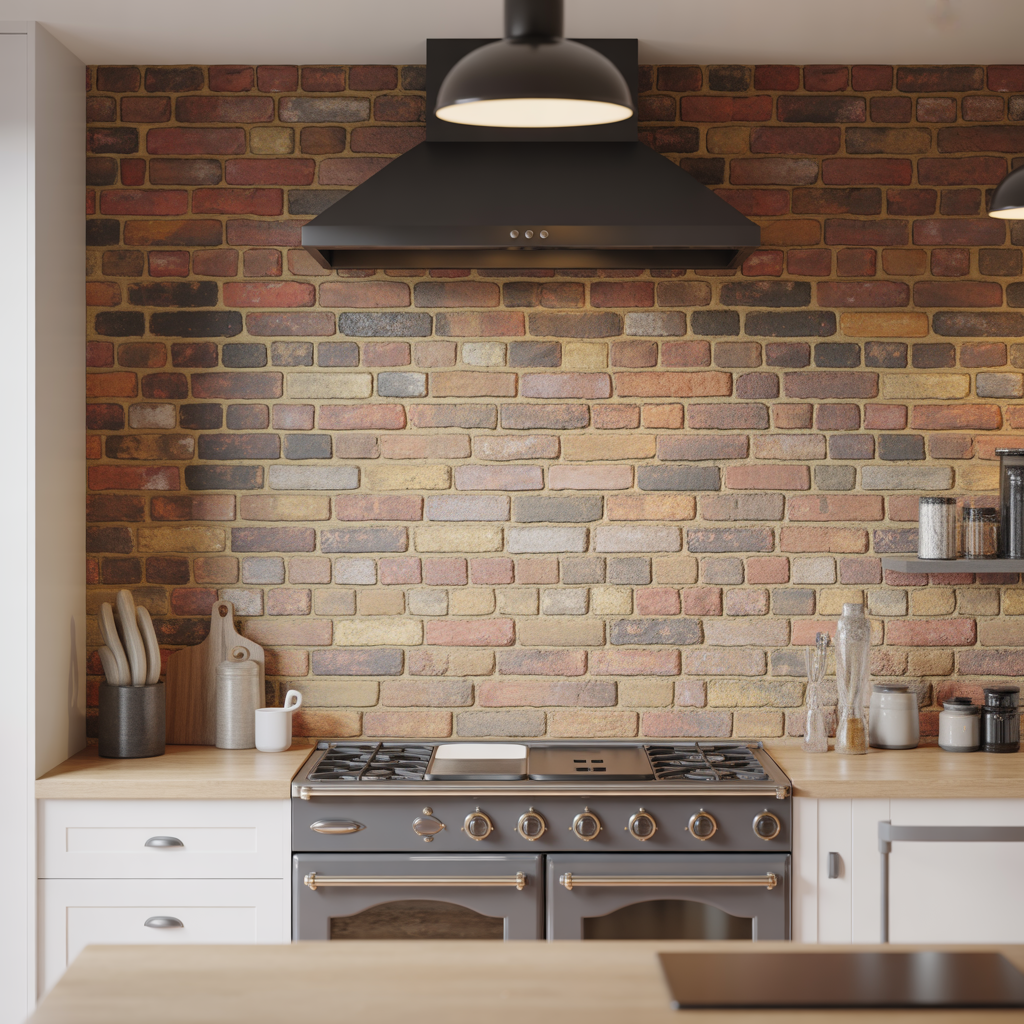
The most popular application, and for good reason. A single wall of reclaimed brick in a kitchen, dining room, or living space provides all the character and warmth of the material without the commitment of cladding an entire room. The key is choosing the right wall — typically the wall that is already the visual focus of the room, or the wall against which the main furniture is arranged. A reclaimed brick feature wall behind a sofa, behind a bed, or as the backdrop to a kitchen range becomes a backdrop for the room rather than a surface competing for attention.
Fireplace Surrounds and Chimney Breasts
Reclaimed brick and fireplaces have a natural affinity. The warmth of the material — visually and literally — suits the hearth environment, and brick has been the traditional material for fireplace construction for centuries. A reclaimed brick chimney breast, exposed or newly clad in slips, anchors the room in a way that plastered or tiled alternatives do not. The colour variation of handmade Victorian brick lit by the fire below is one of the most appealing visual combinations in any interior.
Working with reclaimed materials at the fireplace also connects naturally to the approach taken with timber mantels — much as reclaimed wood brings grain and patina to the horizontal element above the fire, reclaimed brick brings texture and depth to the surround itself, and the two materials together produce a fireplace with a coherence and authenticity that manufactured alternatives cannot replicate.
Georgian fireplace surrounds work tastefully with exposed, original brickwork in a period living room.
Kitchen Splashbacks
A reclaimed brick slip splashback — behind a range cooker or along the full length of a kitchen wall between worktop and cabinet — brings warmth and texture to the functional heart of a home. The surface requires thorough sealing to resist the cooking grease and steam of a kitchen environment, but a properly sealed reclaimed brick splashback is practical, easy to clean, and far more characterful than standard tiling. The mortar joints require particular attention — an epoxy-based grout or a sealed lime mortar prevents ingress of grease and makes the surface genuinely hygienic.
Exposed Structural Walls
In period properties where the original brickwork has been plastered over, stripping back the plaster to reveal the original structure can produce one of the most satisfying results in any renovation. Original Victorian stock brick or Georgian hand-pressed brick that has been sealed inside a wall for decades is typically in excellent condition — protected from weathering and frost — and carries the full, unharvested character of the original material.
The process requires careful assessment of the brick and mortar condition before the plaster is removed, and the pointing will almost certainly need attention once the wall is exposed. But a successfully revealed original brick wall is one of the most authentic and least interventionist things you can do in a period property.
Flooring
Reclaimed brick pavers — thin, wide bricks or cut-down full bricks specifically intended for use as flooring — have been used in farmhouses, kitchens, and utility spaces for centuries. The visual warmth of brick underfoot, combined with the thermal mass qualities of the material, suits ground-floor rooms where a connection to traditional building materials is part of the aesthetic intention. Brick flooring requires a proper base preparation, appropriate adhesive, and thorough sealing to resist the moisture and traffic demands of a floor — but a well-installed reclaimed brick floor is extraordinarily durable and develops a beautiful worn patina with use.
Sourcing Reclaimed Brick
Specialist Reclamation Yards
The most reliable source for quality assessed brick in meaningful quantities. A good yard will have graded its stock by condition, origin, and type, and will be able to advise on suitability for specific applications. Always visit in person for a large project — selecting brick from photographs is an imprecise process when the colour, texture, and condition of individual bricks matters to the result.
Architectural Salvage Companies
The premium end of the market — focusing on rare regional types, specific historical provenance, and high-condition stock. If the project requires a particular type of brick — Flemish bond farmhouse, Georgian London stock, specific regional handmade — an architectural salvage specialist is more likely to source it than a general reclamation yard.
Demolition Contractors
Direct negotiation with demolition contractors working on local buildings can yield large quantities of brick at lower cost than yard-bought material. The trade-off is that the brick will arrive uncleaned and unassessed, in whatever condition the original building left it. This route is most appropriate for buyers with the time, tools, and experience to clean and assess the material themselves.
Online Platforms
For smaller quantities — enough for a feature wall or splashback — online platforms and local salvage listings can be productive. Apply the same assessment criteria as for yard-bought brick: ask about origin, condition, and quantity available. For brick slips specifically, several specialist suppliers now offer pre-cut reclaimed brick slips in a range of types, which significantly reduces the preparation work.
Preparing Reclaimed Brick for Interior Use
Cleaning Old Mortar
Mortar removal from reclaimed bricks destined for interior use requires care — aggressive mechanical cleaning can damage the face of soft handmade bricks that you want to preserve. The bolster and brick hammer method — chipping mortar from the bed faces — is appropriate for full bricks that will be used structurally. For bricks being cut into slips where the face character is paramount, a milder approach — a diluted brick cleaning acid applied to the mortar and left to soften before removal with a stiff brush — preserves the face better than mechanical methods.
Always wear appropriate PPE when working with brick cleaning acids and ensure good ventilation. Rinse thoroughly after acid treatment and allow bricks to dry completely before use.
Cutting Brick Slips
Brick slips cut from reclaimed full bricks are made using a wet tile saw with a diamond blade. The brick is cut lengthways to produce slips of 20–25mm depth. The saw cut reveals the interior colour of the brick, which is typically paler than the face — this is used as the back face of the slip, not the visible surface. The original weathered face of the brick becomes the visible surface of the slip.
Cutting reclaimed brick is slow, wet, and dusty work even with a wet saw. Budget significantly more time per slip than a manufacturer’s pre-cut product would require, and plan for a meaningful percentage of breakages in soft or heavily weathered bricks.
Assessing Condition
Before any brick is used in an interior, it should pass a basic condition assessment. Tap each brick — a clear, resonant sound indicates a sound brick; a dull, hollow sound suggests internal cracking or frost damage. Check for spalling on the faces — any brick showing significant face loss is not suitable for use as a slip. Check for active salt efflorescence — white deposits that are dry and stable are historical and can be sealed in; deposits that are still forming indicate ongoing moisture movement that needs to be resolved before the brick is used.
Installation, Pointing, and Sealing
Adhesive and Bedding
Brick slips for interior feature walls are applied with a flexible tile adhesive — the same product used for heavy natural stone tiles. A notched trowel is used to apply adhesive to the wall surface, and each slip is pressed firmly into position with a slight twisting motion to ensure full adhesive contact. Spacers maintain consistent joint width — typically 10–12mm for a traditional brick joint appearance. Start from a level base line established with a batten fixed to the wall, and work upward in courses.
Full bricks used structurally are bedded in mortar in the traditional way. A lime-based mortar — rather than a cement-rich mix — is more appropriate for soft handmade bricks, as it is more flexible and allows the wall to breathe without trapping moisture.
Pointing
Pointing is the detail that most visibly determines the quality of the finished result. The pointing mortar colour, the joint profile, and the neatness of the application all contribute to whether the wall looks authentic or manufactured. A lime-based pointing mortar — mixed to a colour that complements rather than overwhelms the brick — is the most appropriate choice for reclaimed Victorian or Georgian brick. A slightly recessed joint profile (a raked joint or a weathered joint) gives more shadow and depth than a flush-pointed finish, emphasising the relief of the brick face.
Apply pointing mortar with a pointing bag or a small pointing trowel, working it firmly into the joint. Strike the joint to the chosen profile once the mortar has begun to stiffen — typically thirty to forty minutes after application depending on temperature and humidity. Brush off any mortar smears from the brick faces with a soft brush once the pointing has hardened.
Sealing
Reclaimed brick in an interior requires sealing to protect against moisture ingress, staining, and — in kitchen and bathroom applications — the ingress of grease and steam. A breathable masonry sealer — silicone-based or siloxane-based — is the most appropriate product for most interior brick applications. It penetrates the brick surface without forming a visible film, allowing the brick to breathe while significantly reducing water and oil absorption.
Apply sealer with a brush or roller in two coats, allowing the first coat to penetrate fully before applying the second. In kitchen applications where the brick is immediately adjacent to a cooking area, a more robust penetrating sealer or an impregnating stone sealer rated for kitchen use will give better long-term protection. Always test the sealer on a small inconspicuous area before full application to confirm it does not alter the colour or surface character of the brick in an unwanted direction.
Frequently Asked Questions
How do I clean reclaimed brick once it is installed?
Day-to-day cleaning of sealed reclaimed brick is straightforward — a damp cloth or a soft brush is sufficient for dust and light surface marks. For more ingrained soiling, a diluted solution of washing-up liquid applied with a soft brush and rinsed thoroughly will clean the surface without damaging the sealer. Avoid acidic cleaners, bleach, or abrasive scrubbing pads, which can strip the sealer and damage the pointing. In kitchen applications where cooking grease has accumulated, a diluted degreaser — applied gently and rinsed promptly — is more effective than a general cleaning product. Re-seal the surface every three to five years in normal domestic conditions, or more frequently in kitchen environments.
Can reclaimed brick be used in a bathroom?
Yes, with appropriate sealing. Reclaimed brick in a bathroom — as a feature wall, as a shower enclosure surround (in appropriate positions), or as flooring — is a visually striking choice that works particularly well in industrial, rustic, and loft-style interiors. The key requirement is thorough sealing with a product rated for wet environments, and the use of an epoxy grout or a sealed lime mortar in the joints to prevent moisture ingress. In a shower enclosure specifically, the brick and pointing must be fully sealed to prevent water penetration behind the slip layer. A professional waterproofing membrane applied to the substrate before the slips are adhered is strongly recommended in any direct-water application.
How do I stop white salt deposits appearing on reclaimed brick?
Salt efflorescence — the white crystalline deposits that appear on brick surfaces — occurs when water-soluble salts within the brick or the mortar are carried to the surface by moisture and deposited as the moisture evaporates. The primary remedy is ensuring the moisture source is eliminated: efflorescence on interior brick is most commonly caused by residual moisture in the wall substrate, adhesive, or pointing mortar during the drying-out period after installation.
In most cases, it resolves itself once the installation has fully dried out. Persistent efflorescence indicates an ongoing moisture source that needs to be identified and resolved. Dry efflorescence deposits can be brushed off with a stiff dry brush — do not wash them off with water, as this simply reintroduces moisture. Once the wall is stable and dry, sealing will significantly reduce the likelihood of recurrence.
Is reclaimed brick more expensive than new brick?
For full bricks, reclaimed handmade Victorian or Georgian brick is generally comparable in price to new handmade brick of similar quality — and significantly more expensive than standard machine-made new brick. The premium reflects both the character of the material and the labour involved in reclamation, cleaning, and sorting. For brick slips, pre-cut reclaimed slips from a specialist supplier are typically more expensive than new brick slip products, but the comparison is not straightforward — the character of genuinely reclaimed material is not replicated in new slip products, however they are finished. For large interior projects, buying full reclaimed bricks and cutting slips in-house reduces the material cost but increases the labour cost significantly.
Do I need planning permission to use reclaimed brick on an interior wall?
In the vast majority of cases, no. Interior alterations using reclaimed brick as a finish or feature wall material do not require planning permission. The exception is listed buildings — any alteration to the fabric of a listed building, including interior alterations that affect original features or materials, may require listed building consent. If your property is listed, consult your local planning authority before carrying out any work, including interior redecoration or finish changes. Conservation area designation applies to the exterior of buildings, not the interior, and does not generally affect interior finish choices.
Conclusion
Reclaimed brick earns its place in an interior the same way that all genuinely good materials do — by being exactly what it appears to be, without pretence or approximation. The colour variation in the face of a handmade Victorian brick, the texture of a surface that was shaped by hand and fired in a coal kiln, the warmth of a wall that carries the accumulated character of a hundred and fifty years of use — none of these qualities can be manufactured. They can only be salvaged, prepared, and given a new context in which to continue developing.
The challenges are real: sourcing consistent quantities, assessing condition, preparing the material properly, and installing it with the skill the result demands. But the reward — a wall, a fireplace surround, a floor that genuinely cannot be replicated by any other means — justifies the effort comprehensively.
Working with reclaimed materials is a commitment to authenticity. Whether that means brick, or the reclaimed wood that pairs so naturally with it, the principle is the same: old materials, honestly used, produce results that new materials aspire to but never quite reach.