
Table of Contents
Key Takeaways
- Old homes for sale at below-market prices exist across the UK in significant numbers — the challenge is knowing where to look, how to assess what “cheap” actually means for a period property, and how to distinguish a genuine opportunity from an expensive problem in disguise.
- Auction houses are the single most productive source of discounted period property in the UK, with digital-first platforms having handled 72% of all UK auction lots in 2025 — making them far more accessible to buyers across the country than the traditional auction room.
- The cheapest postcodes for period property in England are concentrated in County Durham, Teesside, parts of South Yorkshire, and coastal towns in the North East — where genuinely old housing stock can still be acquired for well below £100,000 in some cases.
- A genuine below-market-value purchase on a period property is typically defined as 15–25% below open market value — and the discount almost always reflects something that needs resolving, whether that is condition, title complexity, probate, or structural issues.
- Listed building status, private drainage, solid wall construction, and the absence of modern damp-proof courses are the four most common factors that suppress the price of old homes and increase the cost of ownership — understanding them before purchase rather than after is the difference between a bargain and a burden.
- The UK House Price Index from HM Land Registry is the single most important tool for any buyer of old homes — it tells you what comparable properties have actually sold for, not what vendors or agents hope to achieve.
Why Old Homes Offer Value — And Why They Require a Different Approach
The appeal of old homes for sale is not difficult to understand. Period properties — Victorian terraces, Edwardian semis, Georgian townhouses, pre-war farmhouses, and older vernacular buildings of every regional tradition — offer a character, solidity, and spatial quality that modern new build simply cannot replicate. The thickness of the walls, the height of the ceilings, the irregularity of the rooms, and the sense of material connection to the history of a place are genuine and enduring qualities that sustain demand and long-term value.
But buying old homes cheaply requires a different mindset and a more rigorous approach than purchasing a modern, ready-to-move-into property. Period properties are priced below their potential for specific reasons — condition, structural issues, title complexity, probate situations, energy performance challenges, or simply a location that the market has not yet fully reappraised. Identifying which of these suppresses price temporarily and which represents a permanent or prohibitively expensive constraint is the fundamental skill of the period property bargain hunter.
This guide covers where to find discounted old homes across the UK, how to assess what you are actually buying, and what due diligence to apply before committing to a purchase.
Where Are the Cheapest Old Homes in the UK?
The North East and County Durham
According to HM Land Registry data, the cheapest postcodes for period residential property in England are concentrated in County Durham, Teesside, and parts of South Yorkshire. The DL4 postcode covering Shildon in County Durham has an average sold price of approximately £62,983 — and within that postcode and its immediate neighbours, Victorian terraced housing of genuine age and character can be found at prices that would buy a parking space in most of southern England.
The wider North East — Bishop Auckland, Spennymoor, Ferryhill, Stanley, and the former pit villages of the Durham coalfield — contains extensive stocks of Victorian and Edwardian terraced housing, originally built for mining and industrial workers, that now represents some of the most accessible period property in Britain. Structural quality in these properties is often better than their low price suggests; they were built to last, and many have been continuously occupied and maintained throughout their lives.
The trade-off is employment and amenity context. These markets offer low entry prices partly because local employment opportunities are limited and population has declined. For buyers who work remotely, are retired, or have employment in larger nearby centres like Durham City or Newcastle, this can represent extraordinary value. For buyers who need deep local rental demand as an investor, the due diligence on tenant demand and achievable rents needs to be done carefully before assuming that a low price translates to a good yield.
South Yorkshire and the East Midlands
Rotherham, Barnsley, and parts of Doncaster in South Yorkshire, alongside areas of the East Midlands including Mansfield, Chesterfield, and the former coalfield communities of Nottinghamshire and Derbyshire, all contain substantial stocks of Victorian and Edwardian terraced and semi-detached housing at prices significantly below the national average.
The Bank of England base rate dropped to 3.75% in December 2025, and Nationwide forecasts modest price growth of 2–4% in 2026 — which means buyers who purchase in these markets in 2026 are entering at a point where borrowing costs have eased from their recent peak and values have not yet fully responded. For buyers with cash or well-structured mortgage finance, this combination creates a genuine window.
Wales: The Brecon Beacons Hinterland and the Valleys
The former industrial valleys of South Wales — the Rhondda, the Cynon Valley, Merthyr Tydfil, and the communities along the A465 Heads of the Valleys road — contain Victorian terraced housing at some of the lowest prices in Britain for habitable period stock. Properties at £50,000–£80,000 for a two-bedroom Victorian terrace are not unusual in some valleys postcodes, and the proximity to Cardiff — which sits just 20–40 minutes south of many of these communities — makes some of them genuinely viable for commuters.
The Brecon Beacons hinterland and rural mid-Wales offer different but equally compelling value: stone farmhouses, rural cottages, and former agricultural buildings at prices that are 40–60% below equivalent properties in comparable English rural settings.
Scotland: Inverclyde and the Central Belt
The cheapest postcode in the UK is PA15 (Greenock, Inverclyde), with an average sold price of just £56,823 — 79% below the UK average of £269,862. Greenock and its surrounding communities contain substantial stocks of Victorian and Edwardian tenement flats and terraced houses — the Scottish tenement tradition produces properties of considerable character and solid construction, often with high ceilings and good proportions, at prices that are simply not achievable elsewhere in the UK.
Beyond Inverclyde, the former industrial towns of Lanarkshire, Ayrshire, and the Clyde Valley all offer accessible period property at prices well below the Scottish average. Edinburgh and Glasgow themselves have affordable period stock in the less fashionable tenement areas — Govan, Maryhill, Springburn, and Leith — that offers the full character of the Scottish tenement tradition without the New Town or West End premium.
The Best Routes to Finding Old Homes Below Market Value
Property Auctions
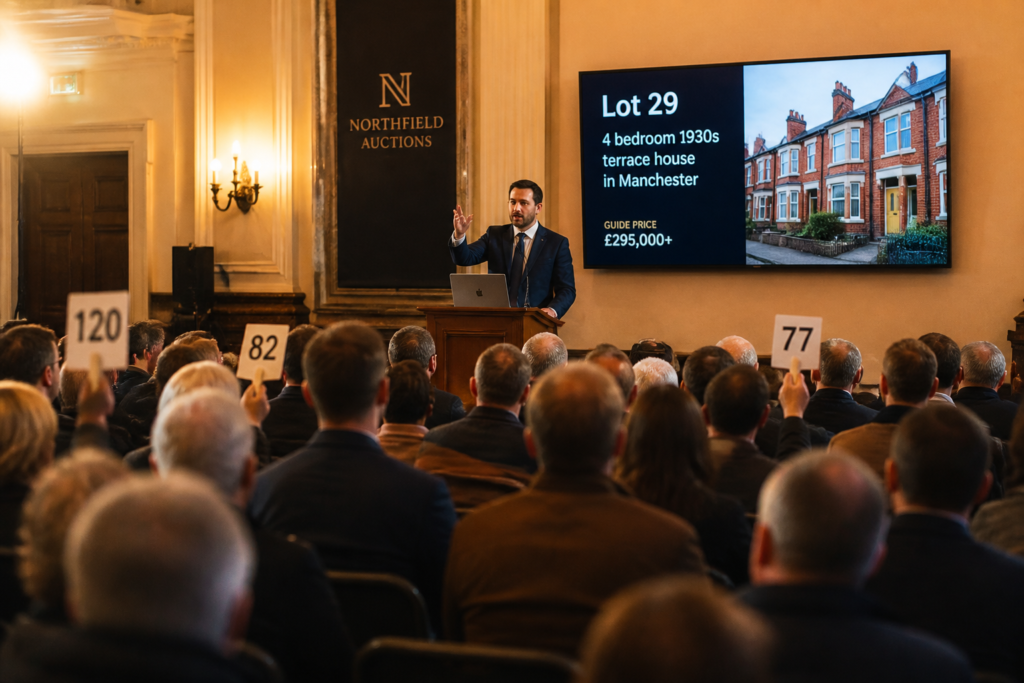
Property auctions are the most reliable and accessible route to genuinely discounted old homes in the UK. Period properties come to auction for a range of reasons — probate (where an estate needs to be liquidated), repossession, local authority disposal, developer exits, and private sellers who need certainty of sale rather than the extended and uncertain private treaty process. All of these can produce opportunities to acquire genuinely characterful old properties at prices that reflect urgency and circumstance rather than open market value.
Digital-first auction platforms handled 72% of all UK auction lots in 2025, with a fixed 28-day completion window from the fall of the hammer. This has democratised the auction process significantly — buyers no longer need to attend a physical auction room to compete. The major online and hybrid platforms include Allsop, Savills Auctions, SDL Property Auctions, Auction House, and iamsold, all of which carry period property across the UK and allow online bidding.
The mechanics of auction purchase are non-negotiable and must be understood before bidding. The fall of the hammer constitutes exchange of contracts — you are immediately legally committed to complete within the specified timeframe (typically 28 days for unconditional auctions, or up to 56 days for conditional auctions). A 10% deposit is paid on the day. If you fail to complete, you lose your deposit and face further liability. This means all survey, legal pack review, mortgage arrangement, and due diligence must be completed before bidding — not afterwards.
Reading the Legal Pack
Every auction property is accompanied by a legal pack — a bundle of documents including the title register, searches, special conditions of sale, and any relevant tenancy or planning information. Reading the legal pack is not optional; it is where the things that suppress the price are disclosed. Your solicitor should review the legal pack before bidding and flag anything that could affect the property’s value, mortgageability, or usability. Common issues disclosed in legal packs for old homes include: restrictive covenants on use, rights of way, absence of building regulations sign-off for previous works, missing planning consents, and title defects. Most of these are manageable; some are not — knowing which is which before the hammer falls is essential.
Probate Properties and Motivated Sellers
Properties coming to market following the death of the owner — probate properties — are among the most consistent sources of period homes in original condition and at negotiable prices. Executors of estates are motivated by resolution rather than maximising price; they are often willing to accept a realistic offer quickly in exchange for certainty of completion. These properties frequently appear on the main portals with indications of vacant possession, no onward chain, and early availability — all signals worth filtering for when searching.
Direct-to-vendor approaches — writing to the owners of properties you have identified as potentially motivated sellers, or approaching owners of properties that have been on the market for a long time without selling — can also produce opportunities, though they require more legwork and a clear and credible buying position to be taken seriously.
Long-Listed Properties
Properties that have been on the market for three months or more without selling have, by definition, not found a buyer at the asking price. This represents a negotiating opportunity, particularly for period properties where condition concerns, unusual construction, or other factors are deterring buyers. Filtering Rightmove and Zoopla searches by “oldest listed” rather than “newest” is a simple and underused technique for identifying properties where the vendor has already demonstrated willingness to wait — and where a realistic, well-evidenced offer below asking price is likely to receive more serious consideration than on a freshly listed property with competing interest.
Local Authority Empty Homes Initiatives
Many local councils in England maintain records of long-term empty properties and operate schemes to bring them back into use. Under the Housing Act 2004, local authorities have powers to serve Empty Dwelling Management Orders (EDMOs) on properties that have been empty for more than six months and are causing a nuisance, and some councils actively work with potential buyers to facilitate purchase of empty properties in their area.
Contacting the empty homes officer at the relevant local authority — or searching the council’s website for an empty homes policy or register — can occasionally surface properties that never reach the open market. This is a slower route than auction buying, but for buyers specifically seeking old, neglected homes with renovation potential, it is worth including in the search toolkit.
HM Land Registry Title Register Searches
For buyers who have identified a specific property they believe may be vacant or unlisted, it is possible to obtain the title register for any registered property in England and Wales from HM Land Registry for a fee of £3. This reveals the registered owner’s name and address (or the address to which correspondence was sent), which allows direct contact. Owners of long-vacant properties are sometimes unaware of the value of what they hold, or have been intending to sell but have not got around to it — a polite direct approach occasionally unlocks a transaction that would never have reached the portals.
How to Assess Whether a Cheap Old Home Is a Genuine Opportunity
Understanding What Suppresses the Price
A genuine below-market-value purchase is typically defined as acquiring a property at 15–25% below its open market value — and these opportunities exist because they reflect an underlying issue. For old homes specifically, the most common price-suppressing factors are:
Condition and disrepair. Properties requiring significant renovation — new roof, rewiring, replumbing, structural repairs — are priced to reflect the cost of works. Before assuming a discounted price represents a bargain, you need a realistic estimate of the full renovation budget. Building works in 2026 are substantially more expensive than the pre-inflation era estimates that some buyers carry in their heads — obtain actual quotes from contractors before committing.
Solid wall construction and energy performance. Pre-1919 properties with solid walls rather than modern cavity construction typically have poor EPC ratings — often E, F, or G — because solid walls are expensive to insulate without either internal dry-lining (which reduces floor area and can damage historic fabric) or external wall insulation (which requires planning consent in conservation areas and for listed buildings). The cost of improving EPC ratings on solid-walled period property can be significant, and buyers should factor this in, particularly given the direction of travel on EPC minimum standards for let properties.
Listed building status and the absence of consents. Old homes that carry listed building status, or that have had alterations carried out without the required listed building consent, present a specific legal and financial risk. Unpermitted works on listed buildings constitute a criminal offence that runs with the land, not with the person who carried them out — meaning a buyer who purchases a listed building with unpermitted alterations inherits the liability. Your solicitor must identify any such issues through the local authority search, and Historic England’s National Heritage List for England is a searchable database for checking listed status before viewing.
Private drainage and services. Old homes in rural and semi-rural locations frequently rely on private drainage systems — septic tanks or package treatment plants — rather than mains sewerage. The condition, capacity, and regulatory compliance of these systems must be investigated before exchange. Non-compliant systems under Environment Agency regulations may require replacement, which can cost £5,000–£15,000 depending on the system and ground conditions.
Japanese knotweed and ground contamination. Industrial-area period properties and those on former brownfield land may have ground contamination or Japanese knotweed issues. Both affect mortgageability and can add significant remediation cost. A full environmental search conducted by your solicitor will flag contaminated land risk; a specialist survey is required for knotweed identification and treatment planning.
Verifying the Price Against Comparable Sales
The single most important step in assessing whether a cheap old home is genuinely underpriced or simply priced to reflect its problems is checking the Land Registry sold price data for comparable properties in the same street and postcode. This tells you what similar homes have actually sold for — not what they were asking, and not what the vendor or agent believes they are worth.
For period properties specifically, the comparables need to be genuinely comparable — same age, same construction type, broadly similar condition. A renovated Victorian terrace two streets away is not a reliable comparable for an unrenovated example with structural issues; the gap between the two can legitimately be £30,000–£80,000 depending on the scope of work required.
Due Diligence: What Every Buyer of Old Homes Needs to Do
The Survey
A full RICS Level 3 Building Survey is the appropriate standard for virtually all old homes. The Level 2 Homebuyer Report is insufficient for genuinely old properties — it is not designed to assess the range of issues that solid wall construction, pre-modern services, and the natural deterioration of age can present.
Brief the surveyor on the specific concerns you have identified from viewing — damp patches, cracks, roof condition, state of chimney stacks, any alterations that might have required consent — so they focus additional attention on these areas. A good survey on an old home can identify issues that reduce the purchase price by far more than the survey fee, or — just as valuably — confirm that the apparent problems are minor and manageable.
The Solicitor’s Role
Your solicitor should conduct all standard searches — local authority, drainage and water, environmental, and chancel repair liability — plus any additional searches indicated by the property type and location. For old homes specifically, the local authority search will reveal listed building status, conservation area designation, any planning conditions or restrictions, and any outstanding enforcement notices. The drainage search will confirm whether the property is connected to the mains sewer. The environmental search will flag contaminated land risk, flooding, and ground instability.
All solicitors in England and Wales are regulated by the Solicitors Regulation Authority — verify registration before instructing. For properties involved in auction purchase, instruct your solicitor to review the legal pack at least a week before the auction date — not the day before.
Planning and Building Regulations History
Old homes frequently have alterations — extensions, loft conversions, garage conversions, new windows — that were carried out in the past. Some will have planning permission and building regulations sign-off; others will not. Your solicitor’s local authority search will reveal any outstanding planning enforcement notices, but will not necessarily confirm that all previous works had the required consents. Where a significant alteration — a rear extension, a structural alteration, a conservatory — is apparent, ask the vendor to provide the planning permission and building regulations completion certificate. If they cannot, an indemnity insurance policy is often available to cover the absence of documentation for older works, though this is not a substitute for confirming that the works themselves are structurally sound.

Frequently Asked Questions
What is the cheapest type of old home to buy in the UK?
Victorian terraced housing in the former industrial towns of the North East, South Yorkshire, the Welsh Valleys, and parts of the East Midlands represents the most accessible entry point for period property buyers in the UK. Two-bedroom Victorian terraces can be found in some of these markets below £70,000–£90,000, with larger examples and those in better condition ranging from £90,000 to £150,000. These are genuine period buildings of solid brick or stone construction, built to last, and often carrying original features — fireplaces, cornicing, sash windows — that would command a significant premium if they were in a more fashionable location.
Is buying an old home at auction risky?
Auction purchase carries real risks if approached without preparation — but it is not inherently riskier than a private treaty purchase if the due diligence is done properly beforehand. The discipline that auction requires — legal pack reviewed, survey commissioned, finance confirmed, and a firm maximum bid set before the gavel falls — is actually the discipline that all property purchases should have but often do not. The specific risk of auction is that there is no cooling-off period and no renegotiation after the hammer falls. That makes pre-bid preparation non-negotiable rather than advisable.
Can I get a mortgage on a cheap old home?
Mortgage availability for period properties depends significantly on construction type, condition, and EPC rating. Standard brick or stone construction in habitable condition is typically mortgageable with mainstream lenders, subject to the usual income and deposit requirements. Non-standard construction — timber frame, cob, clay lump, thatched roofs — can restrict the pool of willing lenders significantly. Properties in very poor condition may require a specialist refurbishment mortgage or bridging finance until the property is brought to a habitable standard.
Properties with very low EPC ratings (F or G) are still mortgageable for owner-occupiers, but lenders are increasingly stress-testing energy efficiency as part of their criteria, and the position for let properties is tightening. Consult an independent mortgage broker before committing to a purchase where the property type or condition might affect financing.
How do I find out if an old home is listed?
Historic England’s National Heritage List for England is a searchable database covering all listed buildings in England — you can search by address or postcode to confirm listing status and grade before viewing. For Wales, the equivalent is Cadw’s listed buildings database. For Scotland, Historic Environment Scotland maintains the equivalent record. Listed building status is also confirmed through the local authority search conducted by your solicitor, but checking these databases yourself before viewing allows you to understand the designation before you invest time and money in a property.
What are the hidden costs of buying an old home?
Beyond the purchase price, the main categories of additional cost for old homes are: renovation and repair works (which should be estimated by a qualified contractor, not guessed); survey fees (£500–£1,500 for a Level 3 survey depending on property size); legal fees (£1,500–£3,000 for a standard conveyance, more for complex titles); stamp duty at current HMRC rates (use the HMRC stamp duty calculator for the precise figures); and ongoing maintenance costs that are higher for old homes than for modern properties, particularly where services, roof coverings, or drainage are aging. For listed buildings, the additional cost of using approved materials and specialist contractors for any consent-required works should be budgeted from the outset.
Conclusion
Finding genuinely cheap old homes for sale in the UK is entirely possible in 2026 — but it requires a clear understanding of where to look, what suppresses prices on period property, and how to distinguish an opportunity from a liability. The auction route remains the most reliable source of discounted period stock; the cheapest geographies are concentrated in the North East, South Yorkshire, the Welsh Valleys, and parts of Scotland; and the discipline of verifying comparable sales through Land Registry data, commissioning a proper survey, and having a solicitor review the legal pack before committing are non-negotiable steps in any purchase.
Old homes for sale at below-market prices almost always have a reason for their discount — the skill is identifying whether that reason is temporary and resolvable, or permanent and prohibitive. Get that assessment right, and the combination of period character, solid construction, and the potential for value growth through sympathetic renovation can make an old home purchase one of the most rewarding property decisions a buyer can make.
For a broader perspective on how UK property investors are navigating the current market and finding value across different property types and price points, the guide on how UK property investors are thriving in a changing market provides useful wider context alongside this one.