Table of Contents
Key Takeaways
- Country estates for sale in the UK span one of the most varied and least liquid property categories in Britain — from 100-acre Georgian parkland houses in Wiltshire at £3–5 million to 10,000-acre Scottish Highland sporting estates at £20–30 million, with everything in between.
- The ten best counties for country estate buyers are Wiltshire, Perthshire, Norfolk, Hampshire, Gloucestershire, Yorkshire (North Riding), Northumberland, Herefordshire, Suffolk, and Oxfordshire — each offering a distinct estate character, land type, and buyer profile.
- The April 2026 Agricultural Property Relief reforms — which now cap 100% combined APR and Business Property Relief at £2.5 million per individual — are the most significant regulatory development affecting estate ownership and transfer in a generation, and must be central to any estate buyer’s tax planning from the outset.
- According to Savills, prime English arable land trades at a regional average of £9,941 per acre in the South East, with prime ground in counties like Hampshire reaching £10,340 per acre — figures that underpin the underlying value of estate acreage independently of the residential buildings.
- The most significant supply increase in the country estate market since 2024 has come from landowners restructuring or selling ahead of APR reform — with Savills data showing 44% more farmland marketed in 2024 than the previous five-year average, and the trend continuing into 2025.
- Country estate due diligence is substantially more complex than residential conveyancing — requiring specialist rural solicitors, agricultural surveyors, planning investigation of all rural buildings, sporting rights assessment, and detailed environmental compliance review.
What Defines a Country Estate — And Why They Remain the Ultimate Long-Term Asset
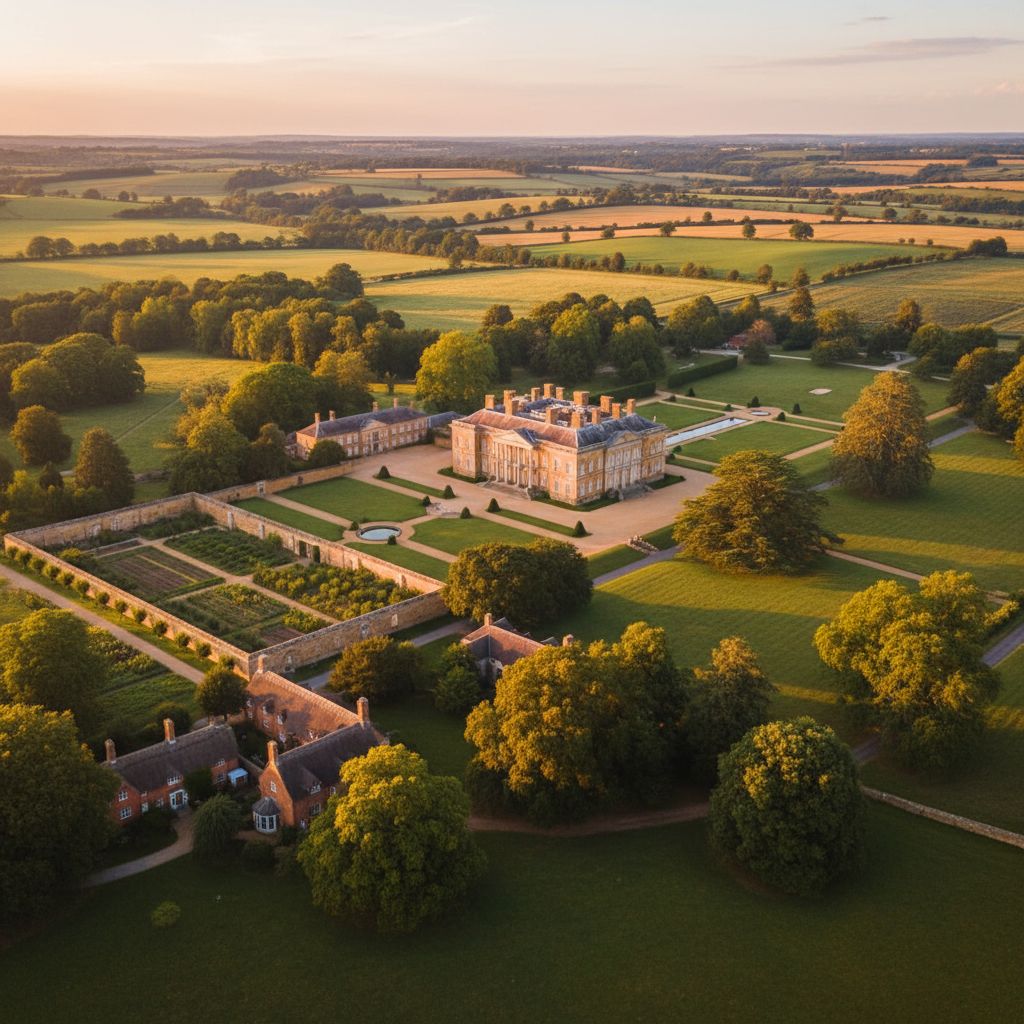
A country estate in the UK is more than a large house with grounds. At its most complete, it is a working entity — a principal house, one or more ancillary residences, agricultural land managed under a farm enterprise, woodland with commercial or amenity value, sporting rights (game shooting, fishing, deer management), and often a portfolio of let cottages or farm buildings generating income. At its most accessible, it might be a 50-acre ring-fenced block with a period farmhouse, a small yard, and a let bungalow — the essential character of landed ownership at a scale that does not require a permanent estate manager.
Country estates for sale attract a specific and sophisticated buyer — one who understands that what they are acquiring is not simply a home but a land-based business, a legacy asset, and in many cases a conservation and stewardship responsibility. The buyers competing for the finest English and Scottish estates are drawn from British private wealth, international buyers (33% of country estate buyers in the UK were international as recently as 2023, according to Knight Frank), and institutional family offices managing multigenerational assets.
The market for estates operates on a longer cycle than the mainstream residential market, with fewer transactions, higher average dwell times, and a much greater proportion of off-market sales. Understanding how to find and approach country estate buying — particularly given the structural changes the APR reform is introducing — is the starting point for any serious buyer.
The April 2026 APR Reform: What Every Estate Buyer Must Understand
No buyer of a UK country estate in 2026 can afford to approach the purchase without a thorough understanding of the changes to Agricultural Property Relief (APR) and Business Property Relief (BPR) that came into force on 6 April 2026. These represent the most significant reform to estate inheritance tax planning in a generation.
Under the previous regime, qualifying agricultural property and business assets attracted 100% relief from inheritance tax with no cap — meaning that a working farm or estate of any value could pass between generations without IHT liability, provided it met the occupancy and use conditions. Under the reformed rules as confirmed by GOV.UK, the full 100% combined APR and BPR relief is now capped at £2.5 million per individual (increased from the originally announced £1 million following consultation). Assets above this threshold attract only 50% relief, creating an effective IHT rate of 20% on the excess.
For individuals, the threshold is £2.5 million. The government subsequently confirmed that unused APR/BPR allowance is transferable between spouses or civil partners on death, meaning that a married couple can potentially pass on up to £5 million of qualifying agricultural or business assets with 100% relief between them.
The practical implications for country estate buyers are substantial. An estate with agricultural land, residential property, and business assets worth £6 million — a relatively modest estate in many southern English counties — may now face a meaningful IHT liability on the assets above the £2.5 million threshold. Every estate purchase in 2026 requires specialist agricultural tax advice from a qualified accountant or tax adviser before the acquisition structure is finalised, not afterwards.
The House of Commons Library briefing on APR reform provides the authoritative summary of what changed and when. The Country Land and Business Association and the National Farmers’ Union continue to lobby for further changes and provide guidance on compliance and planning.
1. Wiltshire: The Classic English Estate County
Wiltshire is the definitive English country estate county — a landscape of chalk downland, ancient parkland, arable farming, and the kind of undisturbed rural character that has attracted serious estate buyers for centuries. The county contains some of the finest Georgian and Regency country houses in England, set within ring-fenced estates that combine residential grandeur with working agricultural enterprises.
The Wiltshire estate market covers a wide range — from smaller ring-fenced blocks of 80–200 acres with period farmhouses at £2–5 million, through to substantial Georgian seat houses with 500–1,000 acres of mixed arable and pasture farming at £8–15 million. The finest Wiltshire estates — those associated with historic parkland, notable architecture, and significant acreage — periodically reach prices above £25 million for truly exceptional examples.
The county benefits from freely draining chalk and limestone soils that provide some of the best arable land in southern England, excellent sporting (particularly driven pheasant shooting in the downland valleys), and proximity to Bath, Salisbury, and Marlborough for day-to-day amenity. The North Wessex Downs National Landscape covers the northern part of the county, and its planning policies are directly relevant to any estate buyer intending to develop agricultural buildings, cottages, or other estate infrastructure.
Prime arable land in Wiltshire trades broadly in line with the South East regional average of £9,941 per acre cited by Savills, with the best chalk downland reaching above £10,000 per acre in competitive sales.
2. Perthshire: Scotland’s Premier Estate County
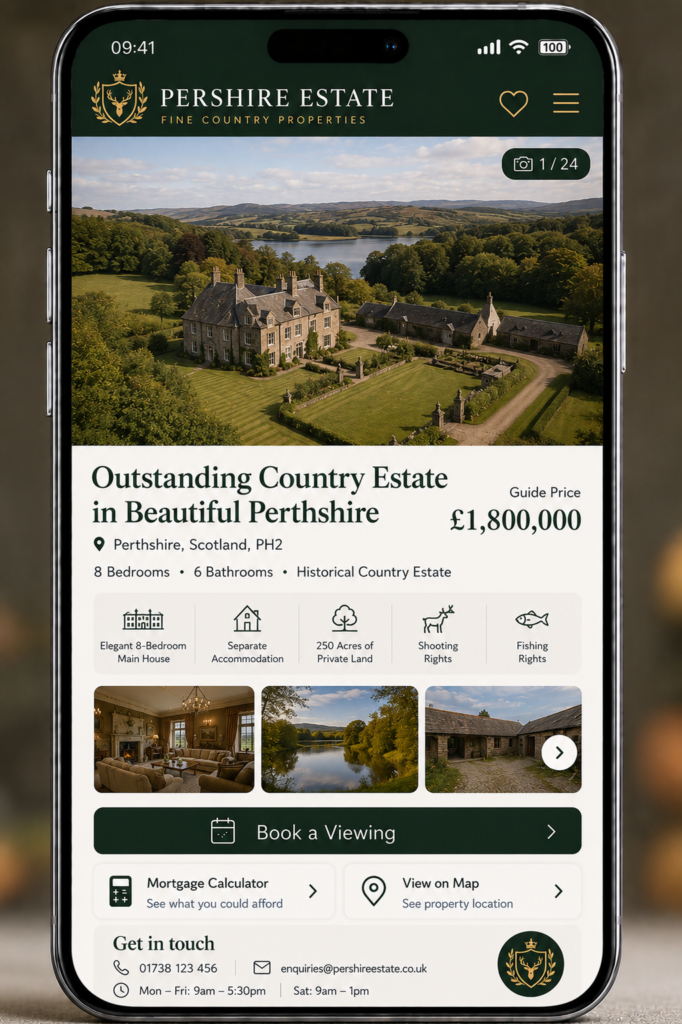
Perthshire is the most celebrated and actively traded county for country estate buying in Scotland — a landscape of Highland rivers, ancient Caledonian pine forest, grouse moors, and productive low-ground farming that provides the most complete estate proposition in Britain for buyers who want both sporting rights and agricultural income on the same holding.
Scotland’s estate market operates differently from England’s. Land registration, the Land Reform (Scotland) Act 2003 public access rights, and the specific Scottish IHT and tax framework all require specialist Scottish advice from the outset. The Scottish Land Commission provides context on land reform policy in Scotland, which continues to evolve and is relevant for buyers of significant Scottish landholdings.
Perthshire estates range from smaller mixed-use properties of 500–2,000 acres at £1.5–5 million to major Highland sporting estates of 5,000–20,000 acres at £10–30 million. The River Tay — one of the finest salmon rivers in Europe — provides some of the most valuable fishing rights in Scotland, and Perthshire beats on the Tay command prices that reflect their scarcity and the quality of the fishing. Grouse moors on the higher ground add further sporting value, with driven grouse shooting income making meaningful contributions to estate economics in strong grouse years.
Scottish estates are not subject to English planning law — the Town and Country Planning (Scotland) Act 1997 governs Scottish planning, and Planning Advice Note 72 provides guidance on housing in the Scottish countryside.
3. Norfolk: The Sporting Estate Heartland
Norfolk is England’s most concentrated county for large sporting estates — the tradition of driven partridge and pheasant shooting on Norfolk’s arable farms, combined with some of the finest wildfowling in the country on the coastal marshes and the Broads, has created a culture and infrastructure of sporting estate ownership that is unmatched anywhere in England.
The Sandringham Estate — the royal family’s private estate in west Norfolk — sits within a landscape that has historically attracted the most serious English sporting estate buyers. The rolling arable farmland of the Good Sands area around Fakenham and the Burnham Market area combines the Norfolk partridge shooting tradition with proximity to the north Norfolk coast. Estates in this area range from 500–2,000 acres of mixed arable and sporting land with period house at £3–10 million, to the very finest multi-thousand-acre estates that reach significantly above this.
Norfolk estate land is among the most productive cereal-growing country in Britain. Prime Norfolk arable land commands £12,000–£18,000 per acre in competitive sales — at the top of the English agricultural land market — and the combination of high-quality farming income, strong sporting potential, and coastal proximity makes Norfolk estates among the most commercially justified of any English county.
The Norfolk Coast National Landscape and the Norfolk Broads Authority both carry planning implications for estates with land in or adjacent to these designations.
4. Hampshire: Shooting Country and the Test Valley
Hampshire’s country estate market is driven by a combination of exceptional game shooting — the chalk downland valleys of the Test, Itchen, and Meon provide some of the finest driven pheasant and partridge shooting in southern England — and the county’s proximity to London, making it one of the most practically accessible counties for estate ownership within the primary residence reach of the capital.
The Test Valley in particular has long been associated with the finest chalk stream trout fishing in Britain — a day ticket on the Test’s most productive beats commands prices that make river access a genuinely significant estate asset. Properties with riparian rights to the Test or Itchen attract a premium that reflects the scarcity of high-quality chalk stream fishing and the depth of demand from buyers who prioritise this.
Hampshire estates range from 200–500 acres of mixed shooting and farming land with period house at £2.5–6 million to substantial seat house properties with 1,000+ acres, formal gardens, let cottages, and full pheasant and partridge shoots at £8–20 million. The county’s free-draining chalk and limestone soils support productive arable and livestock farming, and prime Hampshire arable land reaches approximately £10,340 per acre according to Savills FMU data — among the highest in England.
The South Downs National Park covers the southern part of the county, and its planning framework is directly relevant to any estate buyer with land or buildings within the Park boundary.
5. Gloucestershire: Cotswolds Grandeur and Beaufort Country
Gloucestershire’s estate market is defined by two overlapping traditions — the Cotswolds landscape and its honey-stone manor houses, and the Beaufort Hunt country that sweeps across south Gloucestershire into Wiltshire. Both attract a specific and deeply loyal buyer who has often been looking for the right Gloucestershire estate for years before the right opportunity arises.
The Cotswolds estate market — the ring-fenced limestone upland farms, the Georgian manor houses with formal gardens and walled kitchen gardens, the estate villages with let cottages — is among the most sought-after in England. Proximity to London (the M4 corridor provides 90-minute access), the Royal Agricultural University at Cirencester, and the cultural calendar of the Cheltenham Festival all contribute to a depth of demand that keeps values supported through market cycles.
Gloucestershire estates range from 200–500 acres at £3–7 million for the well-positioned Cotswolds manor house with ring-fenced farmland, through to the grandest Georgian seat houses with 1,000+ acres that reach £15–25 million. The presence of Badminton Horse Trials nearby draws international equestrian attention to the area, and estate properties with equestrian facilities in this county carry additional value for the right buyer profile.
The Cotswolds National Landscape covers the core of the county’s prime estate market and carries planning implications for all rural development.
6. North Yorkshire: Moors, Dales, and Driven Grouse
North Yorkshire’s country estate market spans two very different landscapes and two very different estate characters. The North York Moors contain some of the finest driven grouse moors in England — the heather moorland that defines the high ground between Helmsley and Whitby is managed for driven grouse at levels that generate significant commercial and sporting income in productive years. The Vale of York and the lower Wolds provide productive arable and mixed farming country at more accessible price points.
Driven grouse moor in North Yorkshire is among the most commercially valuable sporting land in Britain — well-managed moors with reliable grouse populations command significant premiums per brace of expected annual bag, and the capital value of a moor is largely driven by its sporting productivity. The regulatory environment for driven grouse shooting has been subject to increasing legislative scrutiny — buyers of grouse moor should understand the current Natural England licensing framework for moorland management and any proposed changes to driven grouse shooting regulation before committing to a moor purchase.
Yorkshire estate prices range from accessible 200–500-acre mixed farms with period houses at £1.5–4 million in the Dales and Wolds, to substantial moor and dale estates of 2,000–5,000 acres at £6–15 million, and the most significant moors with exceptional grouse records reaching above that.
7. Northumberland: Scale, Solitude, and the Border Country
Northumberland offers country estate buyers something genuinely rare in England — genuine scale at prices that are substantially below the equivalent in Wiltshire or Hampshire. The county’s position as the most sparsely populated in England, combined with a dramatic landscape of Cheviot Hills, river valleys, and Border country, creates an estate market where 1,000–3,000-acre holdings are available at prices that would buy a fraction of that acreage in the South.
Northumberland sporting estates — combining mixed grouse moor and driven pheasant shooting, salmon fishing on the Tyne, Coquet, or Till, and hill farming enterprises — represent some of the best-value sporting estate buying in Britain. A well-managed Northumberland estate of 1,500–3,000 acres with a principal house, several let cottages, and good sporting rights can be found from £3–7 million — a price that buys exceptional scale and privacy in one of England’s last genuinely wild landscapes.
The Northumberland National Park covers the western part of the county and carries specific planning policies relevant to estate development and diversification within its boundary.
8. Herefordshire: Undervalued and Deeply Rural
Herefordshire is one of the most consistently undervalued estate counties in England — a fact that is slowly being corrected as buyers discover the quality of its landscape, the richness of its agricultural land (the Hereford cattle breed is the county’s most famous agricultural export, reflecting the quality of its pasture), and its extraordinary heritage of black-and-white timber-framed manor houses and farmsteads.
The Wye Valley — a designated National Landscape — provides some of the most dramatic river scenery in England, and estates with Wye frontage or wooded hillside positions above the valley command significant premiums. The county also benefits from the Golden Valley, the Black Mountains border country, and the agricultural heartland of the Frome and Lugg valleys — all providing distinct characters of estate ownership.
Herefordshire estate prices are meaningfully below comparable Gloucestershire or Wiltshire equivalents. A 300–600-acre mixed farming estate with period farmhouse and let cottages in a good Herefordshire location can be found from £2–5 million — representing genuine value for the quality of land, landscape, and buildings that the county offers.
9. Suffolk: Parkland Estates and the Sporting Tradition
Suffolk’s country estate market centres on the parkland and sporting estate tradition that defines the county’s western and central areas — particularly around Bury St Edmunds, Lavenham, Long Melford, and the Stour Valley. The county’s relatively flat landscape and predominantly arable farming character support some of the finest driven pheasant and partridge shoots in East Anglia, and the combination of productive farming income and strong sporting potential makes Suffolk estates commercially well-supported.
Period estate houses in Suffolk — the Grade II listed or higher Georgian parkland seats surrounded by ancient parkland, formal gardens, and ring-fenced farmland — are competed for by buyers who appreciate the specific quality of the East Anglian estate tradition. Suffolk arable land consistently commands prices at the top of the English farmland market, with the county’s cereal land averaging £12,000–£18,000 per acre in competitive sales.
The north Suffolk coast — the stretch from Aldeburgh through Southwold to the Suffolk Heritage Coast — adds a coastal dimension to some Suffolk estates, with properties combining inland farmland with coastal frontage or proximity to the National Landscape.
10. Oxfordshire: The Oxford Belt and the Chilterns
Oxfordshire’s estate market is shaped by its unique position — within 60 miles of central London, bordered by the Chilterns AONB to the east and the Cotswolds to the west, and home to one of the most active equestrian and polo communities in England centred on the Guards Polo Club at Windsor Great Park and the Oxford area polo grounds.
The Oxfordshire estate market carries a London premium that reflects the depth of demand from buyers who want estate living within practical reach of the capital — a position that few counties can match at Oxfordshire’s level of agricultural quality and landscape character. Ring-fenced arable and mixed estates of 300–800 acres with period houses in well-regarded Oxfordshire locations typically range from £3.5–10 million, with the finest examples significantly above this.
The Chilterns National Landscape covers the eastern part of the county and carries planning implications for estate development. The Oxfordshire Cotswolds National Landscape designation covers the western part, applying the same planning framework as Gloucestershire’s prime estate country.
What Every Country Estate Buyer Must Do Before Committing
Instruct a Specialist Rural Solicitor and Agricultural Surveyor
Country estate conveyancing requires specialist expertise that goes well beyond standard residential or even commercial property practice. Your solicitor must be experienced in rural conveyancing — specifically in matters including agricultural tenancies, sporting rights, riparian rights, commons registration, rights of way, estate roads, and the planning history of all rural buildings on the estate.
An agricultural surveyor — a RICS-qualified rural specialist — should be instructed to assess the farming enterprise, the quality and condition of agricultural buildings, the boundary fences and infrastructure, and the condition and productivity of the farmland. All solicitors in England and Wales are regulated by the Solicitors Regulation Authority; for Scottish estates, solicitors are regulated by the Law Society of Scotland.
Investigate Planning History on All Estate Buildings
Country estates frequently contain agricultural buildings, cottages, and other structures whose planning history requires careful investigation. Barns converted without the required planning consent, agricultural occupancy conditions (AOCs) attached to farmhouses and cottages, and buildings erected under permitted development rights that may have been removed are all common sources of planning complexity on estate property.
Your solicitor should obtain planning history searches for all buildings on the estate and confirm whether each structure has the required consents, including any listed building consents for historic buildings. The Planning Portal provides access to planning history for English properties; the Welsh government’s planning portal and Scotland’s eDevelopment portal cover the equivalent positions.
Assess Sporting Rights with Expert Guidance
Sporting rights — the legal rights to shoot game, fish, or manage deer on the estate — require specific assessment separate from the residential and agricultural elements. Game shooting rights over agricultural land may be in-hand (operated by the estate) or let to a shoot, with let shoots carrying tenant rights that affect how the land can be managed. Fishing rights on rivers and lakes require specific legal confirmation in the title and may be subject to Environment Agency rod licence requirements and abstraction consents.
Environmental Compliance and Stewardship Schemes
Country estates frequently have land within agri-environment schemes — Countryside Stewardship, Sustainable Farming Incentive, or their predecessors — that carry obligations and conditions binding on the new owner. A buyer must understand what schemes are in place, what obligations they carry, what income they generate, and whether the agreement transfers with the estate or terminates on change of ownership. The relevant contact is the Rural Payments Agency in England, or the equivalent in Scotland (Scottish Government Rural Payments) or Wales (Welsh Government Rural Payments Wales).
Frequently Asked Questions
What does a country estate in the UK typically cost?
The range is vast. Modest ring-fenced estates of 100–200 acres with period farmhouse, let cottage, and basic agricultural buildings in less fashionable counties start from approximately £1.5–3 million. Mid-range sporting and farming estates of 500–1,000 acres with good principal house and established shoot range from £4–10 million in most English counties. The finest Georgian seat houses with 1,000+ acres of ring-fenced land, let estate cottages, and significant sporting facilities in the prime counties — Wiltshire, Norfolk, Hampshire — reach £10–25 million and above. Scottish Highland sporting estates of 5,000+ acres with lodge accommodation and full sporting rights range from £5 million to £30 million and beyond for the most significant.
How has the APR reform affected the country estate market?
The 2024 Autumn Budget announcement of APR reform — subsequently confirmed and implemented from April 2026 with the threshold raised to £2.5 million per individual — triggered a significant volume of supply as landowners restructured holdings or chose to sell ahead of the new regime. Savills recorded 44% more farmland marketed in 2024 than the previous five-year average. In 2025 this supply increase moderated but remained elevated. For buyers, this has created more choice and improved negotiating conditions, particularly at the larger estate level. The long-term impact on estate economics and succession planning is still working through the market. Every buyer of an estate above £2.5 million in agricultural and business asset value must take specialist tax advice before completing any purchase.
What is the difference between a country estate and a country house?
A country house is typically a substantial rural residence with grounds — the principal house and its immediate setting. A country estate encompasses the house within a broader landholding — agricultural farmland, woodland, let cottages, sporting rights, and potentially other commercial or residential properties — that together constitute an operating enterprise as well as a residential asset. Estates generate income (from farming, shooting, lettings, and other enterprises) and carry management responsibilities, whereas a country house is primarily a residential asset. The distinction matters practically because estates require a different level of ongoing expertise to manage successfully.
Are country estates a good investment?
Country estates have historically proved resilient long-term assets — they cannot be replicated, their supply is structurally constrained, and the combination of residential amenity, agricultural income, and sporting value creates multiple sources of value support. However, they are not liquid assets, they require ongoing investment and skilled management, and the APR reform has meaningfully changed the inheritance tax environment for passing them between generations. Buyers should approach an estate purchase as a long-term lifestyle and legacy commitment rather than a purely financial investment, and should model the tax position carefully across generational transfer scenarios.
For context on how the broader UK property investment market is performing across price points and asset types, the guide on how UK property investors are thriving in a changing market is worth reading alongside the specific estate market picture.
How do I find country estates for sale that are not publicly listed?
The majority of significant country estate transactions in the UK are handled off-market — sold by specialist rural agents to registered buyers before any public listing. The key is registering with the rural and estate departments of the major specialist agents — Savills Rural, Knight Frank Country, Strutt & Parker, Carter Jonas Rural, Bidwells, and H&H Land & Estates in the north — and providing a clear and credible brief of what you are looking for, your budget, and your timeframe.
Being known as a proceedable, financially capable buyer with a genuine requirement significantly improves the likelihood of being introduced to off-market opportunities. UK Land and Farms and specialist country house portals also carry publicly listed estate stock that is worth monitoring alongside direct agent registration.
Conclusion
Country estates for sale in the UK represent the most complex, the most varied, and in many ways the most rewarding category of UK property — assets that combine residential grandeur, agricultural enterprise, sporting tradition, and heritage stewardship in a single holding. The ten counties covered in this guide between them represent the full breadth of what Britain’s estate market offers, from the chalk downland precision of Wiltshire and Hampshire to the scale and wildness of Perthshire and Northumberland.
The buyers who succeed in this market are those who understand that an estate purchase demands more thorough preparation than any other property category — specialist solicitors and surveyors, detailed agricultural and sporting assessments, rigorous planning investigation of all estate buildings, and above all, comprehensive and current tax planning given the material changes the April 2026 APR reform has introduced.
Get that preparation right, and a country estate purchase offers something that almost no other UK asset can match: a holding that works as a home, a business, a sporting ground, stables and horse racing facilities, and a legacy for those who come after — in some of the most extraordinary landscapes Britain possesses.