Table of Contents
Key Takeaways
- Is Peckham a nice place to live? For the right person, emphatically yes — Peckham is one of South London’s most culturally rich, genuinely characterful, and well-connected inner-city neighbourhoods, with a creative and food scene that has drawn national and international recognition over the past decade.
- Peckham was named the best place to live in London by the Sunday Times in 2017 — a verdict that reflected its transformation from a neighbourhood with a difficult reputation into one of the capital’s most exciting urban communities, a trajectory that has continued since.
- Average property prices sit around £596,000–£670,000 depending on the data source and period measured, with flats averaging approximately £448,000–£465,000 — making Peckham meaningfully more affordable than adjacent East Dulwich (averaging £817,000) or Brixton, while offering a comparable or superior lifestyle offer.
- Peckham Rye station provides direct Overground and rail services to London Bridge (10–12 minutes), Victoria (15 minutes), and connections across south and east London — Zone 2 connectivity that puts most of the capital’s major employment centres within 30 minutes.
- The neighbourhood’s food and drink scene — anchored by the Rye Lane market, the railway arches of Copeland Park and Peckham Levels, South London Gallery, and an extraordinary concentration of independent restaurants — is among the most diverse and celebrated in London.
- The honest caveats: crime rates in parts of Peckham remain above the London average, the quality of the built environment varies significantly between streets, and the affordable end of the housing market is declining as gentrification works through the neighbourhood — the Peckham of 2026 is not the bargain it was in 2010.
The Question Everyone Is Really Asking
Is Peckham a nice place to live? It is a question that reveals something about the asker — because Peckham provokes genuinely strong and divergent views, often shaped more by reputation than by reality. For a generation that grew up watching Del Boy and Rodney navigate the Peckham of the 1980s — tower blocks, market stalls, and the cheerful grime of a down-at-heel South London neighbourhood — the idea of Peckham as a desirable address takes some adjusting to.
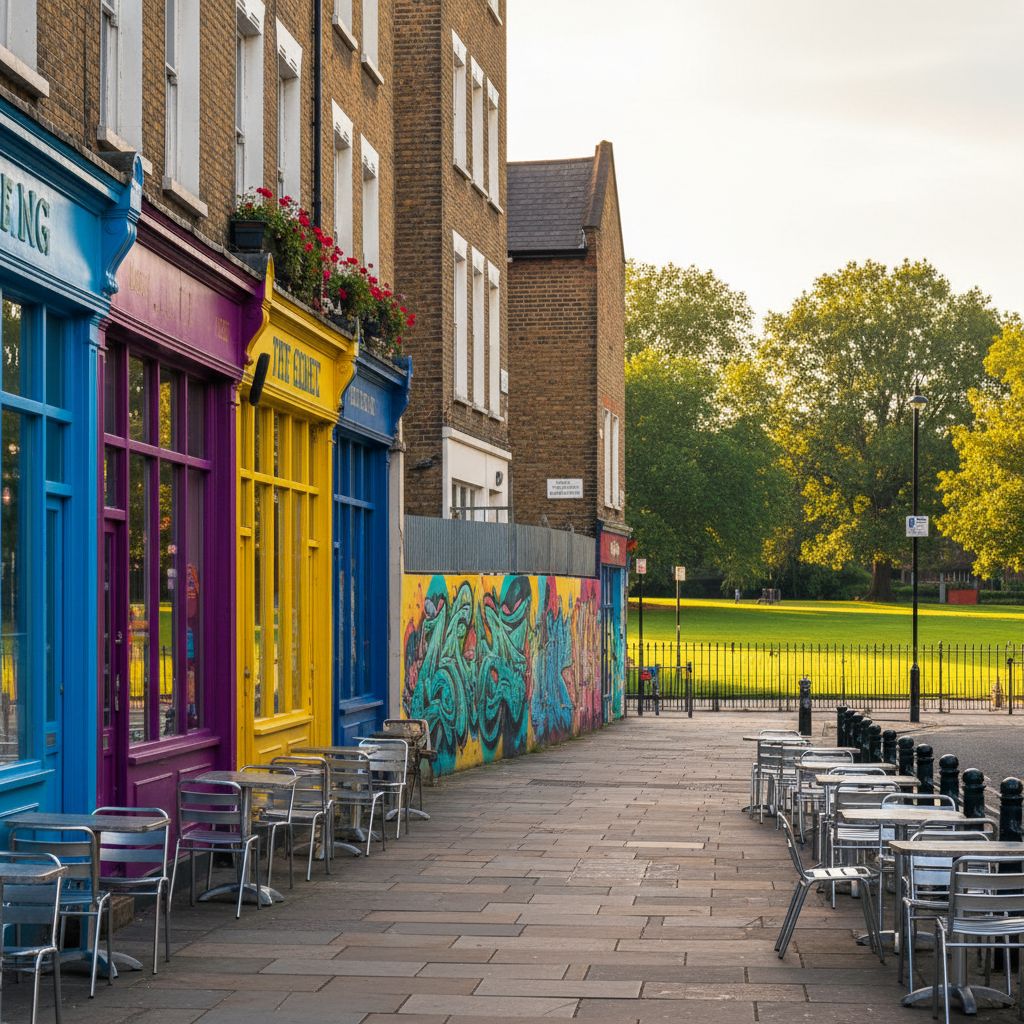
For the generation that actually lives there now, the disconnect between Peckham’s reputation and its reality is both amusing and mildly irritating. The neighbourhood has undergone one of the most dramatic transformations in London’s residential and cultural landscape over the past twenty years. The tower blocks are still there; so is the market. But alongside them has grown up a creative and cultural infrastructure — rooftop bars, contemporary art galleries, restaurant openings that attract queues from across London, and a community of young professionals, artists, and families — that has made Peckham one of the most genuinely exciting places to live in the city.
This guide works through the full picture: the genuine strengths that have made Peckham so consistently popular, the honest challenges that any newcomer should understand, and the practical information about transport, property, schools, and daily life that helps you decide whether it is the right place for you.
What Makes Peckham Genuinely Special
The Culture and Creative Scene
Peckham’s cultural identity is its most celebrated asset and its most genuine differentiator from surrounding South London neighbourhoods. The South London Gallery on Peckham Road is one of London’s leading contemporary art spaces, offering free exhibitions and a programme of events that draws visitors from across the capital and internationally. The Copeland Gallery and the railway arch spaces of Copeland Park host studios, galleries, and creative businesses that give the neighbourhood a working creative energy rather than a curated aesthetic.
Peckham Levels — the reimagined multi-storey car park above Peckham Rye station — has been one of the most written-about regeneration projects in South London, housing independent food vendors, bars, workspaces, and a rooftop with views across the city that have become one of the neighbourhood’s defining experiences. The Bussey Building — the creative venue in a former cricket bat factory — and the cluster of bars and music venues in the railway arches and surrounding streets create a nightlife and cultural density that rivals Dalston and Hackney at their best.
The neighbourhood has been home to, or has formed, people of genuine significance: actor John Boyega grew up in Peckham; Florence Welch of Florence and the Machine is associated with the area; and the specific cultural tradition of south London — its grime, afrobeats, and community music scenes — has deep roots here. This is not a manufactured cultural identity; it is something that grew organically from a community with a strong and specific sense of itself.
The Food Scene
Peckham’s food and drink offer is extraordinary for a neighbourhood at its price point — and genuinely impressive by any London standard. Rye Lane, the neighbourhood’s main commercial street, hosts a dense and diverse concentration of food businesses that reflects Peckham’s multicultural character: West African restaurants and grocers, Turkish bakeries, Caribbean food shops, Vietnamese cafés, and the full range of international street food. Forza Wine, Bar Levan, and a cluster of independently operated restaurants on the side streets off Rye Lane have attracted reviews and attention that would suit any central London address.
The Saturday market at Rye Lane, the Peckham Farmers Market at Peckham Rye Park, and the food vendors at Peckham Levels collectively create a weekend food culture that gives the neighbourhood a European market-town atmosphere quite different from the conventional London high street experience.
Peckham Rye Park and Green Space
Peckham Rye Park and Common is one of South London’s finest green spaces — 113 acres of parkland, formal gardens, woodland, and open common land at the southern edge of the neighbourhood. The park’s Japanese garden, the deer in the woodland section, and the long open common that runs from Peckham toward Honor Oak are a daily amenity that buyers who have discovered it consistently cite as one of the most surprising and valued aspects of living in the area.
The scale and quality of Peckham Rye is significantly underappreciated by people who have not visited. It is not a pocket park or a scrappy bit of greenery — it is a substantial Victorian park of genuine beauty that provides walking, cycling, and open space at a scale comparable to much better-known South London parks.
Transport Connectivity
Peckham Rye station provides direct rail services to London Bridge in approximately 10–12 minutes and to Victoria in around 15 minutes — two of the capital’s most important rail hubs, serving the City, the West End, and Canary Wharf by interchange. The London Overground also runs through Peckham Rye on the South London Line, connecting the neighbourhood directly to Clapham Junction westward and to New Cross and Brockley eastward — providing cross-south-London connectivity that makes much of the rest of inner south London accessible without going into central London.
Peckham High Street station (a separate station, sometimes overlooked) provides an additional rail connection toward London Bridge. Buses are extensive, and Peckham’s position in Zone 2 means that Oyster and contactless travel throughout the city is available at Zone 2 rates.
For buyers and tenants who need to travel across South London as much as into central London — Clapham, Brixton, Dulwich, Greenwich — the Overground connections are particularly valuable. The TfL Journey Planner is the most reliable tool for mapping actual journey times from a specific Peckham address to your primary destination.
The Honest Challenges
Crime and Safety
Any honest guide to Peckham has to address the neighbourhood’s crime statistics directly. Southwark — the London Borough that includes Peckham — has crime rates above the London average in several categories, and Peckham itself has historically had pockets of higher crime, particularly street crime and knife crime in and around the town centre and some of the surrounding estates.
The situation is more nuanced than the broad reputation suggests, and it has improved significantly over the past decade. The specific streets around Rye Lane and the wider Peckham Rye Park area have a very different character from parts of the neighbourhood closer to the major road junctions, and most residents of Peckham’s residential streets report feeling safe in their immediate environment. The Metropolitan Police’s crime data dashboard provides ward-level statistics that allow anyone considering a specific address to understand the crime profile of that specific area rather than relying on the borough-wide average.
It is also worth noting that Peckham has been improving consistently, not stagnating. The investment in the neighbourhood’s public realm — Peckham Levels, the regeneration of the town centre, the growth of the food and arts scene — has brought more economic activity and more eyes on the street, which correlates consistently with improved safety. But it would be dishonest to claim that crime is not a real consideration in some parts of the neighbourhood, and buyers and renters choosing specific streets should do their research at that granular level rather than treating the neighbourhood as uniform.
Gentrification and Affordability
Peckham’s transformation has not been without cost. The same forces that have made it so attractive — the arts scene, the restaurant openings, the inward migration of young professionals and creative workers — have driven prices upward and reshaped the cultural mix of the neighbourhood in ways that have displaced some of the communities that originally gave it its character. This is a genuine tension that plays out in conversations about Peckham regularly, and it deserves acknowledgement rather than avoidance.
For buyers and renters considering Peckham in 2026, the practical implication is that the neighbourhood is no longer the affordable alternative it was a decade ago. Average flat prices of £448,000–£465,000 are accessible by London Zone 2 standards but are not cheap, and the rental market reflects the same pressure. The gentrification story is well advanced, and the gap between Peckham and East Dulwich or Herne Hill on price has narrowed considerably.
Variable Built Environment
Peckham’s built environment is notably uneven — a characteristic of its history as a working-class South London neighbourhood that developed organically over 150 years rather than being planned as a coherent residential environment. The finest Victorian and Edwardian terraces of the Bellenden Road conservation area and the streets around Peckham Rye Park are genuinely handsome; the post-war estates and 1960s flatted developments in parts of the wider neighbourhood are considerably less so.
The variation between streets is significant enough that a buyer attracted to Peckham should view the specific street and immediate neighbourhood as carefully as they view the property itself. The fifteen minutes’ walk between Peckham Rye station and the far end of the Bellenden Road conservation area traverses a range of built environment quality that a flat buyer from outside the area might not anticipate from the listings.
The Specific Neighbourhoods Within Peckham
Bellenden Village and the Conservation Area
The Bellenden Road area — sometimes marketed as Bellenden Village — is the most desirable and expensive part of Peckham, a Victorian conservation area of well-maintained terraces, independent cafés and restaurants, and a community character that is self-consciously village-like. Artusi, Ganapati, and a cluster of independent food businesses on Bellenden Road have created a destination dining street that draws visitors from across South London.
Property prices in the Bellenden area are the highest in Peckham — well-presented Victorian terraces requiring budgets from £800,000 to above £1 million for three or four-bedroom examples. For buyers who want the Peckham lifestyle at its most polished, Bellenden is the answer; for those seeking the value proposition that Peckham’s reputation suggests, this part of the neighbourhood may not deliver it.
Rye Lane and the Town Centre
The Rye Lane corridor — the main commercial street running from Peckham High Street toward Peckham Rye station — is the cultural and commercial heart of the neighbourhood. The diversity of its food, retail, and service businesses is a direct reflection of Peckham’s multicultural community, and the intensity of the street life — the market stalls, the music, the density of pedestrian activity — is one of the things that either draws people to the neighbourhood or puts them off.
Rye Lane is not a polished high street. It is busy, occasionally chaotic, and visually varied in ways that some buyers find invigorating and others find challenging. Experienced Peckham residents tend to find it one of the neighbourhood’s greatest assets precisely because of this authenticity.
Nunhead: The Quieter Alternative
Nunhead sits immediately to the south of Peckham proper — technically a separate neighbourhood within the London Borough of Southwark, but close enough to Peckham to be considered alongside it. Where Peckham is busy and urban, Nunhead has a genuinely village-like character — a small high street, Nunhead Green, the extraordinary Victorian Nunhead Cemetery (one of the Magnificent Seven London cemeteries, 52 acres of wild woodland and Victorian monuments), and residential streets of Victorian terraces at prices somewhat below the Peckham average.
For buyers who want access to Peckham’s amenity but prefer a quieter immediate neighbourhood, Nunhead is a consistently recommended alternative. Rail access is via Nunhead station on the same line as Peckham Rye, providing similar London Bridge and Victoria connectivity.
Property in Peckham: What Buyers and Renters Need to Know
The Property Market
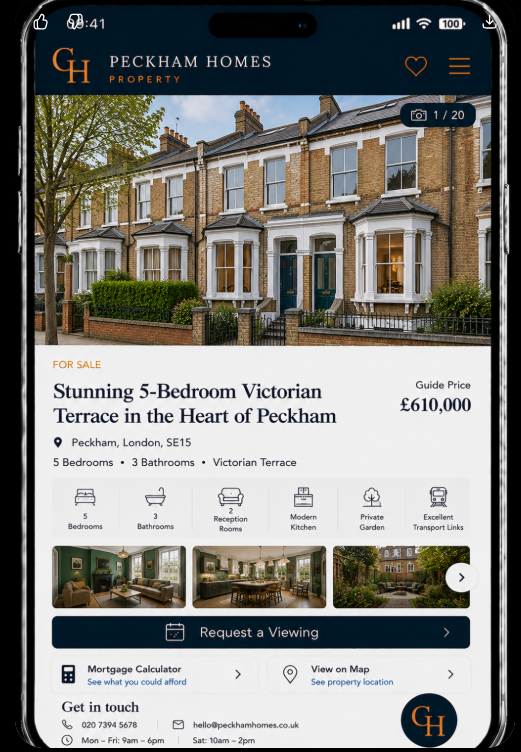
Peckham’s property market is dominated by flats — accounting for approximately 79% of all transactions — reflecting the mix of Victorian conversion properties and purpose-built apartment buildings that makes up most of the housing stock. Average flat prices sit in the £448,000–£465,000 range across most data sources, with the Bellenden area significantly above this and the areas further from the park and conservation area offering somewhat more accessible entry points.
Victorian terraced houses — the most sought-after property type for family buyers — average approximately £868,000 across recent transactions, with the finest examples in the Bellenden conservation area above £1 million and properties requiring renovation in less fashionable streets below £700,000 in some cases.
Sold prices have been broadly stable through 2025 into 2026, reflecting the wider South London market pattern of resilience rather than growth — a more comfortable position than the volatility seen at some peak market moments and suggesting that current prices are broadly grounded in sustainable demand rather than speculative froth.
The UK House Price Index from HM Land Registry allows buyers to research what specific properties in Peckham’s SE15 postcodes have actually sold for — essential due diligence in a market where asking prices can diverge from achieved prices.
Renting in Peckham
Peckham’s rental market is active and competitive — the neighbourhood’s combination of Zone 2 transport, cultural appeal, and relative value compared to more central South London addresses creates sustained demand from young professionals and creative workers. One-bedroom flats are typically available from £1,500–£1,900 per month in the mainstream market; two-bedroom flats from £1,800–£2,400 depending on location and specification; and Victorian terraced houses from £2,500 upward for family-sized properties.
Schools in Peckham
School quality in Peckham and the surrounding area is mixed, and families considering the neighbourhood with school-age children should research catchments carefully before committing to a specific address. The Ofsted school inspection database provides current ratings for all schools; the London Borough of Southwark’s school admissions service provides catchment information and the application process.
The secondary provision across Southwark has improved significantly in recent years, and several primaries in and around Peckham carry good or outstanding Ofsted ratings. However, as in all inner London boroughs, the catchment geography is tight and verifying the specific school eligibility of any particular property before purchase is essential for family buyers.
Frequently Asked Questions
Is Peckham safe to live in?
Peckham is safer than its reputation suggests, and has improved consistently over the past decade — but crime rates in parts of the neighbourhood remain above the London average, and the variation between specific streets is significant. The Bellenden conservation area, the streets around Peckham Rye Park, and the residential areas to the east of Rye Lane have a very different profile from parts of the neighbourhood closer to the major road junctions and some of the post-war estates. Check the Metropolitan Police’s ward-level crime dashboard for the specific postcode you are considering rather than relying on the neighbourhood’s aggregate reputation.
How does Peckham compare to East Dulwich for buyers?
East Dulwich and Peckham are adjacent neighbourhoods that serve overlapping but distinct buyer profiles. East Dulwich is more polished, quieter, more uniformly high-quality in its built environment, and more expensive — the Sunday Times has called it the best place to buy a period house in South London for around £500,000, though average prices are closer to £817,000. Peckham offers more cultural energy, more diversity, more nightlife, and a more affordable property market — but with more variation in built environment quality and a crime profile that requires more street-level research. Buyers who prioritise lifestyle intensity and relative value tend toward Peckham; those who prioritise residential quality and quiet community character tend toward East Dulwich.
What transport does Peckham have?
Peckham Rye station provides direct rail services to London Bridge (10–12 minutes), Victoria (approximately 15 minutes), and Overground connections to Clapham Junction, New Cross, and Brockley. Peckham High Street station provides additional rail access. Both stations are in Zone 2. The bus network is extensive. The combination of fast rail access to London Bridge and Victoria, alongside cross-south-London Overground connectivity, makes Peckham one of the better-connected Zone 2 addresses in south London. Check the TfL Journey Planner for actual journey times from any specific address.
Is Peckham good for families?
Peckham is increasingly popular with families — the combination of Peckham Rye Park’s scale, the improving school provision, the availability of larger Victorian terrace properties at prices below East Dulwich, and the neighbourhood’s genuine community character make it a credible family choice. The caveat is that family buyers should research specific school catchments carefully, assess the specific street they are considering rather than the neighbourhood as a whole, and be realistic about the built environment variation that characterises parts of the neighbourhood.
Will Peckham property prices continue to rise?
The property market across Southwark — and Peckham specifically — showed resilience through 2025, with prices broadly stable rather than declining in the face of higher mortgage rates. The neighbourhood’s structural fundamentals — Zone 2 transport, cultural depth, improving amenity, and sustained buyer demand from young professionals — support long-term value. The gentrification trajectory that began in earnest in the early 2010s has significantly reduced the gap between Peckham and adjacent more expensive neighbourhoods, and the neighbourhood is unlikely to deliver the dramatic value appreciation of its earlier years. For buyers purchasing as a primary residence and holding over the long term, the case remains solid; for buyers expecting rapid short-term capital growth, expectations should be calibrated accordingly.
Conclusion
Is Peckham a nice place to live? The answer for the right person is unambiguously yes — and the character of the right person for Peckham is fairly well-defined. Someone who values cultural energy, genuine diversity, an extraordinary food and arts scene, Zone 2 transport at prices more accessible than adjacent gentrified South London addresses, and Peckham Rye Park on the doorstep will find a neighbourhood that consistently delivers on its reputation. The Sunday Times called it the best place to live in London for a reason — and that reason has not fundamentally changed in the years since, even as the neighbourhood has matured and prices have risen.
Someone who prioritises uniformly high residential quality, quiet streets, low crime rates, and maximum school catchment certainty may find East Dulwich, Herne Hill, or Nunhead — the slightly quieter neighbouring alternatives — a better fit. Peckham is a neighbourhood of genuine character and genuine complexity, and it rewards residents who engage with both.
For those considering buying in Peckham specifically, the guide on how UK property investors are thriving in a changing market provides useful broader context on the South London and wider UK property market conditions that frame any purchase decision in 2026.