Start by getting a stamped survey, confirming setbacks, easements, HOA rules, and permits, and staking a square layout on your line. Build for your climate: use frost-depth footings sized to soil, rated masonry, and proper mortar. Excavate to undisturbed soil, add geotextile, 12 inches of angular gravel pitched 1%, a wrapped perforated drain, and weep holes every 24–32 inches. Reinforce with rebar, grouted cores, and piers, then cap with a sloped drip-edge and seal after curing—next you’ll see the details that prevent cracks.
Key Takeaways
- Verify property lines, easements, setbacks, and HOA rules with a stamped survey, and secure permits before any excavation or masonry work.
- Design for the wall’s purpose and site conditions, including height limits, step-downs on slopes, and alignment marked with stakes and string lines.
- Build a frost-depth, soil-rated footing on undisturbed, compacted soil, widening for weak or expansive soils to prevent settlement and cracking.
- Install reliable drainage: angular gravel with geotextile, perforated drainpipe, and weep holes every 24–32 inches to relieve water pressure.
- Reinforce and weatherproof: rebar and grouted cores at corners/intervals, plus a sloped overhanging cap, control joints, flashing, and breathable sealer after curing.
Confirm Boundary Lines, Permits, and Neighbor Rules
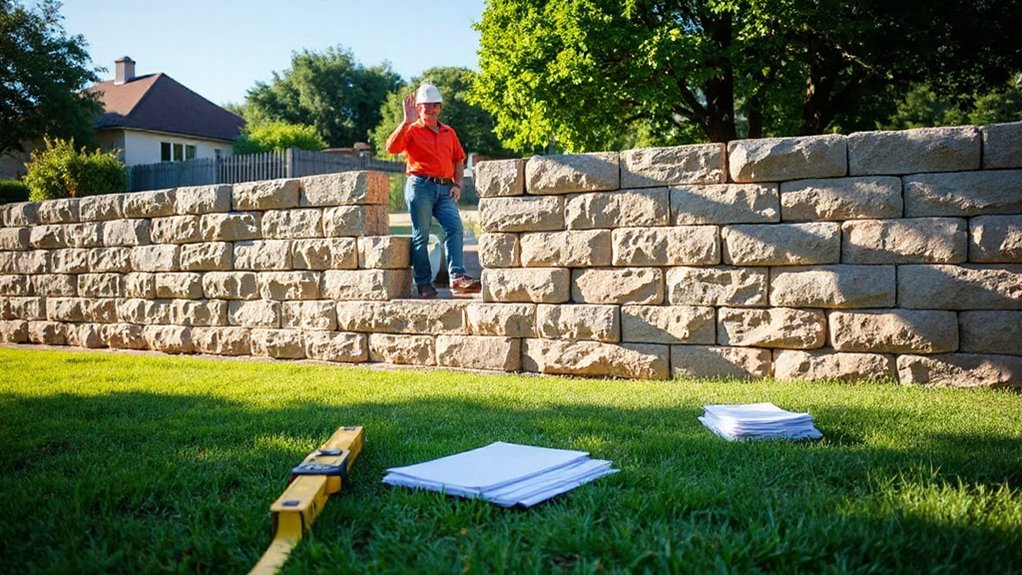
Before you dig a footing or order blocks, confirm exactly where your property line sits and what rules govern construction on it. Don’t rely on old fence lines or online maps; hire a licensed surveyor or obtain a recent stamped survey to verify survey accuracy and locate pins, easements, and rights-of-way.
Next, call your building department to confirm zoning setbacks, required permits, and inspection steps. Check HOA covenants, deed restrictions, and any recorded utility or drainage easements that limit excavation or masonry work. Submit the correct application, drawings, and fees, then keep the approved permit on-site.
Talk with adjacent owners early. Get written consent for any work near shared lines, and document access agreements. These steps protect legal compliance and prevent costly stop-work orders.
Set Boundary Wall Purpose, Height, and Layout
Decide what your boundary wall must do—privacy, security, grade retention, or wind screening—because that function drives the required design and code triggers.
Set the wall height to meet local limits and any sight‑triangle or easement restrictions, and plan for any step-downs needed on sloped grades.
Lay out the alignment on the ground with string lines and stakes, keep it on your confirmed property line, and square corners so your footing widths and setbacks stay compliant.
Define Wall Function
Why are you building the boundary wall—privacy, security, noise reduction, pet containment, or simply marking a lot line? Your answer determines materials, openings, and maintenance needs.
For privacy and noise, you’ll favor continuous, opaque construction; for security, you’ll limit footholds and control access points; for pets, you’ll prevent gaps and digging. If you only need boundary delineation, you may be able to use a lower, lighter system, but you still must meet local codes and HOA rules.
Confirm required wall height limits, setback rules, and whether permits or engineered plans apply.
Check utility easements and drainage paths so you don’t block swales or redirect runoff.
Decide where gates, corners, and returns must go to support function without creating conflicts with neighbors.
Plan Height And Alignment
Your wall’s function sets the performance targets, and now you need to lock in a height and a straight, defensible line on the ground that meets code. Start by checking local ordinances and HOA rules for maximum height, setback, and visibility at corners and driveways. Confirm property lines with a recent survey; don’t rely on old stakes or fences.
Mark the layout with batter boards and mason’s string, then square corners using the 3-4-5 method. Measure diagonals to verify true rectangles and maintain measurement accuracy.
Set finished height from the highest adjacent grade and account for cap thickness, drainage slopes, and step-downs on uneven terrain. Keep courses level with a laser or transit, and offset alignment to protect design aesthetics and sightlines. Recheck lines before excavation begins.
Pick Boundary Wall Materials That Fit Your Climate
Pick wall materials based on your local exposure: in high rainfall, you’ll need moisture-tolerant units plus code-approved drainage and weep details to prevent saturation.
If you’re in a freeze-thaw zone, you must use rated masonry, proper mortar, and frost-protected footings set below the required frost depth to limit cracking and heave.
In hot, high-UV climates, choose materials and finishes that resist thermal cycling and sun damage, and include control joints and expansion gaps where required.
Match Materials To Rainfall
In wetter climates, rainfall drives material choice because repeated soak–dry cycles, splashback, and wind‑driven rain can quickly degrade the wrong wall. Choose dense concrete masonry, fired brick, or stone with low absorption, and use Type S mortar where structural capacity is required by code. Avoid soft, porous units and untreated timber near grade.
Detailing matters as much as material. Set the first course at least 6–8 inches above finished grade, add a cap with drip edges, and include weep holes over any solid footing to relieve trapped water. Specify corrosion‑resistant ties and fasteners.
Manage site runoff with erosion control: compacted base, graded swales, and stable aprons at downspout outlets. If you integrate rainwater harvesting, route overflow away from the wall and protect the footing from saturation.
Choose For Freeze-Thaw Cycles
Rain isn’t the only moisture threat—freeze‑thaw cycles can crack and spall a boundary wall when absorbed water expands in freezing weather. Choose dense, low‑absorption units rated for exposure (ASTM C90 for CMU, ASTM C216 severe weathering for brick) and use Type S mortar where allowed by local code.
Specify air‑entrained concrete for caps and footings to resist scaling.
You’ll also need a frost‑protected foundation: place footings below the local frost depth, bear on undisturbed soil, and add washed gravel plus perimeter drainage to reduce frost heave.
Detail a sloped cap with a drip edge, too, so water can’t soak the wall.
Control joints and flexible sealant at returns help the wall tolerate temperature fluctuations without random cracking.
Plan For Heat And Sun
Where will your wall take the most sun—all day on a south or west exposure, or only in short bursts? Map sun exposure before you pick finishes, joints, and coping.
Dark masonry and metal heat up fast, so specify light-colored caps or UV-stable coatings where allowed. Provide control joints at code-recommended spacing and align them with changes in height, corners, and gate posts to manage thermal expansion and shrinkage.
Use flexible, exterior-rated sealant at movement joints and keep weep paths open so hot, dry cycles don’t trap moisture behind veneers.
If you’re using wood or composite panels, choose products rated for your temperature range and leave manufacturer-required gaps at ends and fasteners. Keep expansion joints clear of mortar droppings.
Size Boundary Wall Footings for Soil and Frost
Even if your wall layout is perfect, the footing size has to match your soil’s bearing strength and your area’s frost depth so the wall won’t settle, tilt, or heave. Check local code for minimum depth below frost line and required footing width for your wall height and material.
In weak or expansive soils, you’ll need wider footings or engineered reinforcement to spread loads.
Excavate to undisturbed soil, remove organics, and verify Soil compaction meets spec so the base won’t compress later.
Place the footing bottom below seasonal freeze depth to prevent frost heave.
Keep rebar cover per code, lap bars correctly, and use the specified concrete strength.
If you’re unsure, get an engineer’s bearing evaluation.
Add Gravel, Fall, and Weep Holes for Drainage
After you set the footing depth and width, how will you keep water pressure from building up behind the wall? Start with gravel drainage: place 12 inches of clean, angular 3/4-inch stone directly behind the wall, from the base up at least 24 inches, separated from soil with geotextile so fines don’t clog it.
Grade the trench with fall—aim for 1% minimum slope—to daylight or an approved discharge point.
Install a 4-inch perforated drain pipe at the bottom of the gravel, holes down, and wrap it in filter fabric.
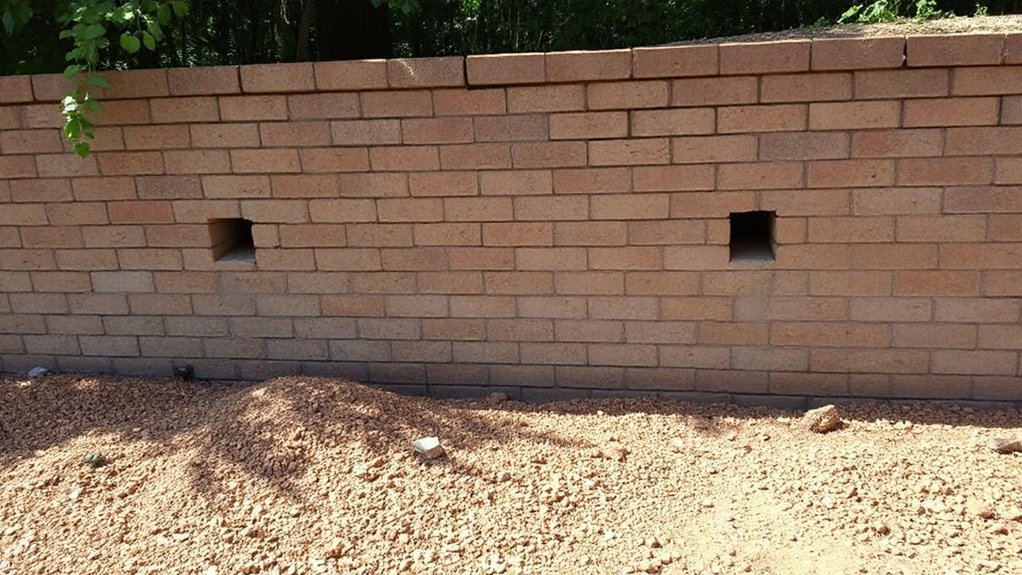
Add weep holes through the lowest course at 24–32 inches on center, sloped slightly outward. Keep outlets clear and protected from pests and erosion.
Use Rebar, Filled Cores, and Piers for Strength
Once you’ve handled drainage, you still need steel and grout to resist sliding, overturning, and cracking under soil loads and frost movement. Set Rebar reinforcement per your engineer or local code: dowel vertical bars from the footing, tie into horizontals at required spacing, and maintain proper cover so steel won’t corrode.
Use filled cores strategically. Grout cells that contain rebar, at corners, at wall ends, and at intervals required for wind and soil pressures; consolidate grout to eliminate voids.
Add piers or pilasters where the wall is tall, long, or retaining: thicken the section, increase bar size, and lap splices to specified lengths. Anchor caps or top bond beams to the rebar cage to create a continuous load path throughout.
Lay Bricks/Blocks Straight, Level, and Plumb
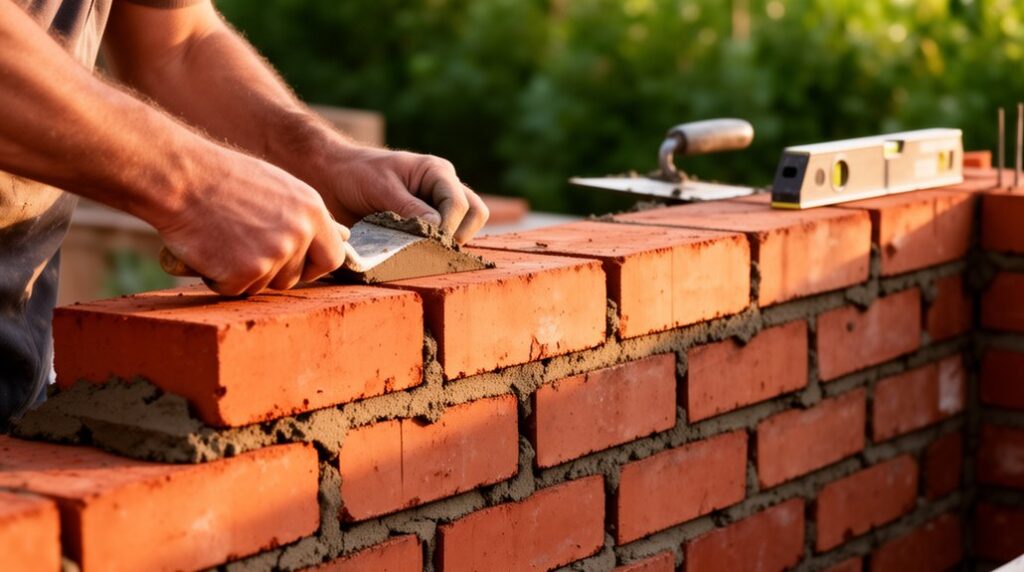
Because a boundary wall only performs as well as its layout, you’ve got to set each brick or block straight, level, and plumb from the first course. Establish corner leads first, then stretch a mason’s line tight between them for consistent brick alignment on every course.
Use a long level or laser and check level accuracy at the ends and midspan; don’t trust your eye. Butter head joints fully, set units into fresh mortar, and tap to line with a trowel handle, not the face. Maintain uniform joint thickness and stagger vertical joints per code requirements.
Verify plumb on corners and wall faces every few units with a level or plumb bob, correcting immediately before mortar grabs. Recheck each course before you proceed.
Cap, Seal, and Detail the Boundary Wall for Weather
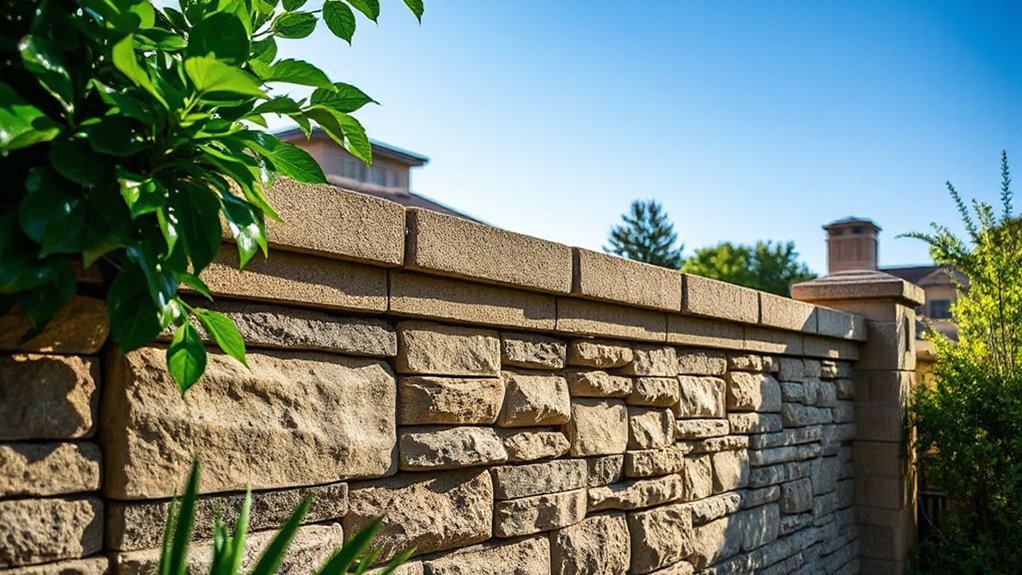
Straight, level, and plumb courses give you a solid wall, but the cap and weather details determine whether it stays that way through freeze–thaw and wind-driven rain.
Set a sloped, overhanging cap with a drip edge on both sides, and bed it on full mortar for continuous bearing. Tool joints tight, then cure properly; don’t seal green mortar.
After 28 days, apply a breathable silane/siloxane sealer to masonry faces and cap joints, following manufacturer coverage rates.
Seal control joints with backer rod and an exterior-grade, UV-rated sealant, and keep weep paths clear at ledges.
Flash changes to gates, columns, and retaining interfaces with metal or membrane.
Finish with compatible decorative finishing that won’t trap moisture or bridge joints.
Frequently Asked Questions
How Much Does a Boundary Wall Typically Cost per Linear Foot?
You’ll typically pay $25–$150 per linear foot for a boundary wall, depending on material options and labor rates.
Wood or vinyl privacy runs about $25–$60/ft.
Chain-link $20–$45/ft.
CMU/block $60–$150+/ft.
Stone or brick $80–$250+/ft.
Design considerations like height, footing depth, drainage, and wind loads affect cost.
You’ll also need permits, surveys, and property-line setbacks for code compliance.
Can I DIY a Boundary Wall, or Should I Hire a Contractor?
You can DIY a boundary wall if it’s low, non-structural, and you’re comfortable with excavation, drainage, and accurate layout; otherwise, hire a licensed contractor.
You’ll need permits and must meet local setback, height, and footing code.
Material selection affects frost resistance, longevity, and maintenance.
Design considerations include soil conditions, reinforcement, weep paths, and expansion joints.
If utilities, slopes, or retaining loads exist, don’t DIY.
How Long Should a Properly Built Boundary Wall Last?
A properly built boundary wall should last 30–75 years, and you’ll often get longer with reinforced concrete or well-laid masonry on a frost-depth footing.
You’ll extend life by managing drainage, sealing capstones, and controlling vegetation.
Check Permitting requirements and inspections so setbacks, height, and reinforcement meet code.
Plan Landscaping ideas that keep sprinklers and soil away from the base and allow access for repairs.
How Do I Prevent Graffiti or Staining on My Boundary Wall?
Treat your wall like a clean page: seal it before anyone writes on it.
For Graffiti prevention, apply a sacrificial or permanent anti-graffiti coating over cured masonry, and keep joints tooled and cracks sealed.
To reduce Wall staining, add a breathable water-repellent silane/siloxane, slope caps to shed water, and install drip edges.
Use non-staining mortar, control runoff from sprinklers, and follow local fire and material codes.
What Maintenance Does a Boundary Wall Need Over the Years?
You’ll keep a boundary wall sound by inspecting it yearly for cracks, loose caps, and leaning, then repointing mortar and sealing joints as needed.
You’ll clean and reseal masonry per manufacturer specs, keep weep holes clear, and guarantee drainage slopes away.
Use Landscaping tips: trim vegetation off the wall, control roots, and avoid soil buildup.
Add Security enhancements: maintain lighting, cameras, and anti-climb features, and repair fasteners.
Conclusion
You’ve checked the lines, pulled permits, and set the height—now the wall’s fate hangs on the last details. As you tamp the footing below frost depth, you can almost hear future winters testing it. You slope gravel to daylight, add weep holes, and tie rebar through filled cores and piers, keeping every course level and plumb. Then you cap and seal, flashing edges tight. Step back—one storm will reveal whether you built it right.