
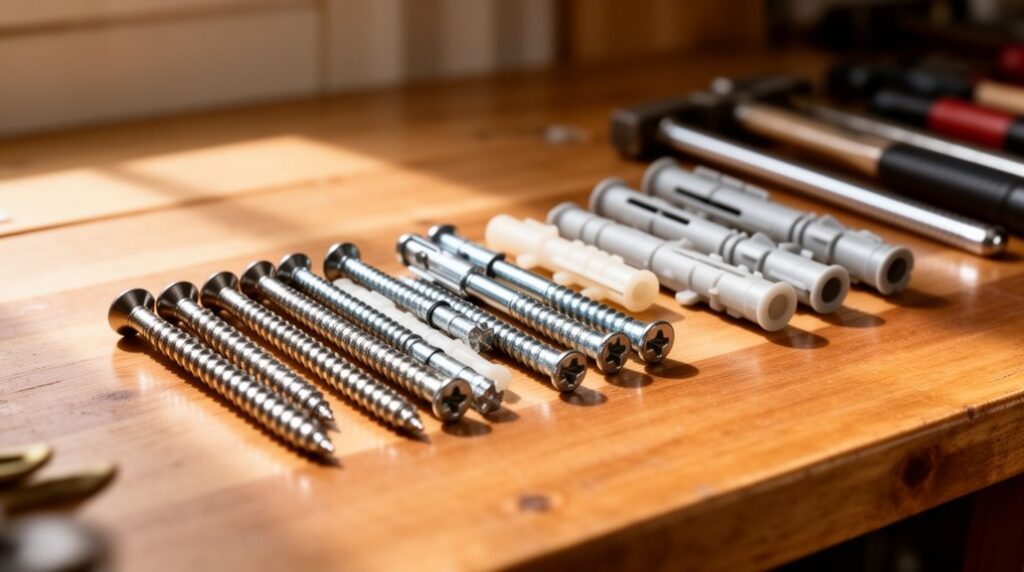
Start by confirming your base material—wood, drywall, or brick—and clean loose paint or plaster before you drill. Use screws straight into studs or solid timber, but choose the right anchor for hollow drywall or brittle masonry. Match the fastener to the load: longer embedment for pull-out, thicker shanks for shear. Drill the correct pilot size, avoid brick edges and soft mortar, and don’t overtighten. Keep going to learn simple sizing and drive choices.
Key Takeaways
- Identify the base material (wood, drywall, brick) and clear loose debris; find studs or solid brick webs before drilling.
- Choose screws for solid timber/studs; use wall plugs, toggles, or masonry anchors for hollow drywall or brittle masonry.
- Size fasteners for load type: longer embedment for pull-out, thicker shank for shear, and correct thread engagement for each material.
- Match head and drive style to the job: countersunk for flush, pan/truss for spread load, Torx/hex for higher torque and less cam-out.
- Select corrosion-resistant screws for damp/outdoor use, drill correct pilot holes, and tighten to spec without overtightening to prevent stripping or cracking.
Identify Your Base Material (Wood, Drywall, Brick)
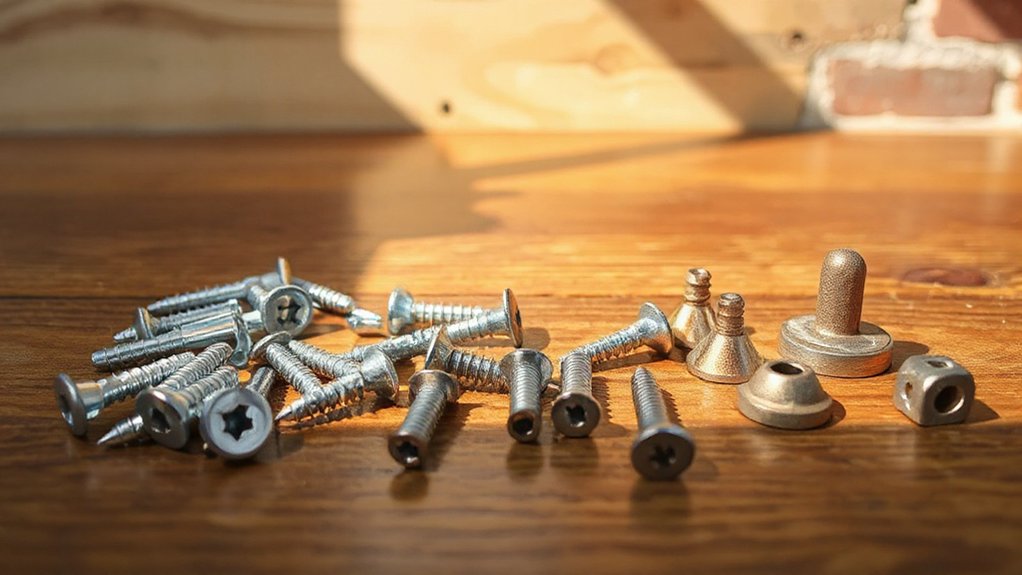
Before you pick a screw or anchor, you’ve got to confirm what you’re fastening into, because wood, drywall, and brick behave very differently under load. Check the surface: wood shows grain and gives a solid bite; drywall sounds hollow and crumbles if overloaded; brick is rigid but can crack or spall at edges.
Do Surface preparation first: remove paint flakes, dust, and loose plaster, and locate studs or masonry joints with a finder or light tap test.
For brick, avoid mortar that’s soft or sandy. Drill a small pilot to verify resistance, and stop if you hit wiring or plumbing.
Keep Tool maintenance tight—sharp bits, straight drivers, and clean chucks reduce slip, heat, and blowouts.
Choose a Fixing System: Screw Alone or Anchor
Although a screw can bite directly into solid material, you’ll get a safer, more reliable hold when you match the fixing system to the base and the load. Use a screw alone only when you’re fastening into sound wood or a stud, and switch to an anchor when you’re in hollow drywall or brittle masonry where threads can strip or crack the surface.
For wood, pre-drill near edges and drive straight to avoid splitting. In drywall, choose a plug, toggle, or metal cavity anchor, and don’t overtighten; stop when the fixture seats firmly.
In masonry, drill to the right diameter and depth, vacuum dust, then set a sleeve or wedge anchor square. These Fixing system advantages reduce rework and failures.
Prioritize Installation safety: locate wires/pipes, wear eye protection, and test the fixing with a controlled pull.
Match Fasteners to Pull-Out vs Shear Loads
When you pick fasteners based on whether the load tries to pull straight out of the wall (pull-out) or slide down/across it (shear), you prevent the most common failures.
For pull-out, choose longer embedment and wider threads, and keep the hole tight so the fixing can grip; don’t rely on a short screw in soft material.
For shear, focus on shank diameter and bearing surface, because the fastener acts like a pin resisting sideways force.
Match fastener material to the environment: stainless or coated steel for damp areas, higher-grade steel for heavy loads.
Use consistent installation techniques: drill square, clear dust, seat the head fully, and tighten to snug—not stripped.
If the load varies, size for both directions and add a safety margin.
Choose Wall Plugs for Solid Walls (Brick, Block)
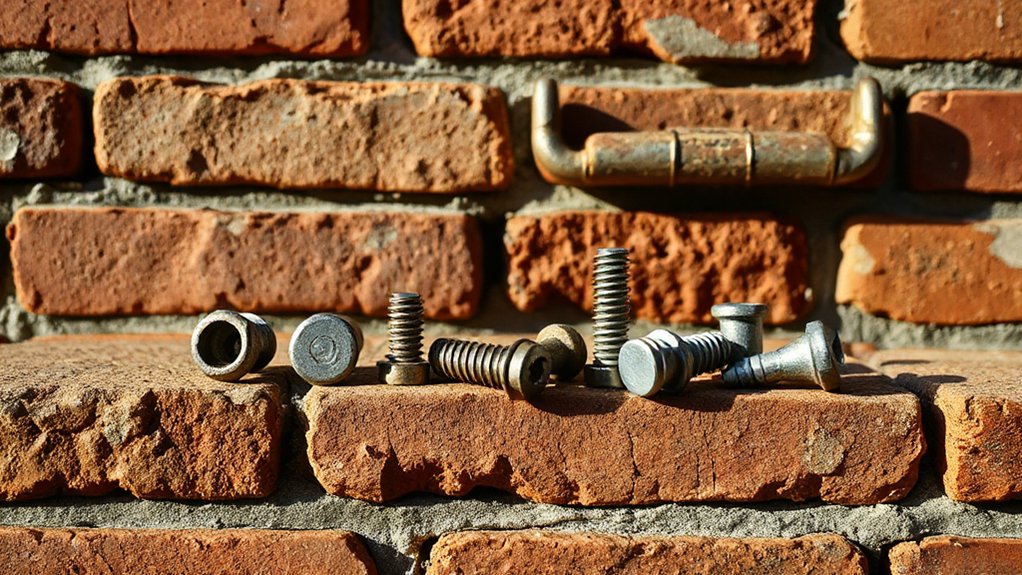
Because brick and block don’t “give” like drywall, you’ll get the safest hold by pairing the right wall plug with the base material and the fixing size.
Choose Wall plug materials to suit the wall: nylon plugs suit most indoor loads, while higher-grade poly or rubber plugs cope better with vibration and damp.
Match plug diameter and length to the screw, and avoid “oversizing” that can split bricks or blow out mortar.
Use clean installation techniques. Drill the correct diameter, keep the bit square, and stop at the plug length.
Brush or blow out dust so the plug can grip.
Tap the plug in flush, then drive the screw steadily to expand it—don’t over-tighten and strip the hole.
Stay clear of edges and joints to reduce cracking.
Choose Masonry Anchors for Brick vs Concrete
How do you choose a masonry anchor that won’t crack brick or spin out in concrete? Start by matching the anchor to the substrate’s strength and voids.
For brick, avoid heavy wedge anchors near edges; they can trigger Brick expansion and split faces. Use sleeve anchors, light-duty hammer-set anchors, or resin/chemical anchors that spread load and improve Masonry adhesion without aggressive wedging.
Drill into the brick’s solid web, not the mortar, and keep edge distances generous.
For concrete, you can use wedge anchors or concrete screws when you need high pull-out strength. Drill to the specified diameter and depth, blow out dust, and torque to the manufacturer’s limit.
Always test-fix one point, then load gradually, and wear eye protection.
Choose Drywall Anchors for Plasterboard Walls
Where do drywall anchors actually hold in plasterboard—paper, gypsum, or the stud behind it? Most anchors grip by spreading load across the back of the board, so you’re relying on gypsum strength plus intact paper.
For light wall decoration, use self-drilling plastic or metal anchors, but stop if you feel spinning or crumbling.
For heavier items, choose toggle bolts or molly anchors that clamp behind the sheet; they resist pull-out better and reduce board damage.
Drill clean holes, keep clear of electrical zones, and don’t overtighten or you’ll crush the core.
If the hole blows out, don’t reuse it—patch it as drywall repair, then re-anchor nearby.
Always test the fix by tugging before hanging.
Pick Screw Length and Diameter (Simple Sizing Rules)
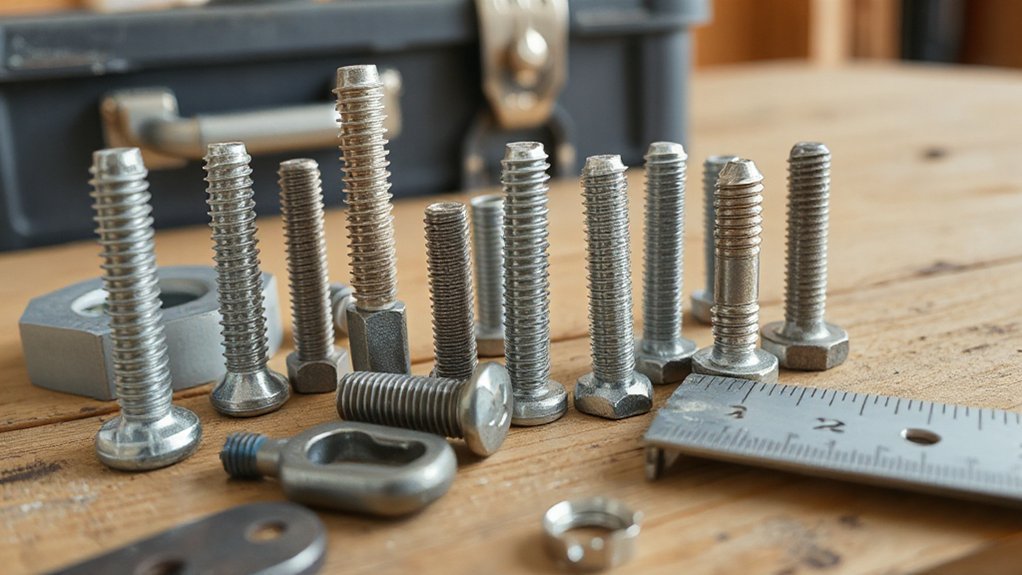
Next, you’ll pick screw length and diameter with a few simple checks that keep the fastening secure. Match the screw length to the materials you’re joining.
Then, choose a diameter that fits the load without splitting or stripping. Make sure you’ve got enough thread engagement in the base material (or anchor) so the screw can actually hold under weight and vibration.
Match Length To Material
Before you drive a screw, match its length and diameter to the materials so it bites deep enough to hold but doesn’t blow out the back or split the workpiece.
Aim for 2/3 of the screw in the base material for wood-to-wood, and full thread engagement in the receiving piece for metal or plastic.
If you’re fastening into studs, pick a length that clears drywall and sinks at least 25–30 mm into solid timber.
For thin sheet, don’t let the tip protrude where it can snag wires or hands; choose a shorter screw or add a washer and nut instead.
Check fastener compatibility with coatings and treated lumber.
Use safe installation techniques: pre-drill near edges, countersink, and stop when the head seats.
Choose Diameter For Load
Length gets you enough bite into the base material, but diameter decides how much weight and twisting force the fastener can handle without snapping, stripping, or pulling out.
For light trims and fixtures, you can usually stick with small gauges, but step up diameter fast for shelves, brackets, and anything that could be bumped or leveraged. When in doubt, choose the next diameter up rather than overtightening a thin screw.
Match diameter to screw material: softer brass or aluminum needs a thicker shank than hardened steel for the same load.
Use proper fastening techniques: pre-drill to reduce splitting, drive straight to avoid side-loading, and stop when the head seats—don’t “muscle” it.
If the joint must resist shear, prioritize diameter over extra length.
Allow Thread Engagement
Even if you’ve nailed the load rating, the joint can still fail if you don’t give the threads enough material to grab. Aim for full Thread engagement in the base material, not just the top piece.
As a simple rule, shoot for at least 1× screw diameter of engagement in steel, 1.5× in aluminum, and 2× or more in wood or plastic.
If you’re using an anchor, match the screw length so the threaded section sits fully inside the anchor’s gripping zone, not bottomed out.
Keep one to two threads proud past a nut for full strength.
Check fastener compatibility: don’t mix metric and imperial threads, and match pitch to tapped holes to prevent stripping.
Choose Screw Head and Drive (Phillips, Torx, Hex)
Next, you’ll choose a screw head that fits the job—flat heads sit flush in countersinks, pan heads spread load on thin materials, and hex heads give strong grip for structural fastening.
Then you’ll compare drive styles: Phillips can cam out, while Torx and hex typically transfer torque better and reduce bit slip.
Match your driver and bit size to the drive, keep it seated square, and you’ll cut stripping and hand injuries.
Head Types And Uses
Because the screw head and drive determine how securely you can tighten—and later remove—a fastener, you should match them to your tool, the material, and the clearance around the work.
Different head types suit different fastening mechanisms: choose flat/countersunk when you need a flush finish in timber or sheet goods, and pre-countersink to prevent splitting.
Use pan, round, or truss heads for sheet metal and plastics where you want a broad bearing surface and less pull-through risk.
Pick hex washer heads for structural timber or exterior fixings when you need strong clamping and easy socket access.
Use button heads where snagging matters, and cap heads where higher clamp loads are required.
Check head clearance to avoid damaging fittings.
Drive Styles Compared
When you match the drive style to your tool and the job’s torque demands, you’ll seat the screw faster, reduce cam-out, and protect both the fastener and your workpiece.
Phillips is common and inexpensive, but it can cam-out under high torque, so keep pressure straight to avoid stripping.
Torx bites deeper and transfers torque efficiently, making it ideal for structural screws and hard materials where you need repeatable, controlled driving.
Hex drives (internal or external) handle higher torque and resist rounding, but they demand clean recesses and aligned pressure to prevent slippage.
Consider Drive styles alongside Screw head types: a robust drive paired with a low-profile head helps prevent wobble, while heavy-duty heads benefit from higher-torque drives.
Replace worn bits to reduce injury risk.
Matching Tool To Drive
Your bit and driver matter just as much as the drive style you pick, so match them before you start sinking screws.
For Phillips, use the exact size (often #1, #2, #3); the wrong tip cams out, chews the head, and can slip into your hand.
For Torx, seat the bit fully and choose the stamped size (T15, T20, T25); Torx rewards straight pressure and resists stripping.
For hex/Allen, use a crisp, unworn key or bit; rounded corners ruin screwdriver compatibility fast.
Keep bits clean, replace worn tips, and use a bit holder that locks securely.
Apply firm, inline force, slow the driver on final turns, and stop if you feel wobble.
That’s Matching tool to drive.
Use Corrosion-Resistant Screws in Wet or Outdoor Areas
Even a small amount of moisture can turn the wrong fastener into a rusted failure point, so choose corrosion-resistant screws for bathrooms, kitchens, basements, decks, fences, and exterior trim. Prioritize stainless steel (304 for most indoor damp areas, 316 for coastal spray) or hot-dip galvanized for treated lumber; avoid mixing metals that can cause galvanic corrosion.
Match the coating to the environment: epoxy-coated deck screws resist weather, while ceramic-coated options boost outdoor durability. Pre-drill near board ends to prevent splits, and drive screws flush so water can’t pool in the head recess.
Use compatible washers or sealant for flashing, and inspect yearly for staining, looseness, or head loss. Better corrosion resistance keeps assemblies safe and tight.
Frequently Asked Questions
Can I Reuse Wall Plugs or Anchors After Removing a Screw?
You can sometimes reuse wall plugs or anchors after removing a screw, but you shouldn’t assume Anchor reusability. Check for stripped plastic, cracks, swelling, or a widened hole; if any appear, replace it.
With Reusable wall plugs, you need a tight fit and clean threads. Tap the plug flush, use the same screw size, and don’t overtighten.
For safety-critical loads, always install new.
How Do I Remove a Stripped Screw Without Damaging the Surface?
About 1 in 5 DIYers strip a screw head, so you’re not alone.
To remove a stripped screw without damaging the surface, start with surface protection: mask around it with painter’s tape and press a wide putty knife under your tool.
For removing damaged screws, seat the correct bit, tap it in, and turn slowly.
If it slips, use a rubber band or screw extractor, eye protection.
Should I Pre-Drill Pilot Holes, and What Size Drill Bit?
Yes—you should pre-drill pilot holes whenever you’re driving screws into hardwood, thin stock, near edges, or into brittle materials.
For pilot hole requirements, match depth to screw length and keep the hole straight.
For drill bit sizing, use a bit equal to the screw’s shank (not threads) in wood; for softwood, go slightly smaller.
Wear eye protection, clamp workpieces, and test on scrap first.
How Do I Prevent Screws From Splitting Timber Near the Edge?
To stop timber splitting near an edge, treat the screw like a wedge: tame it before it bites. Drill a pilot hole and a small clearance hole, then countersink so the head doesn’t force fibers apart.
Keep at least 2–3 screw diameters from the edge, and clamp the work to resist edge cracking.
Use sharp, thinner screws or soap/wax on threads.
Wear eye protection, and drive steadily.
Are There Screw Types Suitable for Fastening Into Metal Studs?
Yes—you can use self-drilling (TEK) screws or fine-thread drywall screws designed for metal stud fasteners.
Check screw compatibility by matching the screw’s point type and thread to the stud gauge: self-tappers for light-gauge, TEKs for thicker steel.
Use the correct driver bit, keep the screw perpendicular, and don’t overtighten to avoid stripping.
Wear eye protection; metal swarf can fly.
Pre-drill if needed for thicker.
Conclusion
Choose screws, fixings, and anchors by starting with what you’re driving into: wood, drywall, brick, block, or concrete. Then decide if a screw alone will hold or if you need an anchor for pull-out resistance. Match the fastener to shear vs tension loads, size the diameter and length to bite deep, and pick a head/drive you can control safely. In wet areas, use corrosion-resistant hardware—like a knight choosing armor.