Table of Contents
Key Takeaways
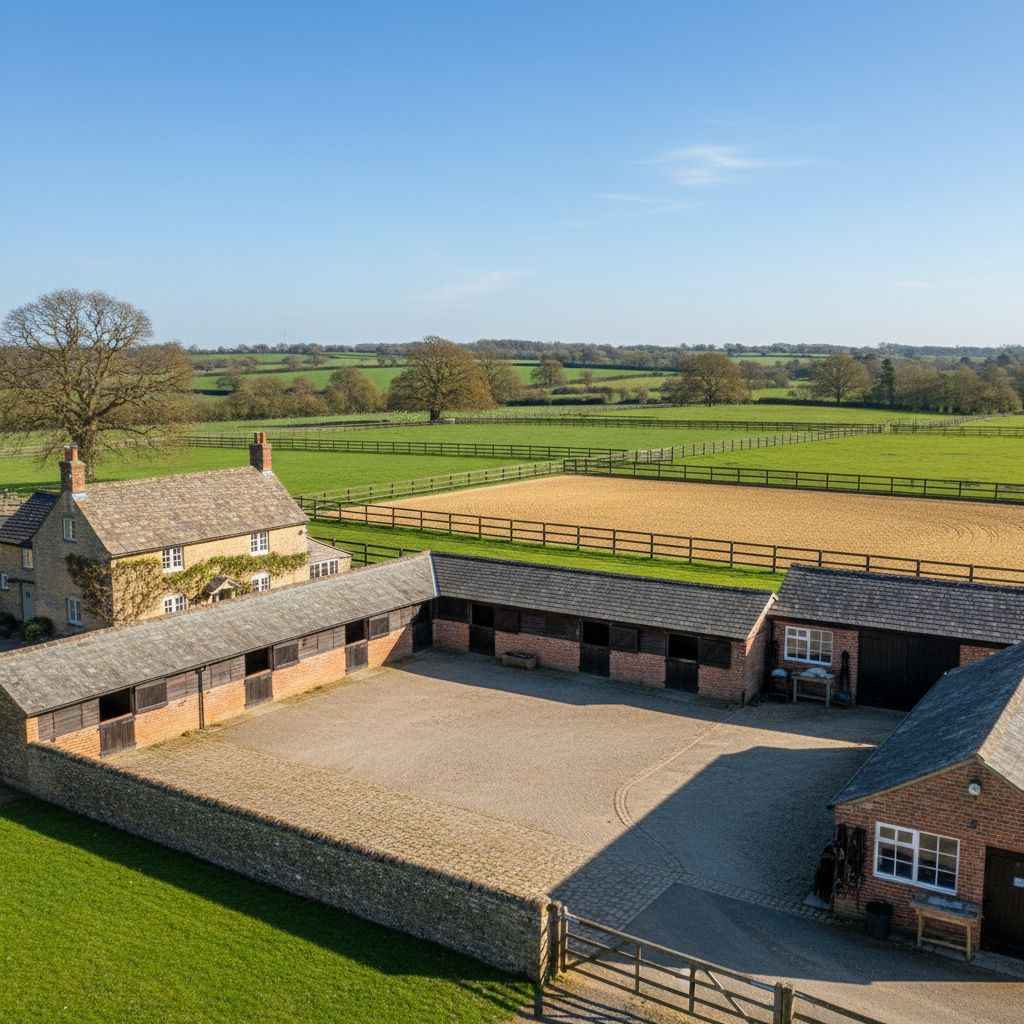
- Equestrian property for sale in the UK covers an enormous range — from a cottage with a couple of paddocks and four loose boxes to international-standard training yards, stud farms, polo establishments, and racing facilities that operate as going commercial concerns.
- The UK is home to approximately one million horses under ownership, generating a substantial and consistent market for equestrian property across all price points and all regions.
- The ten best counties for equestrian buyers are Berkshire, Leicestershire, Surrey, Gloucestershire, Yorkshire, Cheshire, Hampshire, Wiltshire, Shropshire, and Pembrokeshire — each offering a distinct equestrian culture, landscape, and price profile.
- Berkshire’s Lambourn Valley remains the definitive UK address for racing and thoroughbred-focused equestrian property, with the Jockey Club Estates’ gallops representing infrastructure that cannot be replicated elsewhere.
- Planning permission is typically required for new stables, all-weather arenas, and changes of land use for equestrian purposes — buyers should verify the planning position of any equestrian facility at a property before exchange, as operating without consent can create serious enforcement risk.
- Access to off-road hacking — bridleways, byways, restricted byways, and public footpaths permitting horse access — is as important to the practical value of an equestrian property as its internal facilities, and should be assessed through the Definitive Map of Public Rights of Way for the relevant area before committing.
What Makes a County Good for Equestrian Property?
The quality of a county for equestrian buyers is determined by a combination of factors that go well beyond the physical property itself. The landscape and ground conditions — whether the soil drains freely, whether the terrain is suitable for riding, whether the countryside is accessible on horseback — matter as much as the stables and school. The local equestrian infrastructure — vets with equine specialism, farriers, feed merchants, saddlers, competition venues, and the broader community of horse owners — shapes the practical daily reality of keeping horses in an area. And the planning environment — how receptive the local authority is to equestrian development, what restrictions apply in National Landscapes and other designated areas — determines what can be done with a property over time.
Equestrian property for sale is therefore a genuinely specialist market, and buyers who approach it with the same framework they would apply to a conventional residential purchase frequently miss the specific variables that determine whether a property actually works for their horses. This guide covers the ten counties where equestrian buyers have the strongest combination of landscape, infrastructure, property supply, and planning environment to find and successfully manage the right property.
1. Berkshire: The Racing Heartland
Berkshire — and specifically the Lambourn Valley in the western part of the county — is the undisputed centre of British thoroughbred racing property. Upper and Lower Lambourn contain the highest concentration of racing yards in Britain, built around the Jockey Club Estates gallops on the Berkshire Downs — some of the finest training surfaces in the world, maintained specifically for racing use and available to licenced trainers based in the valley.
For buyers seeking an established racing yard or trainer’s house in proximity to world-class gallops, Lambourn is the only answer in England. Properties here range from modest trainer’s houses with four to eight boxes to substantial yard complexes with 20–40 boxes, staff accommodation, covered rides, and all-weather facilities. Prices reflect the infrastructure premium — a well-equipped Lambourn yard with good gallop access can reach £2–5 million and above for the best examples.
Beyond the racing heartland, the wider Berkshire countryside — the North Wessex Downs National Landscape, the Thames Valley, and the Kennet Valley corridor — provides excellent equestrian property for leisure and competition riders. The county has excellent bridleway coverage across the Downs, good ground conditions throughout much of the year, and a well-developed equestrian support infrastructure. Properties with four to eight boxes, a school, and 10–20 acres in this broader Berkshire market range from approximately £900,000 to £2.5 million depending on the residence quality and facility standard.
2. Leicestershire: Prime Hunting Country
Leicestershire occupies a unique position in the British equestrian world — it is the historic heart of English foxhunting, and the landscape of the Vale of Belvoir, the Wreak Valley, and the Quorn and Cottesmore countries remains among the finest and most coveted riding country in Britain. The combination of a predominantly grass-based landscape (Leicestershire’s heavy clay over limestone holds its cover well through winter), a dense network of hunting countries with long histories, and a community of serious equestrian buyers creates a property market of specific and sustained character.
Buyers purchasing equestrian property in Leicestershire are typically doing so for one of two reasons: access to the hunting field, or proximity to the Midlands’ competition infrastructure. Both are well served — the county has multiple hunt countries with active programs, and the national competition venues at various Midlands locations are within practical range.
Properties in the prime Leicestershire hunting country — around Market Harborough, Melton Mowbray, and the villages of the Belvoir and Cottesmore countries — typically include period farmhouses or substantial country houses with traditional stable yards, four to twelve boxes, outdoor schools, and 15–40 acres of grazing land. Prices range from approximately £800,000 for a more modest setup to £4.5 million and above for the most impressive properties with comprehensive facilities and the best hunting country access. The British Horse Society’s Ridden Routes data is useful for understanding bridleway connectivity in specific Leicestershire locations.
3. Surrey: Accessible Equestrian Living Within Reach of London
Surrey’s equestrian property market serves a specific and substantial buyer pool — the London-connected horse owner who needs proximity to the capital for work while maintaining the equestrian lifestyle that a rural property enables. The combination of the Surrey Hills National Landscape — providing dramatic riding country on the North Downs — with the county’s excellent road and rail infrastructure makes it one of the most intensely competed equestrian property markets in England.
Surrey has an extensive network of bridleways, byways, and restricted byways across the North Downs, making off-road hacking from properties in the right locations genuinely excellent. The Surrey Hills specifically — the Greensand Ridge and the chalk Downs — offer some of the best woodland and downland riding in southern England, and equestrian properties with direct bridleway access from the gate are particularly sought after and priced accordingly.
Properties with equestrian facilities in Surrey range from cottages on 3–5 acres with four to six boxes and an outdoor school at £900,000–£1.5 million, through to substantial country houses with 15–30 acres and comprehensive yard facilities above £2.5 million. The National Landscape designation across much of the prime equestrian country carries planning implications — any expansion of equestrian facilities, including new stabling and arenas, requires planning permission, and the Surrey Hills National Landscape planning guidance should be reviewed before purchasing any property where facility development is intended.
4. Gloucestershire: The Cotswolds Equestrian Market
Gloucestershire’s equestrian property market is framed by two very different equestrian cultures. To the north and east, the Cotswolds — with its limestone landscape, grass hunt countries, and the prestigious social calendar centred on the Cheltenham Festival — creates a demand for substantial equestrian country houses and hunting boxes that has few equivalents in England. To the south and west, the Forest of Dean and the Severn Vale provide a more accessible, less expensive equestrian market for buyers focused on leisure riding rather than the prestige addresses.
The Beaufort Hunt country — arguably the most famous hunt country in England, based at Badminton and covering an enormous sweep of south Gloucestershire and Wiltshire — is the defining context for equestrian property in the county’s premium market. Farmhouses and country houses in this territory with established yard facilities are competed for by serious equestrian buyers with the resources to match their ambitions. Properties of genuine substance in Beaufort country — five to eight bedrooms, 15–40 acres, eight to twelve boxes, covered or outdoor school — typically trade from £1.5 million to £4 million.
The county also benefits from the proximity of Badminton Horse Trials — the world’s most prestigious three-day event — and the Cheltenham Festival, creating a strong wider equestrian community and good equine support infrastructure across the county.
5. Yorkshire: Value and Variety
Yorkshire’s equestrian property market offers the broadest range of price points and facility types of any county in England — a function of its sheer size and geographic diversity. From the limestone hunting country of the Vale of York to the moorland riding of the North York Moors, the Dales bridleway network, and the Yorkshire Wolds, the county provides equestrian buyers with almost every landscape type and riding character.
The racing industry — centred on Malton and the flat racing training grounds around the Vale of Pickering — provides a specific infrastructure for racing buyers. Malton is the second largest horse racing training centre in Britain after Newmarket, with gallops, veterinary facilities, and an established yard infrastructure that makes it a genuine alternative to the southern racing heartland for buyers at that level.
For leisure and hunting buyers, the Middleton, York and Ainsty, Bramham Moor, and other Yorkshire hunt countries provide access to varied and beautiful riding country. Properties with four to eight boxes, an outdoor school, and 10–20 acres in competitive Yorkshire locations range from approximately £600,000–£1.5 million — substantially more affordable than Surrey or Gloucestershire equivalents at the same facility level.
6. Cheshire: The North West Equestrian Hub
Cheshire’s equestrian property market is sustained by the wealth of the Manchester and Liverpool professional base seeking rural property with horse facilities within practical daily reach of two major cities. The county’s relatively flat, grassland landscape — predominantly heavy clay over sandstone, which holds its cover but can be wet in winter — supports a good-quality horse-keeping environment, and the local equine infrastructure is well-developed.
The Cheshire countryside around Knutsford, Macclesfield, Prestbury, and the villages of the Cheshire Plain contains a high concentration of equestrian properties, ranging from barn conversions with modest paddocks to substantial farmhouses with full yard facilities. The Cheshire Forest Hunt country provides a hunting tradition; show jumping and dressage competition is well-served by the regional venues accessible from Cheshire.
Equestrian properties in the prime Cheshire locations — Prestbury, Macclesfield, and the villages around Knutsford — carry a premium that reflects proximity to Manchester and the affluent professional base it generates. A well-equipped property with five to eight boxes, school, and 10–15 acres typically ranges from £900,000 to £2 million in these locations. The more rural western and southern parts of the county offer similar facility profiles at somewhat more accessible price points.
7. Hampshire: Varied Landscape, Excellent Infrastructure
Hampshire’s equestrian property market draws from one of the strongest concentrations of equestrian activity in southern England. The New Forest — England’s newest National Park — provides a completely unique riding environment where common land riding and ponies grazing freely remain defining features of the landscape. The chalk Downs of north Hampshire, the Meon Valley, and the Test Valley all provide excellent riding country with good bridleway networks.
The county has comprehensive equine infrastructure — veterinary practices with equine specialism, established farriers, feed merchants, and a dense network of competition venues including polo at Cowdray Park (just over the border into West Sussex) and three-day eventing at various Hampshire venues. The proximity to Newbury and the racing world of the Berkshire Downs adds a further dimension for racing-focused buyers.
Properties in the New Forest National Park carry specific planning considerations — the New Forest National Park Authority governs development within the Park boundary, and extensions to equestrian facilities require specific assessment against the Park’s planning policies. Outside the Park, Hampshire properties with four to eight boxes, school, and 10–20 acres range from approximately £800,000 to £2.5 million depending on the quality of the residence and location.
8. Wiltshire: Gallops, Hunting, and the Chalk Downs
Wiltshire sits at the intersection of three of England’s most significant equestrian traditions — racing (Lambourn is on the county boundary and the Wiltshire Downs carry gallop infrastructure), hunting (the Beaufort and the Vale of White Horse hunt countries both cover significant Wiltshire territory), and three-day eventing (Badminton is on the Gloucestershire-Wiltshire border). The result is a county with extraordinary equestrian depth and a property market that reflects it.
The chalk and limestone landscape of the Marlborough Downs and Salisbury Plain provides free-draining, firm going throughout much of the year — ideal for keeping horses in work through winter months without the mud-management challenges that clay-based counties present. The North Wessex Downs National Landscape covers much of the northern part of the county and provides planning context for properties in this area.
Properties with comprehensive equestrian facilities in the prime Wiltshire areas — around Marlborough, Pewsey, and the Vale of Pewsey — range from £800,000 for modest setups with four boxes and 10 acres through to £3 million and above for the most established yards in prime locations. Access to the Lambourn gallops from the Wiltshire side of the county boundary adds specific value for racing-focused buyers.
9. Shropshire: Value and Space in the Welsh Marches
Shropshire is one of the most consistently undervalued equestrian counties in England — a fact that is increasingly recognised by buyers priced out of Surrey, Gloucestershire, or the Home Counties who are prepared to embrace a more genuinely rural location. The county’s varied landscape — the Long Mynd, the Clun Forest, the Shropshire Hills National Landscape, and the pastoral Severn and Teme valleys — provides a rich and varied riding environment, and the bridleway network across the Shropshire Hills is extensive and largely free of traffic.
Properties with equestrian facilities in Shropshire consistently offer more for the budget than the fashionable southern counties. A farmhouse with six to eight boxes, an outdoor school, and 15–25 acres in a good Shropshire location can be found from £600,000–£1.2 million — a price point that buys considerably less in Surrey or Gloucestershire for the same facility profile. The Welsh border country of the Marches adds a further dimension, with properties on the Powys border combining Shropshire prices with access to the extraordinary open hill riding of mid-Wales.
The Shropshire Hills National Landscape carries planning implications for properties within its boundary — equestrian development including new stabling and arena construction requires planning permission, and the Landscape’s planning policies are specifically relevant to any buyer intending to develop facilities post-purchase.
10. Pembrokeshire: Wales’s Finest Equestrian County
Pembrokeshire offers an equestrian proposition that is genuinely unique in Britain — the combination of the Pembrokeshire Coast National Park‘s spectacular coastline riding, the open moorland of the Preseli Hills, and an extensive network of bridleways and green lanes that provide some of the most varied off-road riding in the UK, at prices substantially below English equivalents.
The county is less well-known in the equestrian property market than its English counterparts, which contributes to the value it offers. A farmhouse with four to six boxes, an outdoor school, and 10–20 acres of grazing in a good Pembrokeshire location can often be found from £450,000–£850,000 — a price that would not approach equivalent facility levels in Surrey or Gloucestershire. The landscape riding is extraordinary: coastal paths accessible on horseback, green lane networks through ancient farming country, and the open Preseli Hills providing moorland riding above 500 metres.
Planning within the National Park — covering the coastline and much of the coastal hinterland — is governed by the Pembrokeshire Coast National Park Authority. Properties outside the Park boundary operate under Pembrokeshire County Council planning policy, with Planning Policy Wales providing the governing framework for all Welsh equestrian planning decisions.

What Every Equestrian Property Buyer Must Assess
Planning Permission for Equestrian Facilities
One of the most important — and most frequently overlooked — aspects of buying equestrian property is confirming that the equestrian facilities at the property have the appropriate planning consents. Stables, all-weather arenas (menage or ménage), horse walkers, covered rides, and changes of use of agricultural land to equestrian use all typically require planning permission from the local authority.
Planning permission is required in most cases for stables, riding arenas and changes of land use for equestrian purposes, with the specific requirements depending on the scale, location and local authority policies. Facilities built or converted without the required consent can be subject to enforcement action — which the buyer inherits on completion. Your solicitor should confirm through the local authority search whether all equestrian structures and land uses at the property have the necessary permissions, and should obtain copies of the relevant consents as part of the conveyancing process.
The Town and Country Planning Act 1990 and the Town and Country Planning (General Permitted Development) (England) Order 2015 provide the legal framework for understanding what requires consent in England. In Wales, Planning Policy Wales governs the equivalent position.
Bridleway Access and Off-Road Riding
The practical riding value of an equestrian property depends heavily on its connectivity to the bridleway network. A property with excellent internal facilities but no off-road riding access is fundamentally limited — the costs and stresses of hacking on roads, and the management challenges of exercising horses in a school or paddock alone, cannot substitute for genuine countryside access.
The Definitive Map of Public Rights of Way for the relevant local authority shows the full network of public rights of way accessible from any property. Bridleways (where horse access is permitted) and byways open to all traffic are the relevant categories. The British Horse Society’s Access team campaigns for and maps horse-accessible routes across Britain, and their Ridden Routes database is a valuable tool for assessing actual off-road riding access from a specific location.
Land Quality and Horse-Keeping Conditions
The quality of grazing land matters for horse welfare and management, and it varies significantly by county and soil type. Free-draining chalk and limestone soils — as found in Berkshire, Wiltshire, and parts of Gloucestershire — provide better year-round going and less mud-management challenge than clay-based soils. Heavy clay soils, common in Leicestershire and Cheshire, hold moisture and can make winter grazing management intensive. Assess the drainage of any paddocks at a viewing — ideally visiting in winter or after a period of rain — and factor in the cost of any required drainage improvement as part of your acquisition assessment.
The British Horse Society’s guidance on land management provides detailed advice on grassland requirements for horses, including the broadly observed standard of approximately one to two acres of grazing per horse depending on quality and management.
Survey and Legal Due Diligence
Equestrian properties require survey attention beyond the standard residential inspection. Specific areas requiring assessment include: the structural condition of all stable buildings, including foundations, roofing, drainage, and ventilation; the surface condition and sub-base of any all-weather arena or outdoor school; the condition of perimeter fencing and field gates; the drainage of paddocks and the condition of water supply infrastructure; and the condition of any manure management facilities.
Your solicitor should, in addition to standard residential searches, investigate: the planning history of all equestrian structures; any agricultural occupancy conditions (AOCs) attached to the property, which can restrict who may legally occupy it; any common land or grazing rights; the position of any public rights of way crossing paddocks or land; and any covenants or restrictions that might limit equestrian use. Agricultural occupancy conditions — found on some equestrian and rural properties — restrict occupation to those employed or last employed in agriculture or equestrian activities, and can significantly affect both the value and the pool of potential buyers at resale.
Where to Search for Equestrian Property
The major portals — Rightmove, Zoopla, and OnTheMarket — all allow filtering for equestrian properties. UK Land and Farms is a specialist rural and equestrian property portal covering the whole of the UK and is worth using alongside the mainstream platforms. Horsemart provides equestrian-specific listings and editorial. Rural property specialists — including H&H Land & Estates, Strutt & Parker, Carter Jonas, and Savills Rural — carry equestrian property that does not always appear on mainstream portals, and registering with their rural teams in your target county is a productive approach.
Sold price data from the UK House Price Index provides comparable evidence for equestrian transactions, though the wide variation in facility types means comparables should be used carefully — two properties in the same postcode can have dramatically different values depending on the scale and quality of their equestrian infrastructure.
Frequently Asked Questions
What is the best county in the UK for equestrian property?
The answer depends on the type of equestrian activity you are pursuing. For racing and thoroughbred breeding, Berkshire’s Lambourn Valley has no equal. For hunting, Leicestershire’s prime hunting country is the most coveted in England. For accessible lifestyle riding within reach of London, Surrey is the natural choice. For value combined with quality landscape and riding, Shropshire and Pembrokeshire offer the most compelling propositions. For the full Cotswolds equestrian lifestyle, Gloucestershire delivers the most complete combination of landscape, infrastructure, and social scene.
Do I need planning permission to build a stable on equestrian property?
In most cases, yes. While agricultural buildings below certain size thresholds can sometimes benefit from permitted development rights under the Town and Country Planning (General Permitted Development) (England) Order 2015, equestrian stables are frequently treated as needing full planning permission — particularly where the land is not in agricultural use and where the stables exceed modest dimensions. The planning position depends on the specific property, its classification, its location, and the local authority’s approach. Always verify with the relevant local planning authority before assuming that stable construction is permitted development, and always ensure that existing stabling at any property you are purchasing has the required consents before exchange.
What is an agricultural occupancy condition and how does it affect equestrian property?
An agricultural occupancy condition (AOC) is a planning condition attached to some rural properties — including certain equestrian homes — that restricts occupation of the property to people employed or last employed in local agriculture, forestry, or equestrian activities. These conditions were historically applied to justify allowing residential development in otherwise-unsustainable rural locations. A property with an AOC cannot legally be occupied by someone who does not meet the condition’s requirements — which significantly restricts the buyer pool, typically reduces the market value by 15–30% compared to an unconditioned equivalent, and can affect mortgageability. Your solicitor should identify any AOC through the local authority search and advise on whether it applies to your circumstances before exchange.
How much land do I need for equestrian property?
The broadly accepted standard is approximately one to two acres of grazing per horse, depending on land quality, soil type, and the intensity of grazing management. In practice, equestrian buyers should consider not just the grazing requirement but also the land needed for yard infrastructure, schooling facilities, and buffer areas around the perimeter. A property with four horses would typically want a minimum of six to eight acres of grassland — more on heavier, wetter land or where horses are kept out year-round. The British Horse Society’s guidance provides detailed land management advice as a reference point.
What finance is available for equestrian property?
Mainstream residential mortgages are available for equestrian properties that include a main dwelling house and modest equestrian facilities — typically up to four to six boxes, basic schooling facilities, and a modest land holding. Larger or more commercially focused equestrian properties — livery yards, riding schools, racing yards, stud farms — are generally financed through specialist agricultural or rural lenders rather than mainstream residential mortgage products. Banks with specific agricultural lending arms — including NatWest, Lloyds, Barclays, and specialist rural lenders — offer products tailored to these requirements. An independent mortgage broker with rural lending experience is the most efficient route to identifying the right product for any specific equestrian property purchase.
Conclusion
Finding equestrian property for sale in the right county requires a clear understanding of what type of equestrian property you need — because the differences between a racing yard in Lambourn, a hunting box in Leicestershire, a leisure property with Surrey Hills hacking, and a remote Pembrokeshire farmhouse with Preseli Hills access are as significant as any other variable in the buying decision.
The ten counties covered in this guide represent the full breadth of what the UK equestrian property market offers — from the world-class racing infrastructure of Berkshire to the extraordinary value of Shropshire and the coastal riding of Pembrokeshire. Across all of them, the due diligence requirements specific to equestrian property — planning confirmation, bridleway assessment, land quality inspection, and agricultural occupancy condition investigation — are non-negotiable steps that protect buyers from acquiring what looks like the perfect equestrian property but conceals material problems that only emerge post-completion.
For a broader view of how the UK property investment market is performing and where rural and equestrian property sits within the national picture, the guide on how UK property investors are thriving in a changing market provides useful context alongside this specialist focus.