Table of Contents
Key Takeaways
- Cotswolds Bourton on the Water property prices average approximately £515,000–£606,000 depending on the data source and sample period — with the GL54 2 postcode delivering 16.6% five-year price growth and 2.93% in the most recent twelve months, outperforming the broader Cotswold district average of just 0.9% annual change.
- The broader Cotswold local authority — the highest-priced district in the South West — averages £410,000 in February 2026 according to the ONS, with private rents rising 9.1% year-on-year to an average of £1,263 per month — the highest rental growth rate in the district and well above the South West average of 5.1%.
- The village market divides clearly between the most accessible end — terraced and semi-detached homes on the residential estates at £325,000–£450,000 — and the premium stone cottage and detached house market at £550,000–£800,000 and above for well-presented examples with character and gardens.
- Bourton on the Water is one of England’s most visited villages, attracting over a million tourists annually, which creates a significant short-term holiday let market and has contributed to a second home and investment buyer profile that competes directly with primary purchasers for the most desirable stock.
- New build activity is present — Grove Court on Station Road offered a modern four-bedroom home at £695,000 in January 2026 — but the most competed-for properties remain the original Cotswold stone cottages and detached houses in the village’s conservation area streets.
- The village’s GL54 postcode sits within the Cotswolds National Landscape, whose planning policies constrain new development and protect the limestone building character that gives Bourton its visual identity — and that fundamentally underpins the long-term scarcity of quality stock.
Why Bourton on the Water Attracts Property Buyers
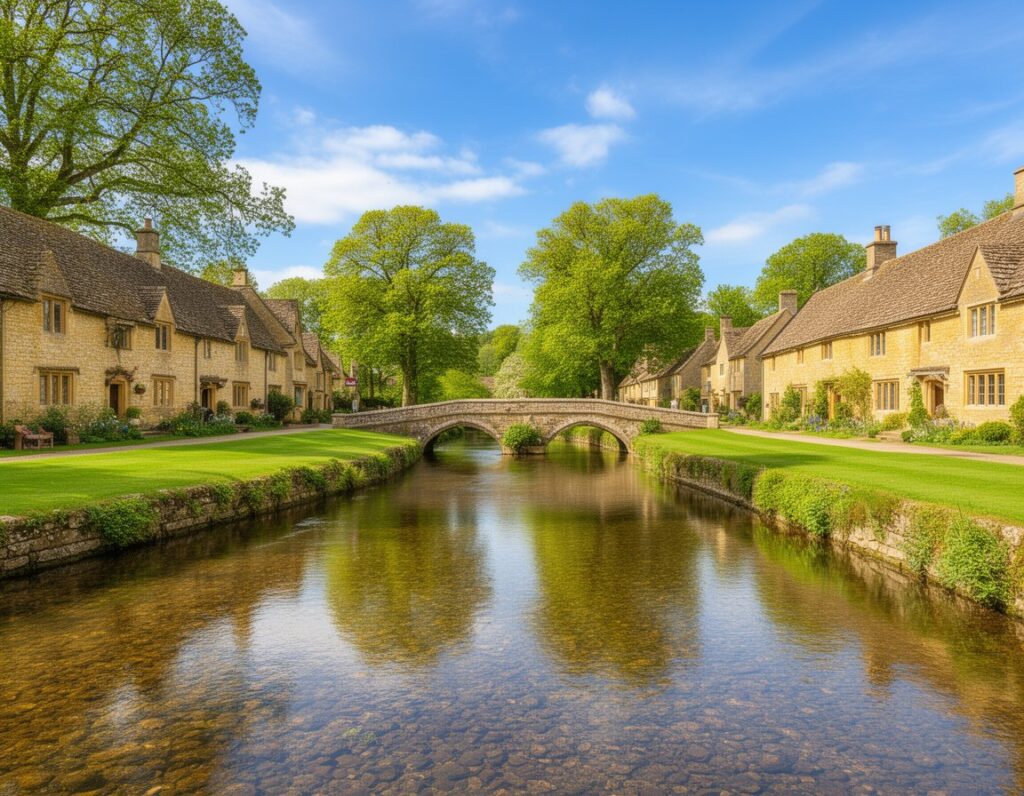
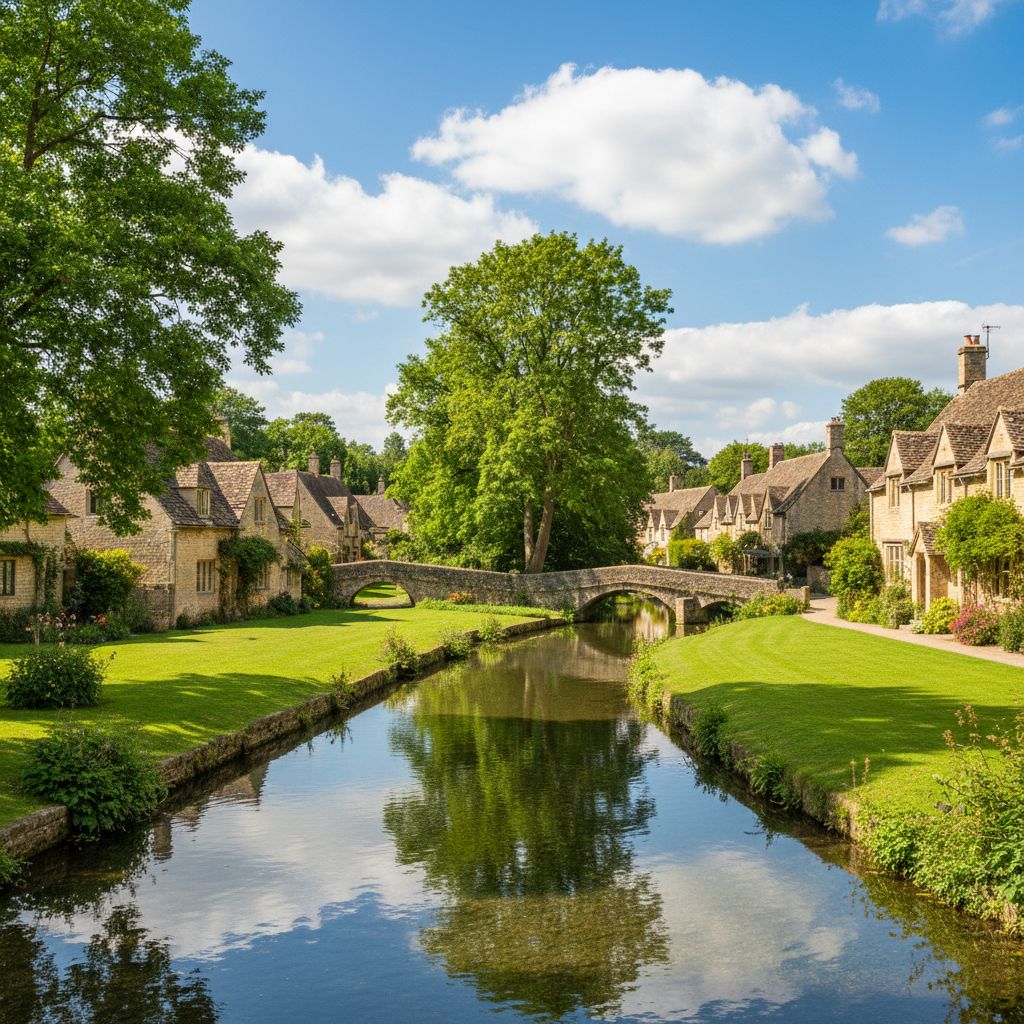
Bourton on the Water is one of England’s most recognisable villages — the shallow River Windrush running along its broad High Street, crossed by a series of low stone bridges, gives it a character so immediately picturesque that it has been called the Venice of the Cotswolds for longer than anyone can reliably verify. It sits in the heart of the Gloucestershire Cotswolds, roughly equidistant between Cheltenham (18 miles) and Oxford (30 miles), and surrounded by the limestone plateau landscape of the Cotswolds National Landscape.
For buyers, that combination — village character of rare distinctiveness, access to two significant employment and cultural centres, and the Cotswolds’ planning-protected scarcity of quality residential stock — creates a property market that has consistently held value and attracted both lifestyle relocators and second home buyers. The ONS data for the broader Cotswold district confirms its position as the highest-priced local authority in the South West, and Bourton’s own price performance — 16.6% over five years against a district average that has been broadly flat — reflects the specific appeal of the village’s position.
Understanding what drives prices in Bourton on the Water, what the market currently looks like at different price points, and what buyers should know before committing is what this guide provides.
The Property Market in Numbers
The average sold price for a property in Bourton on the Water across the past twelve months ranges from approximately £483,000 (Zoopla Land Registry data) to £515,000 (Rightmove) to £606,000 (Property Solvers/Land Registry). The variation reflects different sample periods, inclusion of different property types, and the small total transaction volume in any twelve-month period — Bourton is a village of around 3,500 residents with a property market that turns over only 47–50 residential transactions per year. A handful of high-value transactions can materially shift the average in either direction.
The most reliable context for any specific purchase is the UK House Price Index from HM Land Registry applied to the GL54 2 postcode — which provides the objective comparable evidence for what properties in Bourton and the immediate area have actually sold for in recent months.
The broader Cotswold district average of £410,000 in February 2026 — stable year-on-year — is sourced from the ONS Local Housing Data for Cotswold, which also records the most significant market trend of the moment: private rents rising 9.1% year-on-year to £1,263 per month, the highest growth rate in the Cotswold district and substantially above the South West average of 5.1%. This rental growth reflects both the structural shortage of available rental stock across the Cotswolds and the continued demand from professional households who cannot yet afford to buy in one of England’s most expensive rural districts.
The most common price bracket for sales in Bourton on the Water has been £392,000–£494,000, followed closely by the £290,000–£392,000 range — which gives a practical sense of where the transactional heart of the market sits, even if the headline averages are pulled upward by the less frequent but higher-value stone house transactions.
What Different Budgets Buy in Bourton on the Water
£290,000–£400,000: The Accessible Entry Level
At the lower end of the Bourton market, buyers typically find semi-detached and terraced houses on the residential estates that developed to the west and north of the village centre in the post-war decades — Beddome Way, Roman Way, Rye Close, and the surrounding streets. These are practical family homes of conventional construction, typically three bedrooms, with gardens and parking, at prices that represent Bourton’s most accessible entry point.
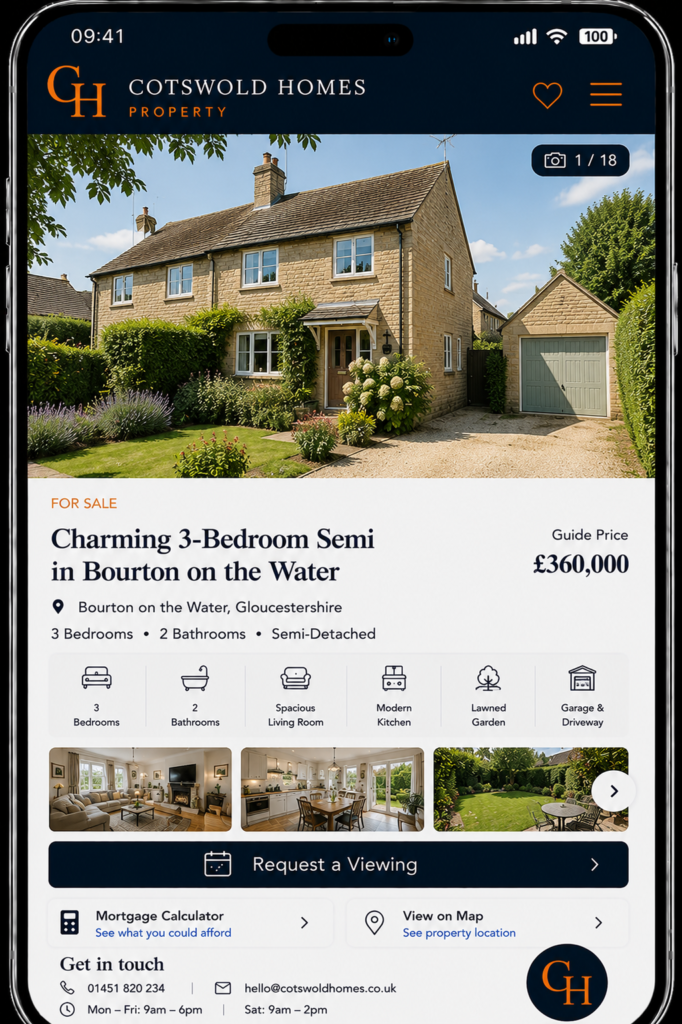
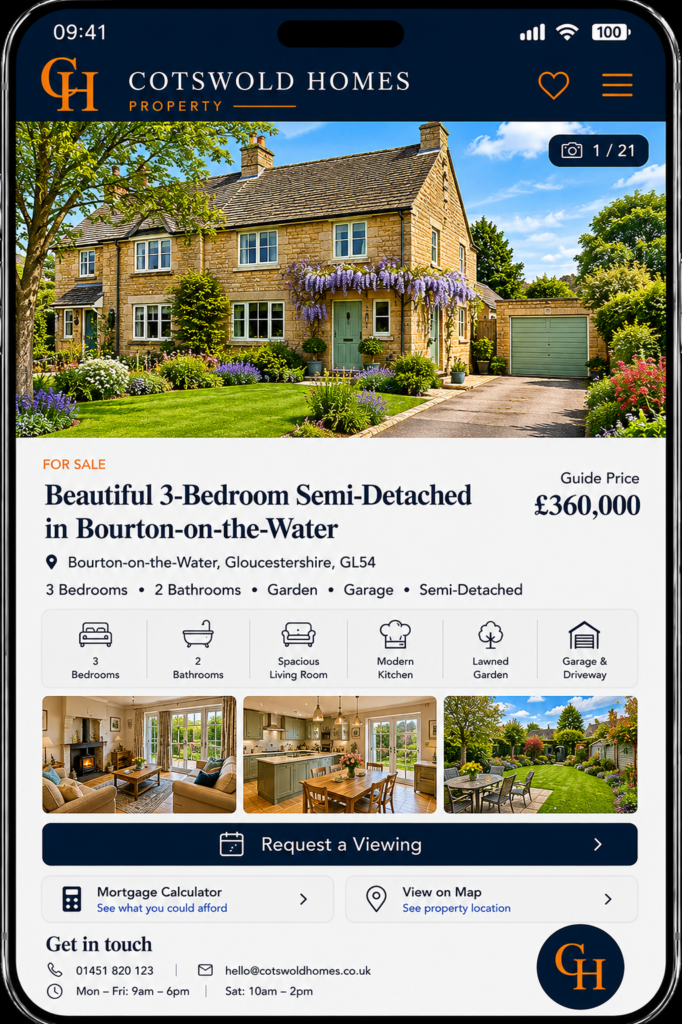
Recent examples include a three-bedroom semi-detached on Beddome Way at £360,000, a two-bedroom on Roman Way at £350,000 with no onward chain, and a three-bedroom terrace on Rye Close at £325,000 with a large garden — each offering genuine Cotswold village living at prices that are meaningfully below the headline average. For first-time buyers in the Cotswolds context, these streets represent a realistic route into the GL54 postcode that is not available in the more glamorous but uniformly expensive villages of Bourton’s immediate neighbours.
£400,000–£600,000: The Mid-Market Family Home
The bulk of Bourton’s mid-market is occupied by modern detached and semi-detached family homes — typically from the 1980s to 2010s era — on the established residential streets around the village perimeter. Three and four-bedroom detached homes with good gardens and double garages sit comfortably in this bracket.
Recent listings in this range include a modern three-bedroom detached on Heron Close at £430,000 (built 2017), a three-bedroom detached on Bibury Corner at £450,000, and a two-bedroom cottage retreat at Park Farm priced at £450,000. A four-bedroom detached on Mallard Crescent in the popular Bourton Chase development was listed at £600,000. For buyers seeking the practical family home with a good garden and garage in a well-regarded village school catchment, this price band delivers the widest choice in Bourton’s market.
£600,000–£900,000: The Cotswold Stone Premium
This is where Bourton’s most characterful and competed-for stock sits — the original limestone cottages, period stone houses, and converted properties that define what most buyers picture when they think of a Cotswold village home. Three-bedroom stone properties in good condition and well-positioned relative to the village centre and the Windrush start from around £600,000 and extend to £750,000–£800,000 for the finest examples with good gardens, parking, and period features intact.
A three-bedroom stone property on Moore Road — described as immaculate and in a desirable location — was listed at £725,000 in December 2025. A Cotswold stone cottage on Victoria Square — previously run as a successful holiday let with an attached studio unit — offered a different investment dimension at above £600,000.
These properties are the most sought-after in the village and the most competed-for when they come to market well-priced. Properties take an average of 64 days to sell in Bourton on the Water, and the average gap between asking and achieved price is approximately -3% (£14,686 below asking) — suggesting that realistic pricing results in relatively smooth transactions, while ambitious asking prices face more sustained negotiation.
Above £900,000: The Exceptional End
At the top of the Bourton market, substantial stone houses with significant acreage, exceptional gardens, or rare architectural distinction occasionally come to market at prices above £900,000 and into seven figures. These are genuinely rare events in a village of this size and attract buyers who have often been searching the area for months or years.
New build at this level is also present — Grove Court on Station Road, a new-build development offering modern four-bedroom homes across three floors at £695,000, represents a contemporary alternative to the period stone market for buyers who want the Bourton postcode without the maintenance requirements of an older property.
The Holiday Let Dimension
Bourton on the Water’s position as one of England’s most visited villages — attracting well over a million visitors annually — creates a significant short-term holiday let market that has a direct impact on the residential property landscape. A meaningful proportion of the village’s most characterful stone properties are operated as holiday lets rather than permanent residences, and this competes with the supply available to primary buyers.
For investors, Bourton represents a credible holiday let proposition — the consistent visitor traffic creates year-round demand rather than purely seasonal occupancy, and the village’s specific character supports strong nightly rates for well-presented stone cottages and characterful properties. The Cotswold Council’s council tax premium on second homes — applicable from April 2025 — adds to the annual holding cost for properties not qualifying for business rates through active holiday letting. As with all Cotswold holiday let investment, professional advice on the specific business rates versus council tax position is essential before purchasing.
Planning, Conservation, and What Buyers Need to Know
Bourton on the Water sits within the Cotswolds National Landscape, the largest National Landscape designation in England and Wales. Planning policy here is managed by Cotswold Council but within the framework of the National Landscape designation, which specifically protects the character of the limestone building tradition, the village streetscapes, and the open agricultural setting of the settlements.
New development within the village boundary is constrained by both the National Landscape designation and the village’s Conservation Area status. Extensions and alterations to properties in the conservation area require planning consent for works that might be permitted development elsewhere — including changes to roofing materials, replacement windows, and alterations to the external character of the building. For any listed building in the village (and there are a number, given the age and significance of the Cotswold stone stock), listed building consent is required for all works affecting character.
Buyers planning any alterations should seek pre-application advice from Cotswold Council before purchasing, and should not assume that works acceptable elsewhere would be permissible in a Cotswold conservation area.
Getting to Bourton on the Water
Bourton is a road-access village — there is no mainline rail station in the village itself, and the nearest stations are Moreton-in-Marsh (approximately 9 miles, on the Cotswold Line to Oxford and London Paddington) and Cheltenham Spa (approximately 18 miles, with services to London Paddington). By road, Cheltenham is around 25 minutes; Oxford around 45 minutes; Birmingham around an hour; and London (via the A40 and M40) approximately 2 hours in normal conditions.
For buyers with regular London or Birmingham travel requirements, the road-dependent access is one of the practical trade-offs of Bourton’s Cotswold location — it is a genuinely rural village, and the daily commute to a major city from here requires either extensive driving or a drive-to-rail combination. The normalisation of hybrid and remote working has materially changed the arithmetic here for many buyers, and the village’s permanent resident base has been augmented in recent years by a generation of buyers for whom the commute is no longer a daily reality.
Frequently Asked Questions
What is the average house price in Bourton on the Water?
Average sold prices across different data sources and sample periods range from approximately £483,000 (Zoopla) to £606,000 (Property Solvers), with Rightmove’s Land Registry data giving approximately £515,000 over the past year. The variation reflects the small transaction volume — around 47–50 sales per year — and the sensitivity of any average to a handful of high or low value transactions. For any specific purchase, checking the UK House Price Index for the GL54 2 postcode provides the most reliable comparable evidence.
Is Bourton on the Water property a good investment?
Bourton on the Water’s property market has delivered 16.6% price growth over the past five years in the GL54 2 postcode — solid performance relative to the broader Cotswold district which has been broadly flat in the past twelve months. The structural case for long-term value is strong: National Landscape planning constraints prevent new development at scale, the village’s tourism appeal creates sustained holiday let demand, and the quality of the limestone building tradition is irreplaceable.
For primary buyers, the combination of location, character, and natural scarcity of quality stock supports long-term value; for holiday let investors, the year-round visitor traffic provides a credible income basis. Both propositions require careful due diligence on the specific property and the relevant tax and planning position.
Can I run a holiday let in Bourton on the Water?
Short-term holiday letting is legal and well-established in Bourton on the Water for unfettered properties without occupancy restrictions. The village’s visitor appeal makes it one of the more commercially viable holiday let locations in the Cotswolds. However, Cotswold Council’s second home council tax premium — introduced from April 2025 — applies to properties not meeting the business rates qualifying threshold (available for letting 140+ days, actually let 70+ days per year). Buyers specifically purchasing for holiday let should verify the current council tax and business rates position with Cotswold Council before committing.
What are the best streets to buy in Bourton on the Water?
For the highest village character, the streets around the village centre and the Windrush — Victoria Square, Moore Road, and the lanes immediately surrounding the High Street — contain the most historically significant and characterful stone properties. For practical family living with good gardens and parking at more accessible prices, the Bourton Chase, Heron Close, and Mallard Crescent developments on the village perimeter offer modern detached homes. For the most affordable entry to the GL54 postcode, the residential streets of Beddome Way, Roman Way, and Rye Close provide the widest choice below £400,000.
How does Bourton on the Water compare to other Cotswold villages for price?
Bourton on the Water sits in the mid-range of the Cotswold village property market. It is more affordable than Bourton’s neighbours in the premium Cotswold villages — the Slaughters (Upper and Lower), Bibury, and Burford all command higher average prices for equivalent property. It is above the Cotswold district average of £410,000, reflecting both its specific character and its tourist profile. The combination of visitor appeal, practical village amenity (Cotswold Secondary School, supermarket, GP surgery), and good stone building stock makes it one of the most complete and accessible Cotswold village markets for buyers seeking genuine village life rather than a purely boutique address.
Conclusion
Cotswolds Bourton on the Water property prices in 2026 reflect a market that has outperformed its broader district context — 16.6% growth over five years against a district that has been essentially flat in the past year — driven by the village’s unique combination of National Landscape planning constraint, genuine visitor appeal, and the irreplaceable character of its limestone architecture on the Windrush. The market has something for buyers at most Cotswold budget levels: entry-level family homes below £400,000 on the residential estates, a practical mid-market of modern detached houses at £400,000–£600,000, and the premium stone cottage and period house market at £600,000 and above that defines what most people imagine when they think of a Cotswold village home.
The ONS rental growth figure of 9.1% year-on-year for the Cotswold district is a signal of underlying demand pressure that supports values from the bottom up — people want to be here, the supply of quality stock is structurally constrained, and the planning framework that creates that constraint shows no sign of relaxing. For buyers who do their research at the street and property level, use the Land Registry HPI to verify comparables, and understand the planning and conservation area implications for any works, Bourton on the Water delivers on the Cotswold promise consistently and at a range of price points that gives it broader buyer accessibility than many of its more exclusive neighbours.