Table of Contents
Key Takeaways
- Berkshire property averages £488,000–£492,590 across the county according to Land Registry data, making it the fourth most expensive county in England and Wales — but the range within the county spans from £250,000 entry-level flats in Slough’s most affordable postcodes to £1.29 million-plus in Winkfield and the villages around Windsor and Ascot.
- The Elizabeth line has been the defining structural event for western Berkshire’s property market since full services launched in 2022 — delivering Reading to Paddington in approximately 27 minutes and transforming the commuter calculus for buyers across the county’s eastern corridor from Slough through Maidenhead to Reading.
- The county’s six main market areas each have distinct price dynamics: Windsor and Maidenhead (average £590,000, premium royal borough) leads; Wokingham follows as the county’s most affluent family market; Reading provides the strongest city economy at a more accessible £349,000 average; West Berkshire anchors the rural western market at £403,000; Bracknell Forest delivered 5% annual growth — the strongest in the county — in 2024; and Slough remains the most affordable at £337,000.
- The median property price to median earnings ratio ranges from 8.3 in Reading to 11 in Windsor and Maidenhead — reflecting the affordability challenge across much of the county, but confirming that Reading offers the most achievable price-to-income position for buyers in Berkshire.
- Wokingham house prices fell by 2% year-on-year to 2026 while the wider Berkshire market rose 0.5% — presenting selective buying opportunities in one of the county’s most consistently high-performing markets, and representing one of the few South East county areas where genuine negotiating conditions exist.
- Rental demand is strong across the county — Windsor and Maidenhead rents rose more than 9% year-on-year; Slough rents increased 4.2% — reflecting the persistent shortfall of supply relative to the demand from the county’s large professional and international workforce.
Why Berkshire Property Occupies Its Own Space in the South East Market
Berkshire sits at the intersection of three of the most powerful forces in the English residential property market: proximity to London, the Elizabeth line’s connectivity transformation, and one of the most diverse and resilient regional economies in the country. The county stretches from the Thames Valley in the east — Windsor, Maidenhead, and the royal associations that give this end of the county its global recognition — westward through Reading, Berkshire’s largest city and a significant regional economic centre in its own right, to the rural North Wessex Downs landscape of West Berkshire around Newbury and Hungerford.
That geographic diversity produces a property market of correspondingly wide range. The Berkshire property buyer who wants a royal borough townhouse in Windsor is operating in a completely different market from the buyer seeking a first home in Reading, the investor targeting Elizabeth line commuter yields in Slough, or the family seeking a large detached home in Wokingham’s premium school catchments. What unites these distinct markets is the infrastructure — the Great Western Main Line and the Elizabeth line collectively — and the economic depth of a county that hosts the UK headquarters of some of Britain’s most significant employers.
Understanding which part of the Berkshire market fits your budget, priorities, and lifestyle requirements is the essential starting point for any buyer in 2026.
The Berkshire Property Market in Numbers
The county-wide average of £488,000 (Rightmove Land Registry data) and £492,590 (broader dataset) places Berkshire as the fourth most expensive county in England and Wales. This headline figure reflects the distorting effect of Windsor and Maidenhead’s premium at the top end — the median price of £421,000 is a more representative measure for the majority of buyers. New-build properties averaged £646,000 across the county, a 50% premium over existing stock that reflects both location effects and the genuine specification improvements that new construction offers.
Most properties in Berkshire in the year to February 2026 were sold in the £300,000–£400,000 range (22.5% of transactions), followed closely by the £500,000–£750,000 bracket (22.2%). The overall market across the county rose 0.5% year-on-year — modest but positive, against a South East backdrop of broadly flat prices.
The UK House Price Index from HM Land Registry provides granular postcode-level transaction data for all six Berkshire local authority areas, and is the most reliable tool for buyers assessing value and negotiating position in any specific part of the county.
The Six Berkshire Markets: What Each Offers in 2026
Windsor and Maidenhead: The Royal Borough Premium
Windsor and Maidenhead commands the highest average prices in Berkshire at £590,000 according to ONS data for June 2025 — a 3.4% annual increase reflecting the sustained demand for a market that combines royal association, Elizabeth line and Great Western Main Line connectivity, and some of the finest Thames-side residential addresses in the South East. Windsor itself — dominated by the Castle, the Long Walk, and the exceptional quality of its historic townscape — is one of the most recognisable residential addresses in England, and its property market operates accordingly.
For first-time buyers, Windsor and Maidenhead’s average entry point of £442,000 is genuinely challenging — the price-to-income ratio of 11 is the highest in the county and among the most stretched in the South East. The rental market has reflected this affordability pressure, with rents rising more than 9% year-on-year as buyers who cannot afford to purchase remain in the rental market longer.
The most affordable properties within the Royal Borough are flats in Maidenhead and the less premium Windsor streets — cheapest flats and maisonettes in the county are found here — with one and two-bedroom apartments available from £280,000–£350,000. The most expensive addresses — Winkfield at £1,295,094 average, and the premium village belt between Windsor and Ascot — represent the top of the county’s market.
Maidenhead has its own Elizabeth line station and serves as the practical commercial centre of the Royal Borough — providing a broader range of everyday amenity than Windsor town while retaining the benefit of the Elizabeth line’s direct Paddington access in approximately 29 minutes.
Reading: The City Economy and Value Case
Reading is Berkshire’s largest city and most economically diverse market — home to the UK headquarters of Microsoft, Oracle, Huawei, and a cluster of technology, pharmaceutical, and professional services businesses that give the city’s economy a resilience and employment diversity that smaller Thames Valley towns cannot match. The annual Reading Festival — one of the UK’s largest and most established music events — is one symbol of a city that has genuine cultural depth alongside its economic credentials.
The average house price in Reading reached £349,000 in March 2026 according to the ONS local housing data — down slightly 1.9% year-on-year, a modest correction that has improved entry-level affordability. Reading’s price-to-income ratio of 8.3 is the most accessible in the county, making it the realistic first-rung-of-the-ladder option for buyers who need Berkshire’s economy and connectivity without the full Windsor and Maidenhead premium.
The Elizabeth line delivers Reading to Paddington in approximately 27 minutes — a transformation from the pre-Crossrail position that has reinforced Reading’s commuter credentials and helped sustain demand even as prices have modestly corrected. The city’s own commercial centre, strong university, and established sports and cultural scene give it a self-contained quality of life that does not depend on the London commute.
Caversham — the village suburb of Reading north of the Thames, averaging £496,051 — represents Reading’s premium residential address, combining the city’s amenity with a village feel and Thames-side access that justifies the premium over Reading proper.
Wokingham: Premium Family Market in Selective Correction
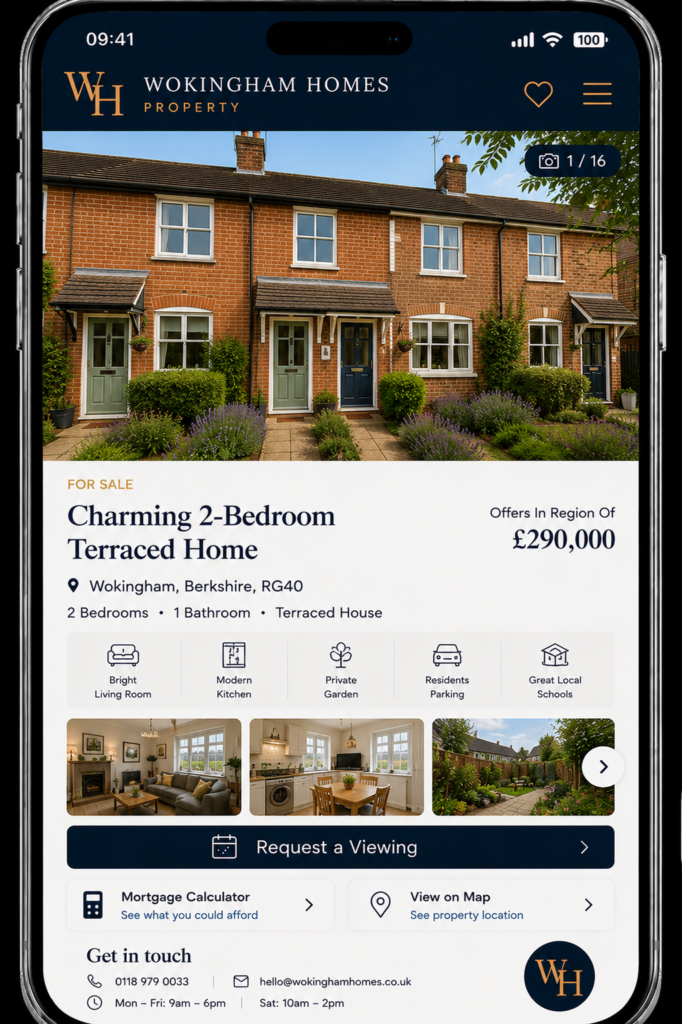
Wokingham is Berkshire’s most consistently high-performing family property market — a large, predominantly suburban and semi-rural local authority with exceptional state school provision (including several outstanding-rated comprehensive and grammar-adjacent schools), a high proportion of owner-occupier family housing, and a resident profile of senior professionals and dual-income families. The borough consistently achieves high scores on quality-of-life indices and is among the wealthiest local authorities in England by average household income.
House prices in Wokingham fell 2% year-on-year to 2026 — the only Berkshire district showing a decline against the county’s 0.5% average increase. With 1,666 residential property sales in the past twelve months, the market is liquid, and the price correction creates genuine buying conditions for well-informed purchasers entering at a lower level than the recent peak. Transactions in recent months range from £290,000 to £510,000 — a wide spread that reflects the variety of property types from flats and smaller terraces at the accessible end to larger family homes approaching the upper boundary.
The most sought-after addresses within Wokingham — the village communities of Twyford, Wargrave, Sonning Common, and the premium areas around Finchampstead — sit above the borough average and attract buyers specifically for their school catchments and village character.
Bracknell Forest: The Strongest Recent Growth and Technology Town Evolution
Bracknell Forest saw year-on-year growth of approximately 5% in 2024 — the strongest of any Berkshire district and far ahead of the 3% average for England and Wales in that period. The district’s average price of £394,734 at its 2024 peak represents a striking turnaround for a new town that was historically among the less fashionable addresses in the Thames Valley.
Bracknell’s transformation from a 1950s new town with a challenging commercial centre to a genuinely improving residential environment has been driven by the complete redevelopment of the town centre — the Lexicon and Peel Centre development has replaced the failed 1960s shopping precinct with a modern retail and leisure quarter — combined with the area’s strong employment base. Hewlett Packard Enterprise, Dell, BMW (UK headquarters), and a cluster of defence and technology employers anchor an economy that provides stable, well-paid employment for a significant resident workforce.
Sandhurst and Crowthorne — the communities on Bracknell Forest’s southern edge adjacent to Wellington College and the Royal Military Academy — carry their own distinct premium reflecting the schools and the more rural character of this part of the district.
West Berkshire: The Rural Alternative
West Berkshire is the most geographically and characterfully rural of the six Berkshire districts — stretching from the Thames at Pangbourne westward through Newbury, Hungerford, and to the Wiltshire border. The North Wessex Downs National Landscape covers much of the northern part of the district, providing exceptional chalk downland scenery and constraining new development in ways that support long-term rural values.
The average house price of £403,000 in March 2026 — broadly stable year-on-year — reflects a market that has not experienced the Elizabeth line connectivity uplift of the eastern districts but maintains consistent appeal from buyers seeking country house and rural lifestyle property within practical reach of both Reading and the M4. West Berkshire has strong stables, equestrian, and racing connections — Lambourn is within the district — and the Newbury area hosts one of the most active horse racing venues in southern England at Newbury Racecourse.
Newbury averages £366,908 for semi-detached properties — the cheapest semi-detached in the county — making it the most accessible of the Berkshire market towns for family buyers who need the amenity of a market town without the premium of Reading or Wokingham. First-time buyers in West Berkshire face an average price of £315,000, which while still significant provides more opportunity than Windsor’s entry-level market.
Slough: Value and Elizabeth Line Access
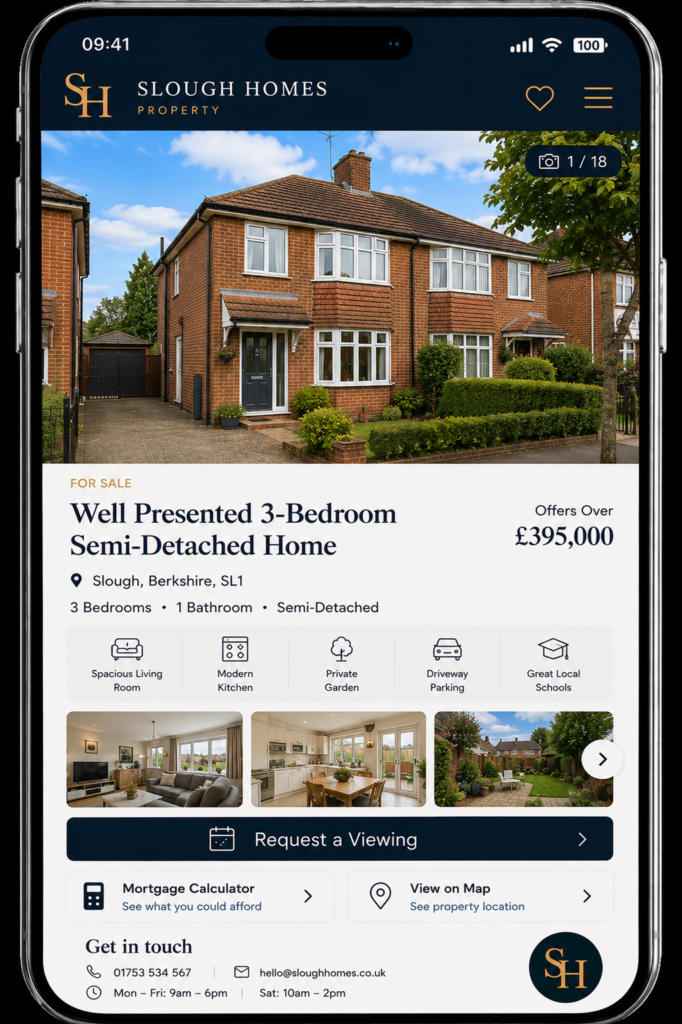
Slough’s position in the Berkshire market — covered in the adjacent buyer’s guide — is as the most affordable district by a significant margin. An average of £337,000 against the county’s £488,000 reflects both the structural differences in housing stock and the town’s profile, and represents a value proposition that the Elizabeth line’s direct Paddington access in under 25 minutes makes increasingly hard to ignore.
The Elizabeth Line Effect on Berkshire Property
The Elizabeth line’s impact on Berkshire property is the most significant single infrastructure story in the county’s recent market history. Since full through-running services began in 2022, properties along the western corridor — Reading, Twyford, Maidenhead, Taplow, Burnham, Slough, Langley, Iver, West Drayton, Hayes — have had direct access to central London, Heathrow, and the eastern Elizabeth line corridor without changing trains.
The price effect of the Elizabeth line was largely anticipated and priced in during the Crossrail construction phase of 2014–2022. Between 2013 and 2022, Berkshire property prices rose substantially as the connectivity benefit was capitalised. In the period since full services launched, the market has reflected the line’s benefit in sustained demand and rental growth rather than in accelerating capital values — which means buyers in 2026 are acquiring a fully operational infrastructure benefit at a price level that has already incorporated it.
The annual ridership of 243 million across the Elizabeth line in 2024–25 — up 10% year-on-year — confirms that the line is operating as a genuine part of the capital’s daily transport infrastructure rather than as a novelty, and that Berkshire’s connectivity to central London has been permanently and materially improved.
Key Trends Shaping the Berkshire Market in 2026
Stabilisation After the 2022 Peak
Berkshire property prices peaked broadly around 2022 and have been on a modestly corrective or flat trajectory since — following the pattern of the wider South East market. The county-wide average of £488,000 in the year to February 2026 is essentially unchanged from the 2022 level of £492,921 — meaning that in real terms, adjusted for inflation, values have fallen since the peak. For buyers who sat out 2021 and 2022, this stabilisation has improved the relative affordability of entry significantly.
The New-Build Premium and Energy Performance
New-build properties in Berkshire traded at a 50% premium over existing stock — £646,000 against £484,000 for established property — reflecting a combination of location effects (many new builds are in premium areas) and the genuine specification advantage of modern construction. Energy-efficient properties with A or B BER ratings are commanding increasing premiums as buyers factor in running costs and the direction of travel on minimum EPC standards. For sellers of older stock, this EPC premium trend is a signal to invest in energy performance improvements before marketing.
Rental Market Strength
Rental demand is strong and growing across Berkshire. Windsor and Maidenhead rents rose 9% year-on-year — the highest in the county and reflecting the acute shortage of rental supply in the Royal Borough’s most sought-after locations. Slough’s 4.2% rental growth outpaced the South East average of 3.6%. This rental market strength provides the investment case for buy-to-let in appropriate locations — though investors should model the full regulatory and tax environment, including the Renters’ Rights Act 2025 changes that came into force in May 2026, before committing to any acquisition.
School Catchments and Family Buyer Demand
Berkshire’s school provision — including several of the highest-performing state schools in the South East — is a consistent driver of property demand at the family end of the market. Langley Grammar School, Herschel Grammar School, Reading School, Kendrick School, and the outstanding-rated comprehensive provision in Wokingham collectively attract family buyers who make school catchment the primary filter on their property search. The Ofsted school inspection database and the relevant local authority school admissions services are the authoritative sources for catchment information and school performance.
Where to Search for Berkshire Property
Rightmove, Zoopla, and OnTheMarket all carry Berkshire listings. Filtering by specific district or town — Reading, Windsor, Maidenhead, Wokingham, Newbury, Bracknell — rather than the county-wide designation produces more targeted results given the significant price variation between districts.
The UK House Price Index provides postcode-level transaction data for all Berkshire areas and is the essential verification tool for assessing whether any asking price is consistent with what comparable properties have actually achieved in recent months.
All estate agents operating in England are regulated through NTSELAT and must be members of a redress scheme — either The Property Ombudsman (TPO) or the Property Redress Scheme (PRS).
Stamp Duty Land Tax applies to all Berkshire purchases. Use the HMRC stamp duty calculator for the precise liability at any given price point. First-time buyers benefit from SDLT relief; additional property purchases carry the 5% surcharge on top of standard rates.
Frequently Asked Questions
Which part of Berkshire is best value for money in 2026?
Reading offers the best combination of price accessibility and city economy — an average of £349,000 with a price-to-income ratio of 8.3 (the lowest in the county) and Elizabeth line Paddington access in under 30 minutes. For buyers willing to sacrifice some Elizabeth line convenience for a market town character, West Berkshire’s Newbury and Thatcham offer family-sized semi-detached housing below the county average. Slough remains the most affordable district in absolute terms at £337,000 with direct Elizabeth line access.
Is the Berkshire property market rising or falling in 2026?
The county-wide market rose 0.5% in the year to February 2026 — modest but positive, against a broadly flat South East backdrop. Within the county, Bracknell Forest showed the strongest recent momentum; Wokingham is the one district in modest correction (-2%) — presenting selective opportunity for buyers in that market. Windsor and Maidenhead maintained 3.4% growth driven by sustained premium demand. Reading fell 1.9% — again improving affordability at the entry level.
What is the Elizabeth line doing to Berkshire property prices?
The Elizabeth line’s pricing effect was largely anticipated and absorbed during the Crossrail construction phase (2014–2022). Since full services launched, the market has reflected the line’s benefit in sustained demand and rental growth rather than dramatic further capital appreciation. Buyers in 2026 are acquiring an operational infrastructure benefit that is already reflected in prices — meaning they are buying the commuter advantage without the speculative premium of the anticipation phase.
Are Berkshire schools good?
Berkshire has some of the highest-performing state schools in the South East. Reading School and Kendrick School in Reading, Langley Grammar and Herschel Grammar in Slough, and several outstanding-rated comprehensives in Wokingham are all significant drivers of family buyer demand. The presence of private schools — Wellington College in Crowthorne, Bradfield College in West Berkshire, and Eton College in Windsor — adds further educational depth at the independent level. Buyers should verify specific catchment eligibility for any priority school with the relevant local authority before committing to a purchase.
What are the best commuter towns in Berkshire for London workers?
Reading (Elizabeth line to Paddington in 27 minutes, with Great Western fast services in under 25 minutes) provides the strongest city-to-London commuter combination. Maidenhead (Elizabeth line to Paddington in 29 minutes) is the premium alternative. Slough (Elizabeth line to Paddington in approximately 23 minutes) is the most affordable. Wokingham has its own Great Western Main Line station though services are less frequent than from Reading. For buyers who need Heathrow access alongside London connectivity, the eastern Berkshire corridor — Slough, Langley — is within 10 minutes of Terminal 5.
Conclusion
Berkshire property in 2026 presents a market of genuine variety — from Windsor and Maidenhead’s premium royal borough at the top to Slough’s compelling Elizabeth line value at the accessible end, with Reading’s city economy, Wokingham’s family premium, Bracknell Forest’s recent momentum, and West Berkshire’s rural appeal completing a picture that serves buyers across a very wide range of priorities and budgets.
The county’s defining structural advantages — Elizabeth line connectivity, economic depth anchored in technology and professional services, exceptional school provision, and proximity to the M4 corridor — are intact and show no sign of diminishing. The current market, with prices broadly stable to modestly lower from the 2022 peak, offers buyers a more rational entry point than the heated conditions of recent years, while maintaining the fundamentals that have made Berkshire one of England’s most consistently attractive property counties.
For buyers and investors considering Berkshire property alongside the broader UK market picture, the guide on how UK property investors are thriving in a changing market provides useful wider context on the trends and conditions shaping the 2026 opportunity.