Table of Contents
Key Takeaways
- Islington property represents one of London’s most enduringly desirable inner-city markets — average prices of £679,000 according to the ONS local housing data for March 2026, with the borough outperforming the wider London average which fell 2.1% over the same period while Islington held broadly flat with 0.9% growth.
- The borough divides clearly between its most prestigious addresses — Canonbury, Barnsbury, and the Georgian conservation areas — where terraced houses regularly exceed £1.5 million, and its more accessible northern areas toward Caledonian Road, Holloway, and Finsbury Park where flats begin from £500,000 and below.
- Flats are by far the most commonly traded property type in Islington, selling at an average of £650,769 according to Rightmove data — making them the primary entry point for first-time buyers, who paid an average of £600,000 in March 2026.
- The transport network is Islington’s most powerful practical asset: Angel (Northern Line, Zone 1), Highbury & Islington (Victoria Line, Overground, Zone 2), Caledonian Road (Piccadilly Line, Zone 2), and the North London Overground collectively give residents access to the City, West End, Canary Wharf, and King’s Cross without changing trains.
- Georgian and Victorian terraces — predominantly in N1 across Barnsbury and Canonbury — are the backbone of Islington’s most sought-after housing stock, and Thornhill Square in Barnsbury is regularly cited as one of London’s finest residential squares.
- Private rents in Islington averaged £2,811 per month in April 2026, up 4.0% year-on-year — higher growth than the London average of 2.0% — reflecting the sustained demand pressure in a borough where supply is chronically constrained.
Why Islington Consistently Attracts Serious London Buyers
This complete Islington property buying guide answers your questions about the area. Islington occupies a position in the London property market that very few inner-city boroughs can match — close enough to the City and the West End to make daily commuting effortless, far enough north to retain genuine neighbourhood character, and possessed of an architectural heritage that ranges from the finest Georgian townhouses in London to the characterful Victorian streets of Highbury and the creative energy of Clerkenwell and Finsbury.
Islington property has attracted buyers at every level of the market for decades — young professionals drawn to Angel’s density of restaurants, bars, and culture; families anchoring around the leafy squares of Canonbury and Barnsbury; creative industry buyers in the converted warehouses and loft spaces of the borough’s southern reaches; and long-term investors who understand that inner Zone 2 London property with strong tenant demand has consistently proved among the most resilient in the capital.
The borough’s evolution from its working-class roots through the gentrification of the 1960s and 1970s — when writers, artists, and professionals discovered the Georgian townhouses of Barnsbury and drove the market’s transformation — to its current position as one of London’s most desired inner-city addresses is one of the most often-told stories in London residential property. The fundamentals that drove that transformation remain intact: architectural stock that cannot be replicated, a transport network that serves the capital’s primary employment centres directly, and a density of independent culture — the Almeida Theatre, Sadler’s Wells, Camden Passage antiques market, the restaurants and cafés of Upper Street — that gives the borough a genuine cultural identity.
The Islington Property Market in Numbers
The most authoritative data for Islington comes from the ONS Local Housing Data, which records an average house price of £679,000 in March 2026. This represents growth of 0.9% year-on-year — modest, but notably better than the wider London market, which fell 2.1% over the same period. The borough was the 8th most expensive London borough by average property price, reflecting its inner-city premium over outer London while remaining more accessible than the prime central postcodes of Kensington, Chelsea, and Westminster.
Rightmove’s sold price data for the borough — drawing from Land Registry transactions — shows an overall average of £846,994, a figure pulled upward by the high transaction prices of terraced and semi-detached properties. Breaking this down by property type reveals the practical buying landscape: flats at an average of £650,769; terraced houses at £1,600,053; and semi-detached properties at £2,054,836. The most common price band for property sales in the borough historically has been £600,000–£800,000.
Semi-detached properties in Islington rose by 6.5% in the year to March 2026 — the strongest performance of any property type — while flat prices held broadly flat over the same period, reflecting the wider London pattern of house price resilience relative to the flat market.
Private rents averaged £2,811 per month in April 2026 — a 4.0% annual increase, substantially above the London-wide average of 2.0% — which speaks to the sustained tenant demand in a borough where supply is tightly constrained and the population of young professionals and creative industry workers continues to exceed available rental stock.
For granular street-level data on what specific properties have sold for, the UK House Price Index from HM Land Registry provides postcode-level sold prices that are essential for grounding any offer in objective comparable evidence.
The Key Areas Within Islington: What Each Offers Buyers
Canonbury: Islington’s Most Prestigious Address
Canonbury is the most coveted residential address in the London Borough of Islington — a neighbourhood of Georgian and early Victorian terraces, private garden squares, and tree-lined streets that represent some of the finest surviving period residential architecture in inner London. Canonbury Square, with its elegant Georgian townhouses surrounding a beautiful private garden, is among the most recognisable and sought-after addresses in the borough. The streets around Alwyne Road, Canonbury Park North and South, and Grange Grove are almost entirely residential in character — a rarity at this proximity to central London.
Property in Canonbury averages approximately £820,000 and above, with the finest Georgian townhouses and well-presented larger properties commanding significantly more. The combination of the period architecture, proximity to the shops and restaurants of Upper Street, and Overground and Victoria Line access at Highbury & Islington — combined with the relative quiet and greenery of its residential streets — makes Canonbury the benchmark against which all other Islington neighbourhoods are compared. Properties here rarely come to market in volume, and when well-presented examples do appear, they attract serious competitive interest.
Barnsbury: Georgian Squares and Community Character
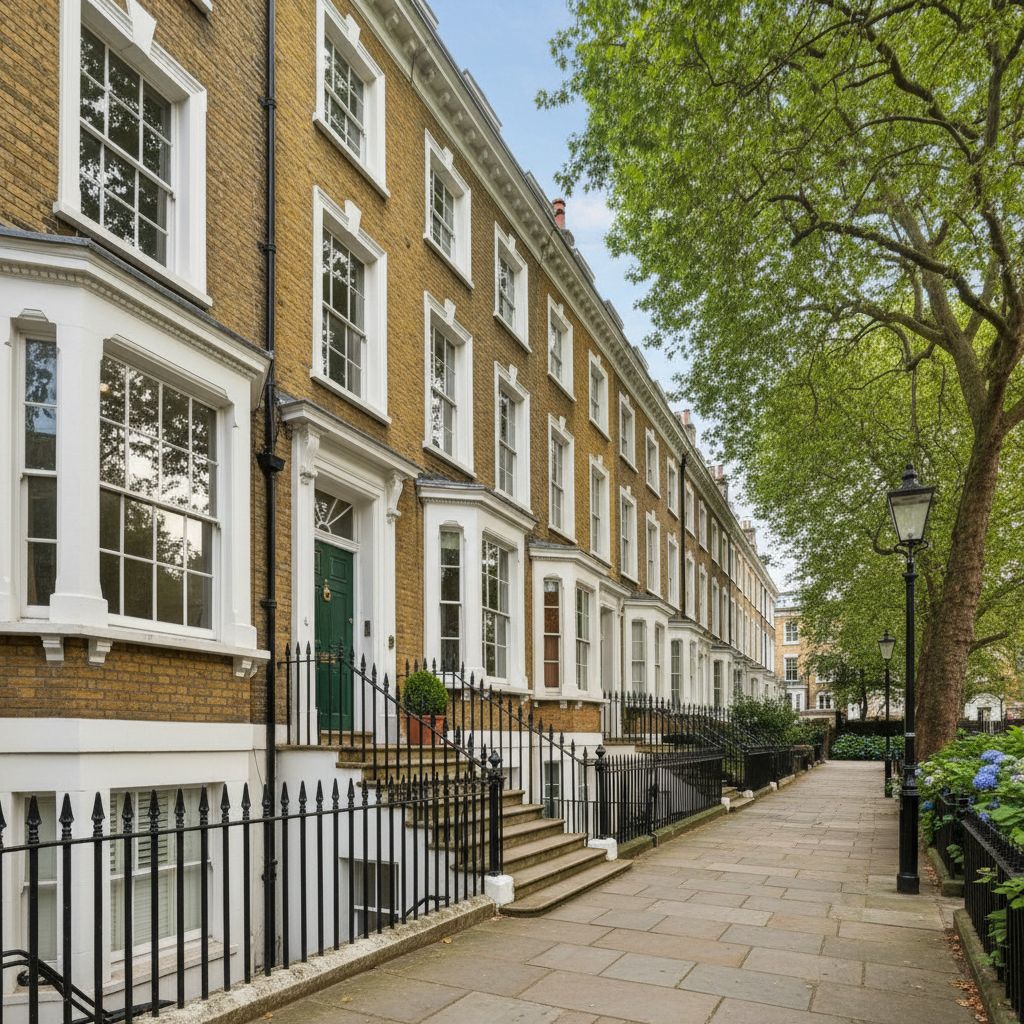
Barnsbury, to the west of Caledonian Road and north of City Road, is where the defining Islington narrative of Georgian townhouse gentrification played out from the 1960s onward — and where the physical evidence of that transformation is most dramatically visible. Thornhill Square, Lonsdale Square, and Gibson Square are among the finest residential squares in all of London — their Georgian and early Victorian terraces surrounding communal gardens of exceptional quality that are accessible only to residents.
Islington property in Barnsbury commands premium prices that reflect the rarity and quality of the stock — a Georgian terraced house in one of the conservation area squares will typically require a budget of £1.5–2.5 million for a well-presented example. The streets immediately around these squares, while slightly more varied in character, are consistently popular with buyers who want Barnsbury’s address and atmosphere at a more accessible entry point. The Barnsbury Estate redevelopment — 1,116 new homes approved in December 2025 in a partnership between Mount Anvil and Newlon Housing Trust — will introduce new-build stock over the next decade, with 38% affordable housing.
Angel: Urban Energy and Northern Line Convenience
Angel takes its name from the historic coaching inn that stood at the junction of Pentonville Road and Upper Street, and the area retains a sense of energy and movement that has always characterised this northern gateway to the City. Angel station on the Northern Line (Zone 1) provides direct access to Bank, London Bridge, Waterloo, and Charing Cross, making it one of the most commercially positioned Zone 1 residential addresses in the capital.
The area’s character is defined by Upper Street — the dense strip of restaurants, bars, independent shops, and the Business Design Centre and Almeida Theatre — and the streets running east and west from it. Property around Angel and the immediate Upper Street corridor is predominantly flatted — Georgian and Victorian conversions and purpose-built apartment buildings — with average prices around £670,000. The Camden Passage antiques market and the Chapel Market add further character to what is already a densely layered urban environment.
For buyers who prioritise City connectivity and urban density above domestic quiet, Angel represents the most commercially convenient and culturally rich entry into Islington property ownership.
Highbury: Families, Fields, and the Victoria Line
Highbury covers the area north and east of Canonbury and Holloway Road — a broader, more varied neighbourhood anchored by Highbury Fields, the 27.5-acre park that provides open space, a swimming pool, tennis courts, and children’s play facilities at a scale that is exceptional for inner London. The Fields face one of Islington’s finest sequences of Victorian mansion blocks and semi-detached houses, and the combination of this green space with the area’s strong school catchments makes Highbury the most family-focused of Islington’s main residential neighbourhoods.
Transport is excellent: Highbury & Islington station provides Victoria Line access to Oxford Circus in under ten minutes and Brixton in under twenty, alongside Overground services to Stratford and Canada Water. The Arsenal Emirates Stadium at Highbury’s northern edge is a significant local presence on match days — buyers who value match-day atmosphere will find it; those who do not should factor it into their assessment of specific streets.
Highbury Barn — the village-like cluster of independent shops, cafés, and restaurants at the top of the Fields — gives Highbury a community focal point that residents cite consistently as one of the area’s strongest quality-of-life assets. Average property prices in Highbury are somewhat below Canonbury at approximately £820,000 for period houses, but the best streets immediately facing the Fields are as keenly competed for as anything in the borough.
Clerkenwell and Finsbury: The Creative Quarter
The southern part of the borough — Clerkenwell, Finsbury, and the Exmouth Market area — has a distinct character from the residential north. This is Islington’s creative and tech quarter, where former warehouses, Victorian industrial buildings, and Georgian merchant houses have been converted into loft apartments, studios, and design offices. The media, architecture, and technology industries have deep roots here — the proximity of the Barbican, the City’s tech cluster, and the concentration of creative businesses around Exmouth Market and Rosebery Avenue creating an employment base that sustains the residential demand.
Property in Clerkenwell tends toward larger, more dramatic conversions — former print works, warehouse loft spaces, and converted commercial buildings that offer industrial-scale living within minutes of the City. These properties attract buyers who value the specific aesthetic of converted space over the period residential terraces of Barnsbury and Canonbury, and typically command prices that reflect their rarity and their very high specification when well-converted.
Caledonian Road and the Northern Reaches
The northern and western parts of the borough — around Caledonian Road, Holloway, Finsbury Park, and Tufnell Park — offer the most accessible price points in Islington, with the trade-off of a less immediate connection to the borough’s most prestigious addresses and a more varied built environment that includes significant amounts of post-war housing estate stock alongside the Victorian terraces.
Caledonian Road (Piccadilly Line, Zone 2) provides direct access to King’s Cross, Holborn, and the West End. Finsbury Park connects the Victoria and Piccadilly lines and the Overground — one of the most transfer-rich stations in north London. For buyers who need Islington for its transport network rather than its prestige addresses, the northern reaches deliver the connectivity at meaningfully lower price points, and the surrounding neighbourhood has continued to improve over the past decade.
Islington’s Transport Network: Why It Matters for Buyers
Transport is the fundamental practical underpinning of Islington property values, and understanding the network is essential before choosing which part of the borough to focus on. The key connections are:
Angel (Northern Line, Zone 1): Direct to Bank (3 minutes), London Bridge (6 minutes), Waterloo (10 minutes), and Charing Cross (12 minutes). The Zone 1 designation carries a premium in both purchase price and rent, but the trade-off is access to every City and West End employment hub without a single change.
Highbury & Islington (Victoria Line, Overground, Zone 2): Oxford Circus in 8 minutes; Brixton in 18 minutes; direct to Stratford and Canada Water via the Overground. The interchange function of this station — combining the Victoria Line with North London Overground — gives it genuine multimodal value for buyers working across different parts of London.
Caledonian Road (Piccadilly Line, Zone 2): King’s Cross in 3 minutes; Holborn in 8 minutes; Heathrow in under 50 minutes. For buyers with regular Heathrow requirements, Caledonian Road’s Piccadilly Line access is a specific and undervalued practical advantage.
Essex Road and Canonbury (Overground, Zone 2): The North London Line connects to Stratford, Highbury, and Dalston Junction — increasingly important for buyers working in the tech and creative clusters of east London.
All borough stations connect to TfL’s Oyster and contactless network, and the borough’s flat terrain makes cycling to the City or King’s Cross a practical daily option for the physically inclined, with Santander Cycle docking stations throughout.
Schools in Islington: What Buyers Need to Know
School quality and catchment are, as in every London borough, a material driver of property values in specific streets and postcodes. Islington has a mixed picture — some excellent state primaries and secondaries, but also a complex catchment geography where the most sought-after schools draw from smaller local areas than many buyers assume.
The Ofsted school inspection database provides the current ratings for all Islington schools. Notable state provision includes Highbury Fields School, which has shown improving results, and a number of outstanding-rated primaries scattered across the borough. The independent sector is also well represented — the City of London School for Boys and Girls are accessible by short commute, and the Almeida Primary School association with the Almeida Theatre gives certain state primaries a distinctive cultural character.
The borough’s school admissions information is the authoritative source for catchment boundaries — given that boundaries can change annually and that proximity criteria vary significantly between schools, verifying the catchment position of any specific property before committing is essential.
What to Know Before Buying Islington Property
Conservation Areas and Listed Buildings
A very significant proportion of Islington’s most desirable property sits within one of the borough’s many conservation areas — covering the Georgian squares of Barnsbury and Canonbury, the Victorian streets of Highbury, and the historic commercial fabric of Clerkenwell. Conservation area designation restricts certain permitted development rights that would otherwise apply, and requires planning consent for external alterations including replacement of windows and doors visible from the street.
Listed buildings — a significant proportion of the Georgian townhouses in Barnsbury and Canonbury carry Grade II designation — require listed building consent for any works affecting their character, inside or outside. Historic England’s National Heritage List for England allows buyers to confirm listing status before viewing, and is worth checking for any property whose age or architectural character suggests it might be listed.
The Town and Country Planning (General Permitted Development) (England) Order 2015 provides the baseline permitted development framework, but this is frequently curtailed within Islington’s conservation areas. Confirming the planning position before purchasing any property where works are intended is a non-negotiable step.
Leasehold, Service Charges, and Ground Rent
The majority of Islington flats — which account for the largest share of transactions in the borough — are leasehold properties. Before purchasing any leasehold flat, buyers must investigate: the unexpired lease length (lenders typically require 70–85 years minimum); the annual service charge and what it covers; the sinking fund balance and adequacy; any planned or ongoing major works; and the ground rent position.
The Leasehold Reform (Ground Rent) Act 2022 abolished ground rents for new leases, but existing leases may carry escalating ground rent clauses that can affect mortgageability and future sale. Your solicitor should review the full lease before exchange and advise on any onerous terms. For properties with short leases (below 80 years), statutory lease extension rights provide a route to extending the lease, but the cost increases significantly below the 80-year threshold — buyers should factor extension cost into their acquisition price for any property approaching this threshold.
Survey Requirements
For period Georgian and Victorian properties — which dominate the most sought-after parts of Islington — a full RICS Level 3 Building Survey is the appropriate standard. The specific survey focus for Islington property includes: the condition of original sash windows and external joinery; damp in solid brick walls; the state of original timber floors; chimney and flue condition; the basement and lower ground floor condition, which is a particular concern in Georgian townhouses where drainage and damp historically concentrate; and the condition of shared party walls in terraced properties under the Party Wall etc. Act 1996.
Stamp Duty
Stamp Duty Land Tax applies to all Islington property purchases at current HMRC rates. Use the HMRC stamp duty calculator for the precise liability on any given purchase price. At Islington’s average flat price of £650,769, standard SDLT (for a primary residence, non-first-time buyer) amounts to £22,538. First-time buyers benefit from SDLT relief on purchases up to £500,000, with a reduced rate applying above this threshold up to £625,000. Additional property purchases carry the 5% surcharge on top of standard rates.
All solicitors conducting property transactions in England are regulated by the Solicitors Regulation Authority. For Islington conveyancing specifically, instructing a solicitor with familiarity with the borough’s conservation area planning framework, its common leasehold structures, and the specific character of its Georgian and Victorian property stock is worth prioritising over purely price-driven selection.
Where to Search for Islington Property
Rightmove, Zoopla, and OnTheMarket all carry Islington listings. Setting up saved searches by specific neighbourhood — N1 for Barnsbury and Canonbury, N5 for Highbury, N7 for Caledonian Road and Tufnell Park — produces more targeted and manageable alerts than a borough-wide search.
Given the volume of transactions that occur off-market in the most sought-after Islington conservation areas — particularly for Georgian townhouses and the finest square-facing properties — registering with local agent offices in specific neighbourhoods and making yourself known as a proceedable buyer remains a productive complement to portal monitoring.
All estate agents operating in England are regulated through the National Trading Standards Estate and Letting Agency Team (NTSELAT) and must be members of a redress scheme — either The Property Ombudsman (TPO) or the Property Redress Scheme (PRS).
Frequently Asked Questions
Is Islington a good place to buy property in 2026?
Islington property has proved consistently resilient — holding broadly flat in a year when wider London fell 2.1%, and demonstrating over multiple decades that inner Zone 2 property with strong transport fundamentals and architectural scarcity holds its value through market cycles. For buyers who value urban character, architectural quality, and outstanding transport connectivity alongside the cultural richness of Upper Street, the Almeida, and Sadler’s Wells, Islington provides one of the most complete inner London residential propositions. The price point demands a realistic assessment of what the borough delivers relative to alternatives — but for buyers whose priorities align with what Islington offers, the case remains strong.
What is the best area of Islington to buy?
Canonbury and Barnsbury are the most consistently sought-after and prestigious addresses — Thornhill Square and Canonbury Square in particular represent a quality of Georgian residential environment found in very few inner London locations. For buyers whose budget does not extend to the finest Georgian townhouses, Highbury offers a strong family proposition around the Fields at slightly lower average prices. Angel provides the most intense urban experience and the most direct City connectivity. The right area depends on whether your priority is residential quality and quiet, family amenity and schools, or City proximity and urban density.
What are average property prices in Islington in 2026?
The ONS records an average of £679,000 in March 2026. Rightmove’s transaction data shows an overall average of £846,994, with flats at £650,769 (the most commonly traded type) and terraced houses at £1,600,053. First-time buyers paid an average of £600,000. The variation within the borough is substantial — from flats in the northern parts of the borough below £500,000 to Georgian townhouses in Barnsbury and Canonbury above £2 million for the finest examples.
What transport links does Islington have?
Angel (Northern Line, Zone 1), Highbury & Islington (Victoria Line and Overground, Zone 2), Caledonian Road (Piccadilly Line, Zone 2), and Canonbury, Essex Road, and Caledonian Road & Barnsbury (Overground) collectively serve the borough. The multimodal connectivity — particularly the Victoria/Overground interchange at Highbury & Islington — gives Islington residents access to virtually every part of London without changing between underground lines, which is a genuine operational advantage over most comparable Zone 2 locations.
Is there new build property available in Islington?
New build is limited in Islington — the borough’s conservation area designations and the predominantly built-out nature of its urban fabric mean that large development opportunities are scarce. The most significant new development is the Barnsbury Estate redevelopment — 1,116 homes approved in December 2025 in a partnership between Mount Anvil and Newlon Housing Trust, to be delivered across six phases over the next decade. Smaller new build schemes and conversions appear periodically, but buyers specifically seeking new build should be prepared for limited choice and should check Rightmove’s new homes search alongside broader market monitoring.
Conclusion
Islington property occupies a specific and enduring position in the London market — inner-city without being central, prestigious without being prime, and possessed of an architectural heritage and transport infrastructure that has sustained demand through multiple market cycles. The borough’s combination of Georgian and Victorian character, Northern and Victoria Line connectivity, independent cultural depth, and the consistent draw of Upper Street’s restaurant and arts scene make it one of the most coherently argued residential propositions in inner north London.
Buyers who approach the Islington market with a clear understanding of which neighbourhood suits their life, a realistic grasp of what the different property types cost and deliver, and the due diligence rigour that period property and leasehold flats demand will find a market that rewards preparation. The competition for the finest properties in Barnsbury and Canonbury is genuine and persistent — but so is the quality of what those properties deliver.
For broader context on how the London and wider UK property market is performing and where buyers and investors are finding the best opportunities, the guide on how UK property investors are thriving in a changing market is worth reading alongside this borough-specific guide.