Table of Contents
Key Takeaways
- Reclaimed stone is the oldest and most enduring of all salvaged building materials — it brings a weight of history to an interior that no manufactured product comes close to replicating.
- The range of stone available through reclamation is vast: flagstone flooring, limestone walls, granite worktops, sandstone fireplaces, cobbled surfaces, and architectural stonework all appear regularly in specialist yards.
- The pros are substantial — extraordinary visual depth, exceptional durability, genuine sustainability credentials, and a material that literally improves with age. The cons are equally real — weight, cost, sourcing difficulty, and the specialist skills required to work with it well.
- Species matters enormously: limestone, sandstone, slate, granite, and York stone all have different characteristics, different appropriate applications, and different maintenance requirements.
- Surface preparation and sealing are the two stages that determine the long-term success of any reclaimed stone interior — getting both right requires patience and the correct products.
- Reclaimed stone pairs naturally with other salvaged materials — much as reclaimed brick brings texture and warmth to walls and surrounds, reclaimed stone grounds a space at floor level or anchors it at the worktop and fireplace with a solidity nothing else provides.
The Floor That Stopped People in the Doorway
Not every material makes people pause before they have said a word. Reclaimed stone does. There is something about it — the scale of the flags, the colour variation across the face, the slight irregularity that tells you immediately this did not come off a production line — that registers before conscious thought has caught up.
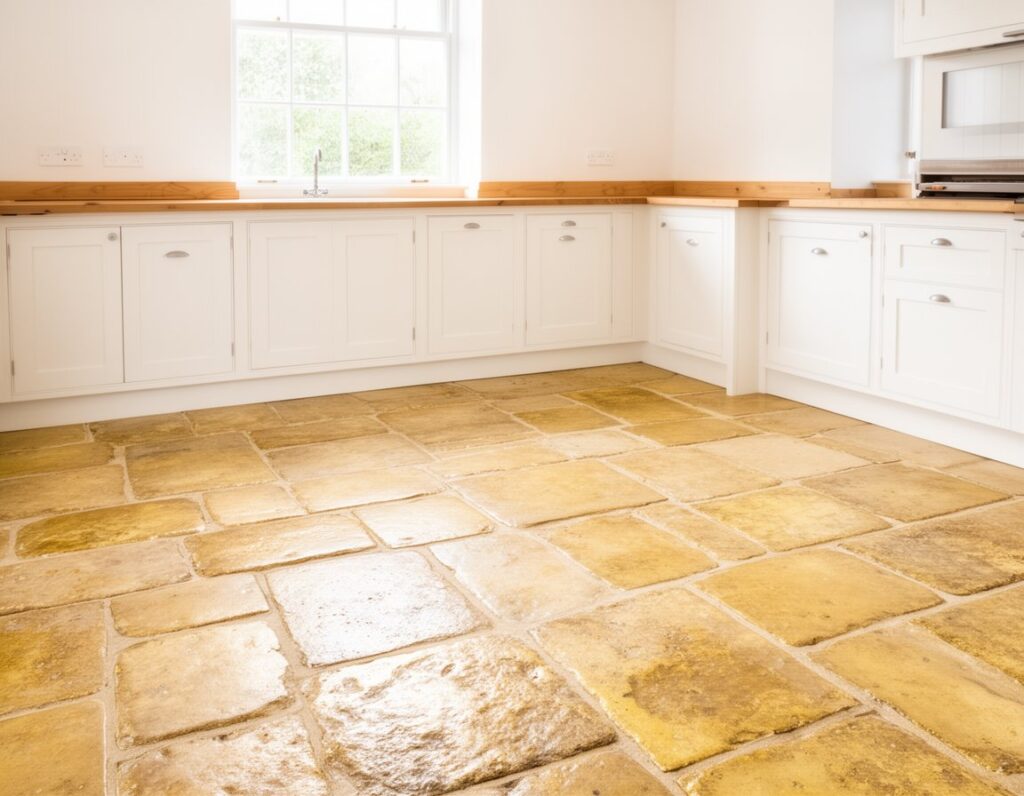
The farmhouse kitchen floor that prompted this guide was laid in reclaimed Yorkshire stone flags — thick, wide, beautifully worn slabs recovered from a demolished mill in the West Riding. They had been under foot in that mill for over a century before they came to us, and the surface showed it: a shallow, smooth depression in the centre of each flag where generations of workers had walked, a warmth of colour that ranged from pale honey through to deep, almost ochre gold depending on the angle of the light.
The floor had been in place for six months before anyone visited without commenting on it unprompted. That is the quality that reclaimed stone delivers at its best. Not a designed look. A presence.
This guide covers everything you need to know to use reclaimed stone in your own interior — the types available, where to find them, the genuine advantages and the honest challenges, and how to prepare, lay, and maintain them correctly.
What Is Reclaimed Stone?
Reclaimed stone is stone that has been quarried, worked, and used in a previous context — as flooring, walling, roofing, paving, architectural detail, or structural element — and salvaged from that context for reuse rather than being discarded or crushed. It encompasses an enormous range of material types, forms, and historical periods.
The distinction from new stone matters in several ways. Natural stone from a working quarry is consistent in colour and character within a given batch, machine-cut to precise dimensions, and arrives with a surface that reflects recent quarrying rather than historical use. Reclaimed stone carries the marks of its previous life: the wear patterns of foot traffic across a flagstone floor, the tool marks on the face of a hand-dressed wall block, the lichen and mineral staining on a piece of architectural stonework, the polish that centuries of use have developed on a limestone threshold. These qualities cannot be added by manufacturing — they can only be accumulated by time.
The Types of Reclaimed Stone Available
Reclaimed Flagstone Flooring
The most sought-after category of reclaimed stone for interior use. Flagstones — large, flat slabs of stone used historically for flooring in farmhouses, mills, churches, manor houses, and civic buildings — are available in a range of species, thicknesses, and sizes. Yorkshire stone, Caithness slate, Hopton Wood limestone, Delabole slate, and various regional sandstones all appear in UK reclamation yards. The defining quality of genuinely old flagstones is the surface character: the worn, slightly undulating face that develops through generations of foot traffic is the detail that no new stone, however it is treated, reproduces convincingly.
Reclaimed Limestone
Limestone is one of the most versatile reclaimed stone types for interior use. Recovered from old buildings, agricultural structures, and traditional country house floors, reclaimed limestone ranges from pale, almost white Cotswold limestone to the warmer honey tones of French Burgundy stone and the deep grey-brown of aged English Blue Lias. It is appropriate for flooring, wall cladding, fireplace surrounds, window sills, and worktops. The surface of old limestone, worn to a subtle sheen by use, has a quiet depth and warmth that new limestone — even when aged or honed — cannot quite match.
Reclaimed York Stone
York stone — a fine-grained sandstone quarried in West Yorkshire and widely used in Victorian paving, steps, and building construction — is one of the most commonly available and most consistently characterful reclaimed stone types in the UK market. Its warm buff-to-gold tones, the slight texture of the riven or sawn face, and the character accumulated through decades of use as paving make it enormously popular for interior flooring, hearth surrounds, kitchen worktops, and wall features. It is robust, relatively easy to work with, and widely available through reclamation yards across the north and midlands.
Reclaimed Granite
Granite is the hardest and most durable of the commonly available reclaimed stone types. Recovered from old kerb stones, cobbles, agricultural buildings, and monumental work, reclaimed granite in interior use most commonly appears as flooring pavers, worktops, and fireplace hearths. The colour range is wide — from the deep blue-grey of Aberdeen granite through the warm pink of Cornish stone to the near-black of certain Welsh and Scottish granites. Granite is the most demanding to cut and work of all the common stone types, but its durability in interior use is unmatched.
Reclaimed Slate
Welsh, Cornish, and Lake District slate recovered from demolished or re-roofed buildings offers an interior material with a specific, quiet character — dark, smooth, and with a subtle lustre that develops with light and use. Reclaimed roofing slate is rarely thick enough for flooring, but specialist suppliers offer thicker salvaged slate — from flooring, cladding, and agricultural applications — that is entirely appropriate for interior floor and wall use. Slate is naturally impermeable, making it one of the best reclaimed stone options for wet and high-moisture environments.
Architectural Stonework
Specialist architectural salvage companies carry a wide range of recovered architectural stonework — carved corbels, moulded window surrounds, balusters, column bases, doorstep thresholds, garden urns, and decorative panels. These pieces carry a level of craft and historical interest that places them beyond the category of building material and into the territory of antique objects. Used as focal points in an interior — a carved limestone corbel repurposed as a mantel bracket, a worn stone threshold set into a kitchen floor as a feature, a pair of reclaimed granite balls used as bookends — architectural stonework adds a dimension of character and historical depth that no manufactured product approaches.
The Case for Reclaimed Stone: The Pros
Visual Depth Accumulated Over Centuries
The surface of a reclaimed flagstone that has been walked on for a hundred and fifty years carries something that cannot be replicated in a factory. The slight depression in the centre of the flag, the irregular wear at the edges, the mineral staining and lichen traces that remain in the low points of the surface despite cleaning — all of these tell a story about the material’s previous life that a new stone flag, however carefully it is finished, simply does not tell. At room scale, this depth of character reads as authenticity — an interior quality that resonates with people even when they cannot immediately articulate why.
Extraordinary Durability
Natural stone is one of the most durable materials used in building. A reclaimed limestone floor that has already served a farmhouse kitchen for two centuries will serve another two without difficulty. The durability that has already been demonstrated by the material’s survival to the present day is itself a guarantee of future performance. Unlike timber, which can be damaged by sustained moisture, or brick, which can be vulnerable to frost and salt, well-selected interior stone in an appropriate application is effectively permanent.
Genuine Sustainability
The sustainability case for reclaimed stone is among the most compelling of any building material. Stone quarrying is one of the most environmentally impactful extractive industries — it involves heavy machinery, significant land disturbance, and substantial transport distances. Reusing existing quarried stone avoids all of this. The embodied carbon in reclaimed stone has already been incurred; reuse allows that investment to continue generating value rather than being wasted. For an interior project where environmental credentials genuinely matter, reclaimed stone is difficult to beat.
Thermal Mass
Stone is among the most effective thermal mass materials available. A stone floor — particularly at ground level on a solid substrate — absorbs heat during warm periods and releases it slowly as the room cools, moderating temperature fluctuations and reducing the demand on heating and cooling systems. In a south-facing room, a kitchen with underfloor heating, or any space where temperature stability is valued, the thermal mass of reclaimed stone is a genuine practical asset rather than simply an aesthetic quality.
It Appreciates With Use
The paradox of reclaimed stone is that the wear and use it accumulates in its new context adds to rather than diminishes its character. Foot traffic on a limestone floor deepens the surface polish. Cooking and preparation on a York stone worktop produces a patina that makes the stone more beautiful over time. The material rewards being lived with in a way that manufactured surfaces do not.
The Honest Assessment: The Cons
Weight
Stone is heavy. Very heavy. Reclaimed flagstones of 50–75mm thickness — a common dimension for Yorkshire stone and many limestone flags — can weigh 80–120kg per square metre. This has structural implications that must be assessed before any significant reclaimed stone flooring project begins, particularly on upper floors or in buildings of lightweight construction. A structural engineer’s assessment of the floor loading capacity is not optional for any large reclaimed stone project in a domestic setting.
Cost
Quality reclaimed stone is expensive relative to new stone products of similar type, and substantially more expensive than manufactured flooring alternatives. The cost reflects the labour involved in salvage, cleaning, grading, and sorting, the scarcity of certain types, and the quality of the material. Reclaimed Yorkshire stone flags in good condition typically cost significantly more per square metre than new sandstone paving, though the comparison is complicated by the impossibility of replicating the surface character of the reclaimed material in any new product. Budget carefully and include a generous contingency — stone projects almost always have unexpected costs.
Sourcing Consistent Quantities
Finding enough matching reclaimed stone to complete a project is the most consistent challenge in working with the material. Flags from a single source will have consistent colour and character; flags assembled from multiple sources will vary, sometimes significantly. For a floor where visual consistency matters — a formal hallway, a reception room, a principal bedroom — sourcing everything from one batch is important and may require patience and compromise on timing. Always buy more than you need; the cost of a surplus is insignificant compared to the impossibility of finding matching material later.
Specialist Installation Requirements
Reclaimed stone is not a DIY-friendly material in the way that some tile or laminate flooring might be. The variation in thickness of genuinely old flags — which can vary by 10–20mm across a single stone, let alone across a batch — requires a skilled layer who understands how to bed and adjust each piece individually. The weight demands safe handling practice and appropriate equipment. The cutting required to fit around obstacles and at edges needs a diamond-bladed wet saw of sufficient power to work through thick stone without overheating. For any significant reclaimed stone floor, professional installation by a stone flooring specialist is the appropriate route.
Porosity and Maintenance Requirements
Most sedimentary stone types — limestone, sandstone, York stone — are porous to varying degrees. In an interior application, this means they require sealing to resist staining from spills, oils, and moisture. Unsealed limestone in a kitchen environment will absorb cooking oils, wine, and food acids rapidly, producing staining that is extremely difficult to remove. The sealing process, and the ongoing maintenance of the seal, is a commitment that buyers of reclaimed stone need to understand and accept before installation.
Sourcing Reclaimed Stone
Specialist Stone Reclamation Yards
The most reliable source for assessed, graded stone in meaningful quantities. A good specialist yard will know the origin of its stock, have assessed the condition and thickness of individual flags, and be able to advise on suitability for specific applications. For flagstone flooring in particular, visiting the yard in person to select individual pieces — or at least to approve a representative sample — is strongly recommended. Colour, character, and condition vary within batches, and selection matters.
Architectural Salvage Companies
For premium material — specific regional stone types, architectural stonework, carved and moulded pieces — architectural salvage companies are the most productive source. Their stock is more carefully curated than a general reclamation yard, their provenance information is typically more detailed, and their prices reflect this. For a project where the quality and provenance of the stone is the primary consideration, this is the appropriate market.
Demolition and Agricultural Sources
Farm buildings, barns, and old agricultural structures frequently contain substantial quantities of flagstone flooring — laid on earth or lime-grouted beds, often in very good condition because they have been protected from frost by the building above them. Demolition contractors working on rural buildings are often willing to negotiate access to salvage flagstones in exchange for taking the material off their hands. This route requires the most physical effort and the most careful condition assessment, but can yield exceptional material at low cost.
Online and Auction
For smaller quantities or specific architectural pieces, online auction platforms and specialist salvage listing sites can be productive. The limitations are the standard ones for buying stone remotely: photographs do not reliably convey thickness variation, surface condition, or the true colour under different light conditions. Request measurements, multiple photographs in different light, and — wherever the value justifies it — a site visit before committing to a significant purchase.
Preparing Reclaimed Stone for Interior Use
Cleaning
Reclaimed flagstones arrive with the accumulated grime of their previous life — old lime mortar on the beds, organic growth on the faces, oil and dirt ingrained in the surface. Cleaning should be thorough but careful — aggressive cleaning removes not just dirt but the surface character and patina that is the whole point of the material.
For most reclaimed stone types, a professional stone cleaning product — pH-neutral or mildly alkaline — applied with a stiff brush and rinsed thoroughly is the appropriate first approach. Stubborn mortar residue on the beds of flags can be removed with a diluted brick acid solution, but this must never be applied to limestone, which is dissolved by acid. For limestone and other calcareous stones, a specialist stone cleaning product formulated for alkali-sensitive stone is essential.
Old organic growth — moss, lichen, algae — can be treated with a biocidal wash before mechanical cleaning. Allow the biocide sufficient contact time before rinsing, and then clean mechanically once the growth has been killed.
Thickness Grading
Before laying, reclaimed flags should be thickness-graded — sorted into groups with similar thickness — to make bedding more consistent. Flags of radically different thickness laid without grading will require very deep adhesive beds under the thinner pieces and very shallow beds under the thicker ones, which makes consistent installation more difficult and increases the risk of hollow spots in the adhesive bed.
Cutting and Fitting
Reclaimed stone is cut with a diamond-bladed wet saw. The quality of the cut depends on the hardness of the stone, the quality of the blade, and the patience of the operator — rushing a cut through thick York stone or granite will overheat the blade and produce a ragged edge. For curves and complex cuts around obstacles, an angle grinder with a diamond blade gives more control than a saw. Always cut with water running on the blade, wear appropriate PPE, and plan cuts carefully before committing — reclaimed stone that is cut incorrectly cannot be un-cut.
Installation: Laying Reclaimed Stone Floors
Substrate Preparation
The substrate beneath a reclaimed stone floor must be flat, stable, and strong enough to carry the weight of the stone. On a solid concrete slab — the most common substrate for ground-floor stone — a self-levelling compound applied to the clean, primed slab surface will provide the flat, even base that stone laying requires. On a suspended timber floor, additional structural support may be necessary, and a cement board decoupling membrane is essential to prevent the movement of the timber substrate from cracking the adhesive bed and ultimately the stone.
Adhesive and Bedding
Thick reclaimed stone flags — 40mm and above — are traditionally laid on a semi-dry sand and cement bed, which allows each flag to be tamped down to its final level and adjusted in position before the mortar sets. This method gives the most control over the finished level of each individual flag, which matters when the thickness variation within a batch of reclaimed stone is significant.
Thinner reclaimed stone — slate, limestone slips, and thinner sandstones — can be laid on a flexible tile adhesive using the same notched trowel method used for ceramic tiling. The adhesive must be appropriate for the porosity of the specific stone type: highly porous stones like limestone require a white adhesive to prevent grey mortar colour bleeding through the face of pale stone.
Jointing
Reclaimed stone floors are traditionally jointed with a lime-based pointing mortar, which gives a slightly irregular, period-appropriate joint finish and allows the floor to breathe in the way that a cement-based grout does not. The joint width should reflect the dimensional variation of the stone: wide-format reclaimed flags with significant variation in length and width may require wider joints than a more regular material to accommodate the variation without creating obviously uneven gaps.
Sealing and Ongoing Maintenance
Sealing
All porous reclaimed stone used in interior applications must be sealed before use. The appropriate sealer depends on the stone type and the desired surface finish.
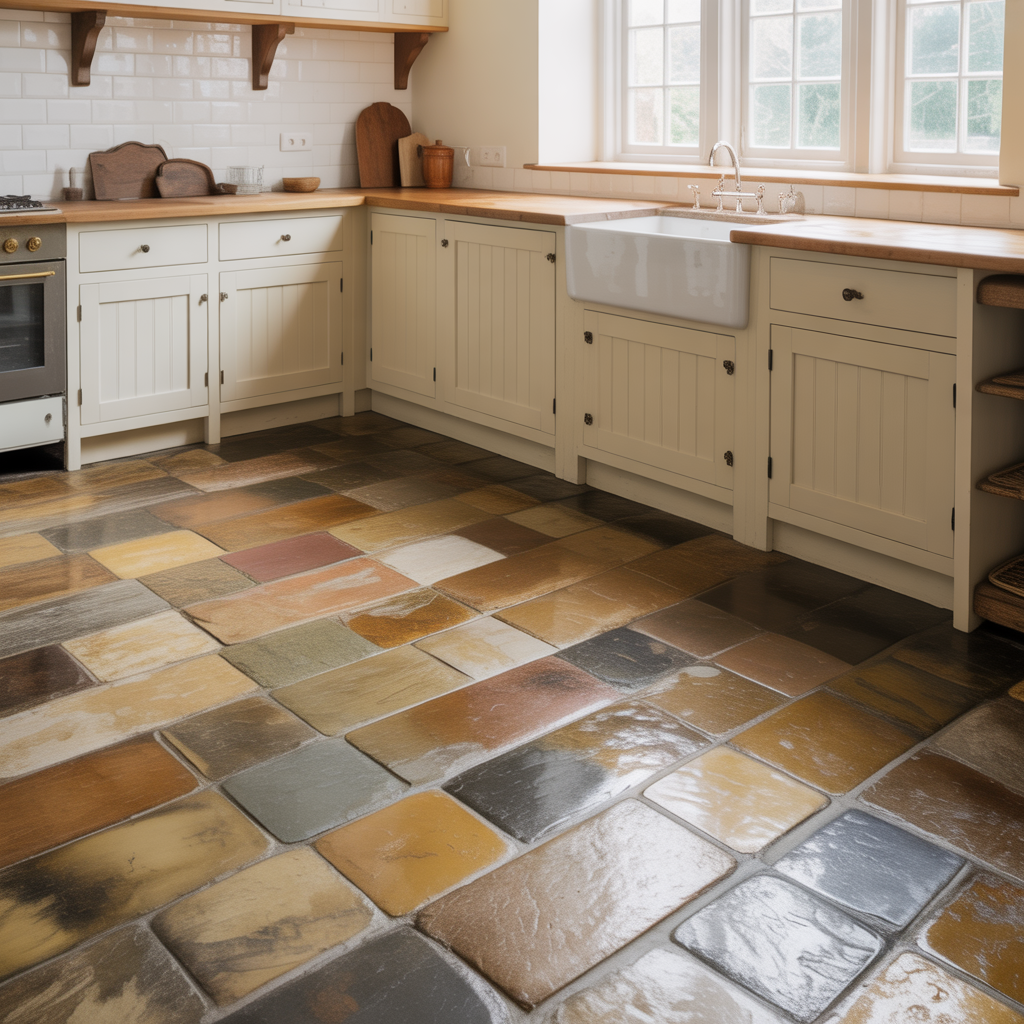
A penetrating impregnating sealer — silicone-based or siloxane-based — is the most appropriate product for most reclaimed stone floors and wall applications. It penetrates the stone surface without forming a visible film, protects against liquid ingress and staining while allowing the stone to breathe, and does not significantly alter the colour or surface character of the material. Apply in two coats after the stone and pointing have fully cured — typically a minimum of four weeks after laying — and test in an inconspicuous area first to confirm the effect on surface appearance.
In kitchen applications where oil and acid spills are a regular occurrence, a more robust penetrating sealer — designed specifically for porous stone in food preparation areas — provides better long-term protection and is worth the additional cost.
Routine Maintenance
Sealed reclaimed stone is straightforward to maintain. Sweep or vacuum regularly to prevent grit from abrading the surface. Clean with a pH-neutral stone floor cleaner and warm water — avoid acidic cleaners (including many standard kitchen products) on limestone and other calcareous stones, which will etch the surface and strip the sealer. Dry thoroughly after wet cleaning to prevent water marks on porous stone types.
Re-seal every three to five years in normal domestic conditions, or more frequently in kitchen and high-traffic areas. The best indicator that re-sealing is due is water absorption — if water no longer beads on the surface but is absorbed into the stone within a few minutes, the sealer has depleted and a maintenance coat is needed.
Frequently Asked Questions
Is reclaimed stone suitable for underfloor heating?
Yes, and stone is one of the best materials for use with underfloor heating. Its thermal mass means it heats slowly but retains and radiates heat effectively once at temperature, making it very efficient in conjunction with a low-temperature underfloor heating system.
The key requirements are that the stone is properly adhered to the substrate with a flexible adhesive rated for underfloor heating use, and that the system is commissioned gradually — bringing it to operating temperature slowly over several weeks after installation to allow the adhesive, pointing, and stone to cure and settle without thermal shock. Reclaimed stone that has not been fully dried before installation can develop cracking as residual moisture is driven out by the heat, so moisture content should be confirmed before laying.
Can reclaimed stone be used on walls as well as floors?
Yes, though the installation approach differs significantly from floor laying. Wall applications use thinner stone sections — typically 20–40mm — applied with a flexible adhesive to a prepared wall substrate. The weight of stone on a wall requires the adhesive to have good initial grab to prevent slippage during installation, and a suitable primer on the wall surface to ensure adhesion. Large-format stone on walls may require temporary support while the adhesive cures. The sealing requirements are the same as for floor applications, and in wet wall environments — shower enclosures, wet rooms — a tanking membrane applied to the substrate before the stone is an essential precaution against moisture penetration behind the cladding.
How do I remove stains from reclaimed limestone?
The approach depends on the type of stain. Oil-based stains — cooking oil, grease — respond to a poultice of fuller’s earth or kaolin powder mixed with a solvent such as acetone or white spirit, applied to the stained area and left covered for twenty-four hours to draw the oil out of the stone. Organic stains — wine, coffee, tea — respond to a hydrogen peroxide poultice. Rust stains require a specialist rust remover formulated for stone. In all cases, clean the surface thoroughly and re-seal the affected area after stain removal. Prevention — thorough sealing before use and prompt cleaning of spills — is significantly more effective than remediation after the fact.
How does reclaimed stone compare to reclaimed brick for a fireplace surround?
The two materials serve different aesthetic and structural roles in a fireplace context. Reclaimed brick, as covered in our guide to reclaimed brick interiors, brings texture, warmth, and the visual rhythm of the bond pattern to a fireplace surround — it suits farmhouse, industrial, and rustic interiors particularly well. Reclaimed stone — limestone, sandstone, or granite — offers a more monolithic, architectural quality that suits period, formal, and contemporary interiors. The choice between the two depends primarily on the aesthetic of the room and the style of the fireplace opening. Both pair naturally with a reclaimed timber mantel above, and both are significantly more characterful than any manufactured fireplace surround product.
What is the best reclaimed stone for a kitchen floor?
York stone and reclaimed limestone are the two most popular choices for kitchen floors, and both have genuine advantages. York stone — a fine-grained buff sandstone — is robust, widely available, relatively affordable by the standards of reclaimed stone, and has a warm, honest character that suits both farmhouse and contemporary kitchen aesthetics. Reclaimed limestone — particularly French Burgundy stone or English Hopton Wood — is softer in both colour and surface character, giving a kitchen floor a quiet, sophisticated quality that suits more refined interiors. Both require thorough sealing for kitchen use. Granite is the most durable and least maintenance-demanding option but carries a more formal, harder character and is more expensive to source and lay.
Conclusion
Reclaimed stone occupies a specific position among the salvaged building materials available to the contemporary homeowner. It is the most ancient, the most durable, and in many ways the most demanding — in terms of cost, weight, sourcing effort, and installation skill. But it is also the material that most fully rewards that investment, delivering an interior quality that literally accumulates value with time rather than diminishing.
The character of a well-worn flagstone floor, the solidity of a limestone fireplace surround, the warmth of a York stone worktop in afternoon light — these are qualities that no manufactured alternative replicates because no manufacturing process can compress centuries of use into a production run. The material can only be what it is because of where it has been.
Working with reclaimed stone, like working with the reclaimed brick that pairs so naturally alongside it, is a commitment to materials that have already proven themselves over time. The results speak for that commitment clearly — and they do so for decades, without apology and without needing to be replaced.